AI Automation Agency: When to Hire One, When to Build In-House, and How to Decide

Founder, Grow Predictably · 15+ yrs building B2B revenue systems
TL;DR: An AI automation agency builds and runs the AI workflows your in-house team does not have the time, fluency, or scale to own yet, typically in customer support, data analysis, sales enablement, or back-office operations. The buy-vs-build decision turns on whether AI lifts a real bottleneck in your business, not on budget. Hire an agency for the work where AI lifts a constraint your team cannot ship inside ninety days. Keep in-house anything that builds strategic muscle your team needs to retain.
Key Takeaways:
- An AI automation agency is a partner that designs, builds, and operates AI workflows, usually anchored on one of four engagement shapes: support, data, sales enablement, or operations.
- The hire question is a Theory of Constraints question. If AI lifts a real bottleneck, an agency accelerates you. If it doesn’t, an agency just adds tooling debt.
- Costs typically land between $5K and $50K per month for retainer engagements, with one-off project work running $15K to $250K depending on integration depth.
- The AI Collaboration Matrix sorts every AI-eligible task by task complexity (routine vs ambiguous) and stakes level (reversible vs consequential), and tells you which AI work to keep in-house and which to hand off before you ever talk to an agency.
- The biggest risk isn’t picking the wrong agency. It’s letting AI work erode your team’s strategic muscle until they feel like editors instead of strategists.
Hire an AI automation agency when you need a fast, specialist fix for a clear, time‑sensitive bottleneck and your team lacks the skills or bandwidth. Build in‑house when the work is strategic, requires deep cross‑team context, or you want to keep the capability long term.
I keep seeing the same thing: a CEO forwards an agency ad, teams pile on AI subscriptions, and marketing leaders end up explaining why AI hasn’t moved a metric. Agencies can buy time and deliver wins, but they also leave behind systems your people can’t run.
This short guide gives 50–1,000 person B2B marketing leaders a practical decision frame: what agencies actually do, when to hire vs. build, ballpark costs, the AI Collaboration Matrix for keep‑vs‑handoff decisions, and seven questions to ask before signing.
The single diagnostic to use in leadership: which bottleneck should the agency lift, and will that work hollow out the strategic muscle your team needs?
What is an AI automation agency, and what does it actually do?
An AI automation agency is a services partner that designs, builds, and operates AI workflows on behalf of clients, typically anchored on one of four engagement shapes: customer support automation, data and analytics pipelines, sales enablement workflows, or back-office and operations automation.
Most agencies start with one shape and expand. The good ones treat AI as a way to lift a specific constraint in your business, not as a thing to install everywhere.
The work breaks down into four buckets:
- Workflow design. Mapping a current process, identifying the manual steps that can be replaced or augmented, and writing the spec for what good looks like after the AI handles it.
- Tool selection and integration. Picking the models, vendors, and orchestration layer (LangChain, n8n, Make, Zapier, custom Python, agent frameworks), then wiring them into your CRM, support desk, data warehouse, or content stack.
- Model tuning and prompt engineering. Getting the AI to perform reliably enough for production. This is where most in-house attempts stall.
- Operations and monitoring. Running the workflow after launch, catching drift, retraining when models change, and handling exceptions.
The pattern I see is that marketing leaders think they’re buying tools when they’re actually buying judgment. Tools are commodity. Knowing which of the four buckets your business needs is what you’re paying for.
According to Robert F. Smith, founder and CEO of Vista Equity Partners, general AI models cannot reliably execute complex regulated enterprise workflows because they lack the proprietary, dynamic, industry-specific context embedded in existing software platforms.
That’s the gap an agency is paid to close, and it’s also why “just give my team ChatGPT licenses” rarely produces durable outcomes.
When does hiring an AI automation agency beat building in-house?
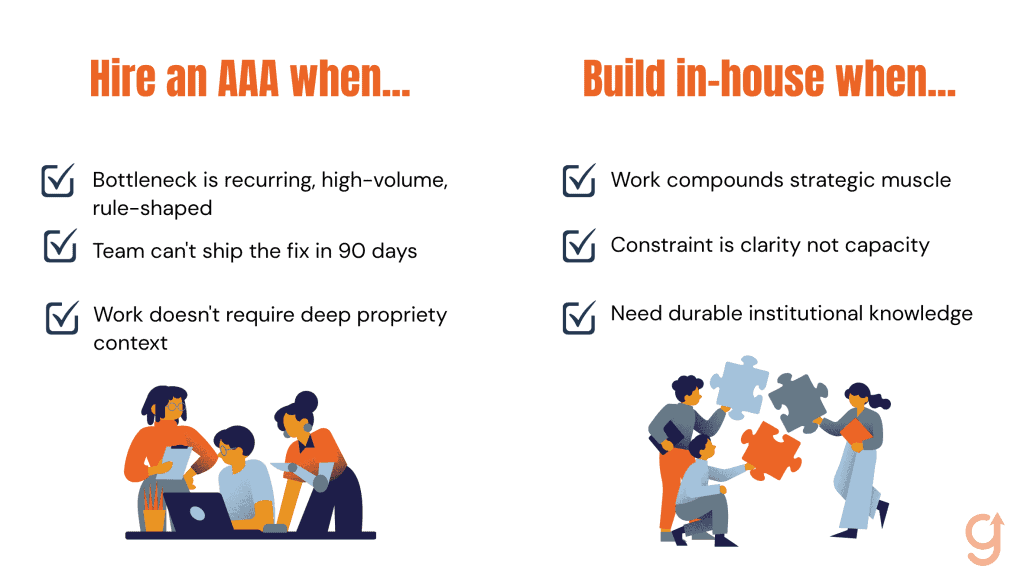
Hire an agency when AI lifts a real bottleneck in your business and your in-house team lacks the fluency or capacity to ship it inside ninety days.
Build in-house when the work is core to your strategic muscle (positioning, ICP, message-market fit) and handing it to an outside team would erode the thinking your marketers need to keep doing themselves. The decision isn’t budget-driven. It’s bottleneck-driven.
I treat this like a Theory of Constraints diagnosis. The question isn’t “should we use AI?” The question is “where is the constraint, and does AI actually lift it?”
Three diagnostic signals point toward hiring:
- The bottleneck is recurring, high-volume, and rule-shaped. Triaging support tickets, scoring inbound leads, deduping CRM records, generating campaign briefs from raw research. Agencies excel here because the work compounds.
- Your team cannot ship the fix in ninety days. Either they don’t have the AI fluency, the operational bandwidth, or both. Agencies arrive with the muscle memory and the tooling already wired.
- The work does not require deep proprietary context. If the workflow needs your team’s positioning instincts, customer relationships, or product roadmap intuition, no agency can substitute for that.
Three signals point toward building in-house:
- The work compounds strategic muscle. Messaging, ICP refinement, campaign hypothesis design, post-campaign analysis. Hand these off and your team atrophies. The marketing leaders I work with tell me this candidly: “AI is slowly killing the strategist in me and turning me into an editor.” Building in-house is how you reverse that.
- The constraint is clarity, not capacity. If your team is busy but no one can articulate the actual customer pain you solve, more AI tooling makes the problem worse. Fix clarity first.
- You need durable institutional knowledge. Agencies leave. The workflows they build are only as good as the documentation they hand back. If the work has to survive turnover, your team has to own it.
Write down the top three bottlenecks in your marketing operation. For each one, name whether AI lifts it and why, then decide build vs buy on the answer.
Most leaders find that two of three are agency-shaped and one is in-house-shaped. That ratio is healthier than “AI everything” or “AI nothing.”
How much does an AI automation agency cost?
AI automation agency engagements typically land in three pricing ranges. Project work runs $15K to $250K depending on integration depth. Monthly retainers sit between $5K and $50K for ongoing operations. Outcome-based pricing tied to tickets resolved, leads scored, or hours saved is becoming more common with agentic-AI vendors.
The wide range reflects how much variance there is in scope. Pinning down what you’re actually buying matters more than the headline number.
The rough breakdown across B2B engagements:
- Discovery and scoping ($5K to $25K). Two to four weeks. Maps your workflows, identifies the highest-ROI use cases, hands back a roadmap with vendor recommendations. Some agencies bundle this into the project, others bill separately.
- Workflow build ($15K to $150K per workflow). One to twelve weeks per workflow. Includes prompt engineering, tool integration, testing, and handoff documentation. A simple support-triage workflow lands at the low end. A multi-step sales enablement pipeline with CRM integration and human-in-the-loop review lands at the high end.
- Ongoing operations ($5K to $50K per month). Monitoring, exception handling, model drift management, occasional retuning. Most agencies require a minimum commitment of six to twelve months.
- Outcome-based add-ons. Some agencies price a portion of the engagement against measurable outcomes (a dollar amount per qualified meeting booked, per ticket auto-resolved, per hour saved). This aligns incentives but only works when the outcome is unambiguous.
Independent estimates project more than $1 trillion of incremental value from agentic AI solutions alone, with Bain estimating $5 to $7 trillion flowing to the software and applications layer broadly by 2030, representing the largest total addressable market expansion in software history. — Robert F. Smith, Founder and CEO, Vista Equity Partners
The TAM number matters less than the implication. Agencies pricing themselves as AI workflow operators rather than tool integrators are betting on a long arc. That means retainer-shaped pricing will replace project-shaped pricing across the category over the next two years.
If you’re evaluating now, ask about both shapes and pick the one that matches your decision horizon.
The other anchor worth running before you talk to an AAA is the all-in cost of doing the work in-house. A senior AI engineer in North America is typically $180K to $250K base plus equity. A mid-level AI ops engineer is $120K to $170K. Add tooling, vendor licenses, and onboarding time.
For most mid-market marketing teams, one in-house AI engineer covers maybe one workflow well in a year. An agency at $20K per month covers three to four workflows in the same window because they bring the muscle memory and the tooling already wired.
The right answer is rarely “all agency” or “all in-house.” It’s usually one strategic in-house hire plus an agency for the workflows your team cannot ship inside ninety days.
What technologies do AI automation agencies actually use?
Most AI automation agencies combine four technology layers: large language models for reasoning and generation (GPT-4/5, Claude, Gemini), retrieval-augmented generation (RAG) for grounding outputs in your proprietary data, workflow orchestration tools (n8n, Make, Zapier, LangChain) for chaining steps, and agentic frameworks (CrewAI, AutoGen, LangGraph) for multi-step reasoning.
The stack is less interesting than the judgment about which layer fixes your actual constraint.
What each layer does:
- Reasoning and generation. The model that does the actual thinking, writing, classifying, or summarizing. Choice depends on cost, latency, context window, and whether the workflow needs deep reasoning or fast pattern-matching.
- Retrieval and grounding (RAG). Pulling context from your CRM, knowledge base, or documents so the AI’s output is grounded in your reality, not the model’s training data. This is the single biggest unlock for B2B workflows.
- Orchestration. Chaining “do this, then check that, then call this API” steps together. Without orchestration, you have a chatbot. With it, you have a workflow.
- Agentic execution. When the AI needs to plan, decide, and act across multiple steps with minimal human input. This is the frontier where most agencies are currently sharpening their teeth.
Three signals separate an AAA that knows what they’re doing from one chasing the buzzword:
- They can explain in plain English why they picked the specific model and orchestration layer for your workflow, not “GPT-4 is the best.”
- They have an opinion on RAG that goes beyond “we’ll vector-embed your docs.” Ask how they handle chunking, retrieval scoring, and re-ranking.
- They’ve shipped agentic workflows that survive in production for six-plus months. Anyone can demo an agent. Few can keep one running.
Robert F. Smith’s three-quality lens is the cleanest evaluation rubric I’ve found. Winning AI solutions need context (deep, proprietary, industry-specific knowledge), trust (accountability, explainability, controls), and the ability to operate at scale in real workflows.
One concrete buyer move: in your first discovery call with any AAA, ask them to walk you through the architecture diagram of a workflow they’ve shipped for a client of comparable size. Not a slide deck. The actual architecture. If they show you boxes labeled “AI magic” with no detail on retrieval, orchestration, or human-review checkpoints, you’re talking to an order-taker. If they walk you through retrieval scoring, fallback handling, and how the workflow degrades when the model returns nonsense, you’re talking to an operator. That five-minute conversation is the single highest-signal screen I’ve used.
How do AI automation agency engagements unfold?
Most AI automation agency engagements move through five phases: discovery and diagnosis, validation and pilot, build and integration, launch and monitoring, and steady-state operations.
The first phase is where most engagements either succeed or quietly fail. Skip it, and you end up paying for tooling that solves the wrong problem.
The rhythm:
- Discovery and diagnosis (2 to 4 weeks). The agency maps your current workflows, runs interviews with the team, and identifies the two or three highest-impact use cases. Output: a written diagnosis naming the constraint, the proposed intervention, and the expected outcome. Your in-house team should be most involved in this phase because the diagnosis sets up everything downstream.
- Validation and pilot (2 to 6 weeks). Build the smallest possible version of one workflow. Run it against real data. Measure whether it actually lifts the constraint. This is the gate. If the pilot doesn’t move the metric, kill it before you scale.
- Build and integration (4 to 12 weeks). Productionize the workflow. Wire it into your CRM, support desk, or data warehouse. Add error handling, exception routing, and human review where the work warrants it.
- Launch and monitoring (4 to 8 weeks). Go live in stages. Monitor closely. Catch drift, retrain on edge cases, fix the things the pilot didn’t surface. This is where good agencies earn their fee, not in the build phase.
- Steady-state operations (ongoing). Monthly or quarterly tuning, model updates, handling new edge cases as your business changes.
The marketing leaders who get the most out of AAA engagements treat phases 1 and 4 as the high-impact phases. Discovery sets up the right work. Monitoring keeps the work alive. Build is the middle, and it’s the part that looks most impressive but matters least if the bookends are sloppy.
How do you choose the right AI automation agency?
Choose the agency that can explain their diagnostic process before they sell you on their tooling, has shipped at least three production agentic workflows that have survived six-plus months, can name the specific constraint your business is hitting before you tell them, and prices the engagement against outcomes you can measure.
Most agencies fail at least two of those four. The ones that pass all four are the ones worth a discovery conversation.
The shortlist criteria to run:
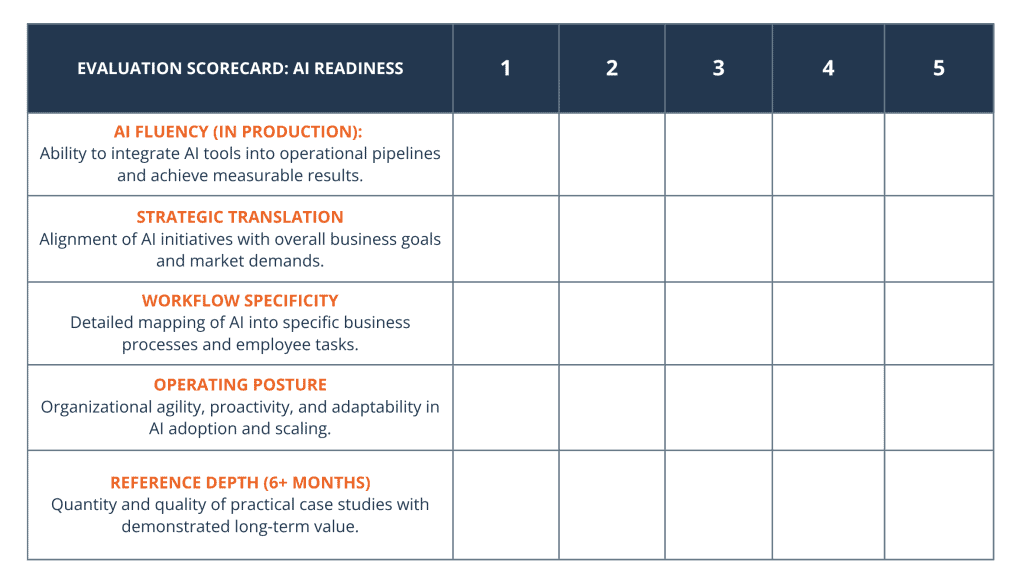
- Demonstrable AI fluency. Ask what they’ve built themselves, in production, that you can see. The AI-Era Marketing Leaders I work with are allergic to anyone who feeds prompts into ChatGPT and serves up the results. Pattern-match the agency’s response: do they show you outputs, or do they show you methodology and outcomes?
- Strategic translation between boardroom and team. Can they bridge leadership direction and team execution? Can they push back on a CEO who says “AI everything” without sounding like they’re resisting change? The translator role moves direction from leadership into execution the team will actually run. The skill is rare.
- Specific workflow proposals. Generic AAAs talk about transformation. Partners name the specific workflow they would target in your business in the first thirty days, the named tools they would put against it, and the metric they would expect to move by day ninety.
- Hands-on operations, not toolkit handoffs. Do they run their own AI ops, or do they hand you a toolkit and leave? You want the former. Toolkits without operators are how AI subscription sprawl happens.
- Reference depth at six-plus months. Talk to two clients who are six-plus months into the engagement, not the case study from launch week. Ask whether the workflow survived a model change, a team change, or a quarterly priority shift. Those are the real tests.
If you can answer “yes” to all five criteria above and “yes” to the bottleneck question from the second section of this article, the agency conversation is worth having. If you can’t, more diligence first.
What questions should you ask before signing with an AI automation agency?
Ask seven questions before signing: what’s your diagnostic process, what’s the specific workflow you’d target in our first thirty days, what does the pilot look like and what kills it, what’s your monitoring and exception-handling posture, who owns the documentation, what’s your handoff plan if we end the engagement, and how do you protect us from AI-generated sameness. The answers separate operators from order-takers.
Why each one matters:
- What’s your diagnostic process? A real AAA will walk you through how they’d map your workflows and find the constraint. An order-taker will jump straight to “here’s what we’d build.” Pass on the order-takers.
- What’s the specific workflow you’d target in our first thirty days? Specificity is the signal. If they can’t name one before they’ve done discovery, that’s fine, but they should be able to name three to five hypotheses and tell you how they’d test which one fits.
- What does the pilot look like, and what kills it? A confident agency tells you what failure looks like before they start. “If the pilot doesn’t move metric X by Y after Z weeks, we kill it and re-diagnose.” That posture is how you avoid sunk-cost spirals.
- What’s your monitoring and exception-handling posture? Production AI workflows drift. Models change. Edge cases surface. Ask how they catch it and how fast they respond. “We monitor monthly” is too slow. “We have alerting on output quality, latency, and cost daily” is the bar.
- Who owns the documentation? You should. The agency writes it, you own it. If they want to keep the documentation as IP, walk away.
- What’s your handoff plan if we end the engagement? A 90-day exit plan should exist before you sign. If they get cagey here, they’re optimizing for retention, not for your durability.
- How do you protect us from AI-generated sameness? This is the single biggest risk for the AI-Era Marketing Leader. The agency should have a clear answer about how they keep your voice, your positioning, and your strategic differentiation intact. Without one, they’ll commoditize your output inside six months.
Most agencies have decent answers to three of seven. The ones that have decent answers to six or seven are the ones worth a real engagement conversation.
Where do you start if you’re evaluating AI for your team?
Start with a sixty-minute diagnostic on your top three marketing-ops bottlenecks before you talk to any agency. Run each bottleneck through the AI Collaboration Matrix to decide whether the work compounds strategic muscle for your team or erodes it, and only then open the build-vs-buy conversation. The shortest path to wasted budget is starting with vendors and working backward.
The AI Collaboration Matrix is the thirty-second pre-flight I use with operator clients before they touch a chat window. It sorts every AI-eligible task by two axes (task complexity and stakes level) into one of four collaboration modes. That sort tells you whether to keep the work in-house, hand it to an agency, or kill it entirely. Most leaders find the matrix flips at least one of their “I was going to outsource that” decisions.
Run the AI Collaboration Matrix on your team’s top five AI use cases before you book a single AAA discovery call. It’s the same diagnostic I run with Fractional CMO clients.
Want to go deeper? Read Hiring a Digital Marketing Agency: 7 Keys to Choose the Right Partner in 2026 for the decision pillar this conversation supports.
About the author
Brian helps B2B founders install marketing + automation engines powered by Co-Thinking with AI. With 15+ years building predictable revenue systems, he's worked with SaaS, agency, and service businesses on 90-day done-with-you growth accelerators.
Ready to see your real growth gap?
Two minutes in the Growth Gap Scan and you walk away knowing the one thing capping your pipeline. Free, no obligation.