AI for Marketing Analytics: A Guide to Better Insights and Decisions

Founder, Grow Predictably · 15+ yrs building B2B revenue systems
TL;DR: AI for marketing analytics means using machine learning to monitor campaign performance, surface patterns in your data, and turn those patterns into faster, better marketing decisions. It augments four areas: managing campaigns and budgets, measuring KPIs, analyzing customer behavior, and optimizing what you run next. The point is not to replace the marketer. The point is to give you decisions you can trust, backed by data you would never have time to comb through by hand.
Key Takeaways
- AI for marketing analytics augments four jobs: managing campaigns and budgets, measuring KPIs, analyzing customer behavior, and optimizing what you run next. It does not replace the marketer.
- The payoff is decisions you can trust, backed by data volumes no team could comb through by hand.
- Tool choice comes last. Name the decision you need analytics to sharpen first, then pick the tool that serves it.
- Analytics is moving toward the edge, with AI and decision-making built into the apps where the data is generated.
- Treat AI analytics as a co-pilot for judgment, not an autopilot. The patterns it surfaces still need an operator to act on them.
Most marketing teams I talk to do not have an analytics problem. They have a decision problem. The dashboards exist, the data piles up, and the weekly reporting ritual runs on schedule, yet nobody can name the last decision a dashboard actually changed. That is the gap AI lands in. Used with intent, it turns the data you already collect into calls you can defend in a budget meeting. Used without intent, it produces more charts nobody reads, faster. This piece walks through what AI adds to marketing analytics, where it plugs in, which tools are worth shortlisting, and the one question to ask before you switch anything on.
What is marketing analytics?
Marketing analytics is the practice of tracking how your marketing performs and using that data to make better calls about where the next dollar and the next hour go. Strip the jargon away and that is the whole discipline: measure what happened, understand why, decide what to do next.
In practice, that means watching how customers engage with your brand, what the market is doing, and how each campaign performs against the goal you set for it. The sequence matters more than the sophistication. A team that reads one report and changes one decision every week beats a team with ten dashboards and no habit of acting on them.
The reason this discipline earns a chapter in every growth plan is blunt: marketing without integrated analytics is guesswork. You want to know which campaigns are making money and which are losing money, so you can stop funding the losers. Everything else is commentary.
What does AI actually add to marketing analytics?
I have worked with AI and machine learning in marketing long enough to see where it genuinely beats the traditional analytics motion and where it just adds noise. The honest version: the gains are real, and every one of them is conditional on how you deploy it.
The field has already moved. Salesforce’s State of Marketing report found that 75% of marketers have adopted AI, and its own headline carries the catch: most still use it to send one-way, generic campaigns. So the question is no longer whether to use it.
The question is whether it sharpens your decisions or just accelerates your output. Analytics is where that difference shows up first.
Here is what AI adds when it is pointed at the right work.
- Better decisions, faster. AI sifts through data volumes no team could read end to end and surfaces the patterns that matter. You are no longer choosing between a shallow read of everything and a deep read of one slice. The machine does the first pass, and you spend your judgment on what it finds.
- Deeper customer understanding. Machine learning tracks how customers actually behave (what they click, where they stall, what they come back for) and predicts what they are likely to do next. Assumptions get replaced by observed behavior, and the more history the model sees, the sharper the prediction gets.
- Hours back every week. Data collection, cleaning, and first-pass analysis are exactly the work AI automates well. In my own work it has taken the manual reporting grind off my plate and freed that time for strategy, and the research agrees on the direction: McKinsey estimates generative AI could increase the productivity of the marketing function by 5 to 15 percent of total marketing spend, and analytics is one of the clearest places that gain shows up.
- An edge most competitors have not built. Adoption is high, but discipline is rare. Most teams that bought AI tooling still run it without a named decision in mind, which means the businesses that build the habit of pointing analytics at specific calls earn insight their competitors do not have. The advantage is quiet, and it compounds.
- Scale without breakage. Data volume grows with the business, and a manual analytics motion breaks under that growth. A machine-learning motion improves with it instead, because more data is exactly what the models feed on.
None of this replaces the marketer. It extends what one marketer can cover, and it moves the bottleneck from processing data to acting on it, which is where the bottleneck belongs.
Tip: feed AI high-quality data
AI output is capped by data input. Accurate, relevant, current data produces patterns you can act on; stale or fragmented data produces confident-sounding noise. This failure mode is the norm, not the exception: in coverage of Salesforce’s latest research, 98% of marketing teams using AI reported at least one data-related barrier to personalization, from data silos to poor-quality data. Fix the plumbing before you judge the machine.
Christopher S. Penn, co-founder and Chief Data Scientist at Trust Insights, put it bluntly:
If your analytics fundamentals are bad, then generative AI won’t fix that. — Christopher S. Penn, Co-founder and Chief Data Scientist, Trust Insights
How does AI power marketing analytics?
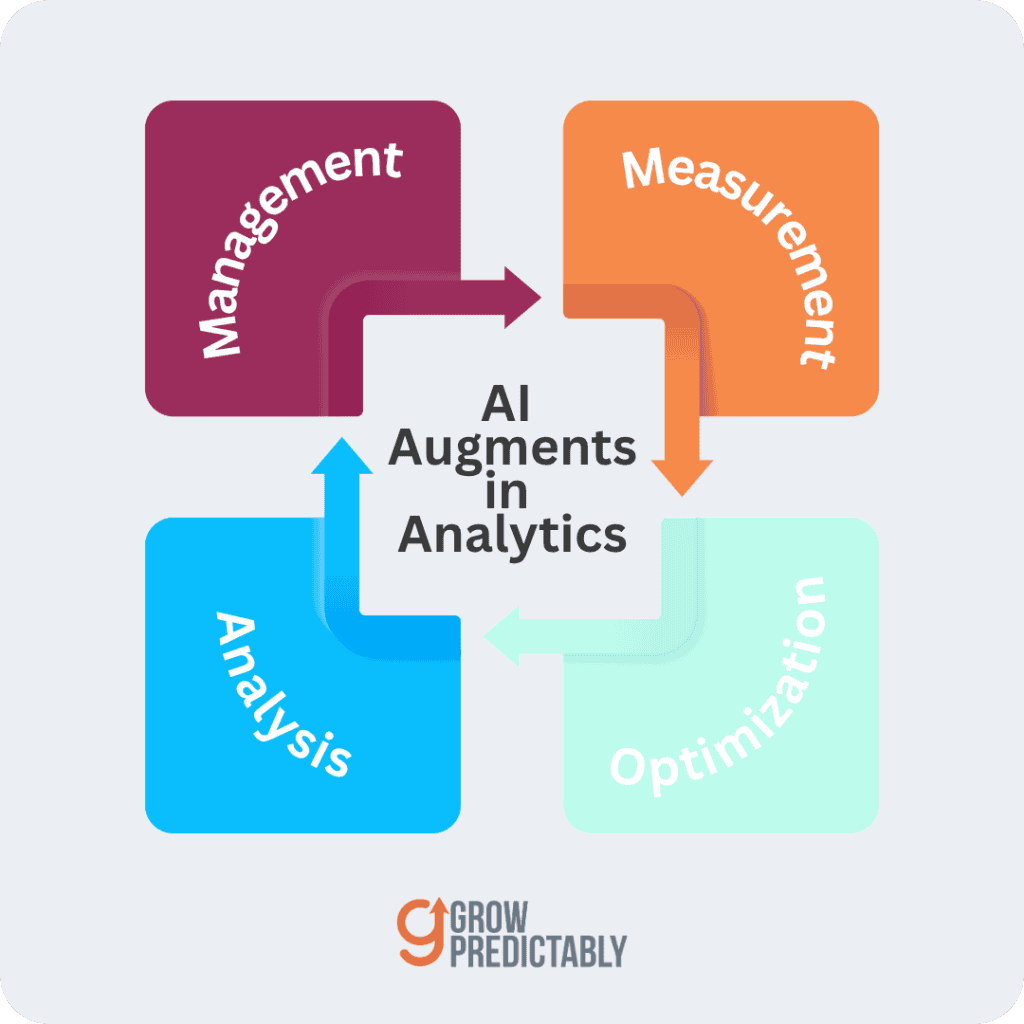
Marketing analytics breaks into four jobs: managing campaigns and budgets, measuring performance, analyzing behavior, and optimizing what runs next. AI augments each job differently, so it pays to be precise about where it plugs in.
Management
Campaign and budget management is data-heavy, repetitive, and unforgiving of lag, which makes it a natural first lane for AI. The machine automates bid management and budget allocation and recommends moves based on historical performance and current market signals. You keep the strategy. It keeps the spreadsheet.
Three moves make this work in practice.
- Hand routine work to AI first. Data collection, analysis, report generation. That frees the team for the decisions the reports exist to serve, which is the point of the whole exercise.
- Use predictive analytics for planning. Models trained on your historical data flag trends, risks, and opportunities before they are obvious in the topline number. Proactive beats reactive, and this is the cheapest way to buy proactive.
- Integrate with the systems you already run. Adopting AI does not mean discarding your stack. Make sure new tools connect cleanly to your existing marketing platforms and CRM, because a half-integrated analytics motion produces half-trustworthy numbers.
One caution before you buy anything: analytics is one workflow inside your overall AI marketing strategy, the operating system that decides which work AI runs, which work it assists, and which work stays human. Bolting an analytics tool on without that system is how teams end up with impressive dashboards and unchanged decisions.
Measurement
Measurement is where AI earns trust, because measurement is checkable. It tracks key performance indicators from click-through to conversion in real time, and it projects future performance from historical data, which lets you correct course mid-campaign instead of in the retro.
Say you want to measure your conversion rate. Here is how I would run that with AI.
- Reconcile the data before you trust the tool. Pull the sources that actually touch conversion (web traffic, customer interactions, sales records) and make them agree with each other first. This is the step teams skip, and it is where most “the AI got it wrong” stories actually start: the model read a clean pattern out of dirty data.
- Configure against one named metric. Point the tool at conversion rate specifically, not at “insights” generally. Setting the parameters and training on your own history takes some technical effort, and that effort is what separates an answer from another dashboard.
- Let it run, then interrogate the result. The AI surfaces the patterns and trends tied to conversion. Your job is the why: does the pattern hold across segments, or is one outlier campaign dragging the average? The machine finds the signal; the operator decides whether to believe it.
- Act on one insight at a time. Change the landing page, or the audience, or the offer, then re-measure before touching the next thing. If a finding does not change anything you do, it was decoration.
Analysis
Analysis is the pattern-finding job. AI reads across volumes of marketing data no analyst could hold in their head and surfaces the relationships that drive behavior: which segments respond, what precedes a purchase, where engaged users drop off.
Say you want to understand what kind of audience is actually gravitating toward your brand. Here is how I would run that analysis with AI.
- Define the categories that would change a decision. Before collecting anything, name the audience cuts you would actually act on differently (demographics, behaviors, engagement levels). If knowing a category would not change what you ship or where you spend, drop it from the analysis now.
- Collect and prepare the engagement data. Visit frequency, time on page, interactions, feedback. Format it so the model can read it cleanly, because the quality ceiling of everything downstream is set right here.
- Train the model and let it categorize. Fed your history, it will surface which groups engage, how they engage, and what each group responds to, including relationships you would not have thought to query.
- Prioritize and act. Focus on the categories with the highest engagement and the most growth headroom, and tailor content and offers to them specifically. An audience analysis that never changes your targeting was an expensive chart.
Optimization
Optimization is the loop that compounds. AI reads campaign data, suggests specific improvements like tighter ad copy or adjusted targeting parameters, and runs A/B tests faster than any manual cadence, so the next iteration always starts from evidence instead of instinct.
Content marketing shows the pattern clearly. Teams already test different content types against their audience; AI enters at the judgment step, helping you decide which content earns more investment and which gets cut.
Here is how I would run a content optimization pass.
- Pick the one or two metrics that define success. Engagement rate, conversion rate, time on page. Not ten. Optimizing against ten metrics is optimizing against none, because every piece of content wins on something.
- Put AI on collection and analysis. Let it gather performance across every content campaign and surface which content types actually resonate, including the predictive read on what is likely to keep performing as you plan your content strategy.
- Double down and cut. The analysis will name winners and losers. Give the winners more investment and stop propping up the losers. This is the judgment step AI informs but does not make, and it is where most optimization programs quietly stall.
- Revise, republish, re-measure. Re-read what underperformed next to what the data says worked, revise against the difference, and put it back in rotation. The loop is the strategy; a single optimization pass is just a report.
That is the four-job map. AI manages, measures, analyzes, and optimizes, and it does each at a scale no team matches by hand. What it does not do is make the call. That stays your job, which is exactly why the next question is where to point it.
Where is marketing analytics heading next?
Toward the edge. More and more data gets generated on devices far from any data center (IoT sensors, industrial equipment, wearables), and hauling all of it to one central place for analysis is becoming the bottleneck. The response across the industry is to build analytics, AI, and decision-making into the applications at the edge of the network, where the data is born.
Gartner put a number on this direction years ago, projecting that by 2025, 75% of enterprise-generated data would be created and processed outside a traditional centralized data center or cloud, up from around 10% when the projection was made. Treat it as a dated projection rather than a live measurement; the reason it still matters is that the direction it named is the one analytics keeps moving in.
The practical consequence is speed and locality. Data gets read almost instantly where it is produced: factories predict maintenance before the failure, banks catch suspicious transactions as they happen, wearables track health changes in real time. Privacy pushes the same way, since analysis that stays local is analysis that does not travel. Expect more micro-analytics at the edge, right where the customer is.
5 AI tools to use for marketing analytics
Tool choice comes last, and it starts with one question: what decision is this analytics work supposed to sharpen? Answer that first and the shortlist gets short quickly. With that question in hand, here are five tools I would actually put on it, with Capterra’s user ratings as a sanity check.
1. Google Analytics
The default starting point for web analytics. Google Analytics tracks website traffic, user behavior, and conversion metrics, and for most teams it is already installed, which makes it the natural place to build the reporting habit before you spend money elsewhere.
Capterra: 4.7 out of 5 stars across 8,097 reviews.
What I like and dislike
- Real-time data
- Integration with other Google products
- Free for the basic version
- It can be complex for beginners
- Data sampling issues for large sites
2. Tableau
Tableau’s job is making complex data legible. It turns raw tables into visuals a room can argue about productively, which makes it the strongest pick when your bottleneck is communicating the data rather than collecting it.
Capterra: 4.6 out of 5 stars across 2,356 reviews.
What I like and dislike
- Intuitive interface
- Powerful visualization capabilities
- Strong community support
- It can be pricey
- It can have a steep learning curve for some
3. Domo
Domo connects to a wide spread of data sources and serves real-time dashboards, which suits teams whose data lives in many systems at once.
Capterra: 4.3 out of 5 stars across 331 reviews.
What I like and dislike
- Versatile data integration
- Real-time updates
- Some users mention it is a bit pricey
- It can have integration challenges
4. Sisense
Sisense is built for making big data usable without a dedicated data team. If you need deep insight and do not want to build the pipeline yourself, it belongs on the shortlist.
Capterra: 4.5 out of 5 stars across 378 reviews.
What I like and dislike
- User-friendly
- Strong analytics
- Can handle large datasets
- It might be overkill for small businesses
- It can be on the pricier side
5. Qlik
Qlik centers on interactive data visualization with AI-generated predictive analytics built in, and it rewards teams willing to climb its learning curve with genuinely explorable data.
Capterra: 4.5 out of 5 stars across 261 reviews.
What I like and dislike
- AI-generated predictive analytics
- Interactive dashboards
- Low-code based
- Limited data source integration
Any of the five can serve. The tool matters less than the decision you point it at, which is why the decision comes first and the procurement comes second.
Frequently Asked Questions
How do you use AI in marketing research?
AI analyzes large volumes of research data quickly and accurately, spotting the patterns and trends that drive data-driven decisions. It automates the grunt work of data collection, cleaning, and analysis, which saves time and resources. It also reads customer behavior, preferences, and sentiment using techniques like natural language processing, so your research surfaces what people actually think, not just what they click.
How can AI track customers who interact with you?
AI tracks customers by analyzing their online behavior across channels: website visits, clicks, purchases, social activity, and email engagement. Using machine learning and predictive analytics, it identifies behavioral patterns and predicts likely future actions. That gives you a connected view of how each customer engages with your brand, so you can time the next touch when it actually matters rather than guessing.
How is AI used in market segmentation?
In market segmentation, AI groups customers by their characteristics, behaviors, and preferences. By spotting patterns and similarities across large datasets, it lets you build targeted campaigns and personalized experiences for each group instead of one generic message for everyone. It can also reveal new segments you had not defined and predict how each group is likely to behave next.
How can AI-based marketing improve customer retention?
AI improves retention by personalizing messages and experiences to each customer’s preferences and behavior. It analyzes customer data to identify patterns and predict churn early, which lets you act before an account slips away. It can also automate timely support through tools like chatbots and assistants, so customers get fast, relevant help that keeps satisfaction and loyalty high.
How do you start with AI in your marketing analytics?
Start with a decision, not a dashboard. Name one call your team has to make repeatedly (where next month’s budget goes, which content earns more investment, which segment gets the next campaign) and stand up the analytics that sharpen that one call. If a metric does not change a decision, it is not a priority; it is decoration.
Tools like Google Analytics, Tableau, Domo, Sisense, and Qlik all serve that path, and none of them substitutes for it. The teams that win with AI analytics are not the ones with the most dashboards. They are the ones with the shortest distance between a pattern surfacing and a decision changing.
The mistake is bolting analytics on everywhere at once. AI moves the number fastest when it is pointed at the one stage of your funnel that is actually capping growth, not spread thin across all of them. Not sure which stage is your binding constraint? Start with a free Growth Assessment, which names the one stage holding your growth back so your analytics effort starts where it will actually move the number.
About the author
Brian helps B2B founders install marketing + automation engines powered by Co-Thinking with AI. With 15+ years building predictable revenue systems, he's worked with SaaS, agency, and service businesses on 90-day done-with-you growth accelerators.
Ready to see your real growth gap?
Two minutes in the Growth Gap Scan and you walk away knowing the one thing capping your pipeline. Free, no obligation.