How to Use AI Marketing for Customer Acquisition Without Sounding Like Everyone Else

Founder, Grow Predictably · 15+ yrs building B2B revenue systems
TL;DR: AI marketing for customer acquisition works when you decide which workflows AI runs, which ones it assists, and which ones stay human. Most B2B teams skip that decision. They let AI automate outbound volume, and buyers delete the output faster than human-written emails. The teams cutting CAC with AI are the ones choosing what AI should never touch.
Key Takeaways
- According to Reboot Online’s AI marketing research, only 5.2% of marketers see no value in AI or have not tried it, so adoption is effectively universal, which means AI sameness is already flattening reply rates, not a threat still on the horizon.
- The workflow trichotomy splits acquisition work into AI-led, AI-assisted, and human-only buckets, and it’s the structural fix that prevents sameness while reducing CAC.
- Lead scoring and personalized content are the two workflows where AI assistance compounds, because both rely on raw human context that competitors can’t replicate at scale.
- Automated outreach is where most teams get burned, because volume without a point of view produces the deletions that drive your CAC up.
- The operator framing for cutting CAC with AI is to decide which work AI should never touch, then measure CAC monthly against a 90-day rolling baseline.
When I audit a B2B acquisition stack, the failure pattern is always the same. The team has added six AI tools in two quarters, every SDR is running the same outbound sequencer, and nobody can point to the document that says which workflows AI was supposed to own and which ones it should never touch.
Reply rates flatten, lead scoring drifts to whatever the vendor shipped by default, and the cross-channel insights that should be sharpening targeting sit unread in a Looker tab.
This article walks the AI-era marketing leader through the AI marketing strategy operating system, the AI Collaboration Matrix applied to acquisition, the operator framing prompts for outbound and SEO, and the 60-180 day reach expansion timeline.
This is for the CMO, VP Marketing, or Head of Demand Generation whose AI-assisted outbound produced volume but no qualified pipeline, and whose CAC has climbed 20-40% in two quarters because the team is paying for AI sameness buyers ignore.
The work that follows is what diagnose-first looks like at the acquisition layer. Not “plug another AI agent into the funnel,” but “rewrite the prompts at every buyer-facing surface so the output stays voice-fingerprinted to your operator perspective.”
What does AI sameness look like in B2B customer acquisition, and why is it the biggest CAC inflator nobody names?
AI sameness is what happens when every outbound touchpoint reads identically because your team prompted the same generic stack your competitors did. Reply rates collapse, customer acquisition costs climb, and the team responds by sending more. That’s the loop I see inflating CAC across almost every B2B SaaS acquisition audit I run.
The industry talking points say AI should be cutting your CAC. Singlegrain’s 2025 analysis argues AI marketing can meaningfully reduce customer acquisition costs when deployed with operator discipline.
For most teams, the reality is the opposite, because they’re using AI agents and AI-powered tools to scale generic outreach instead of designing the workflow first.
Most people fail with AI tools because they skip process design.
The three observable signals of AI sameness
In the acquisition audits I run, I watch for three signals that tell me your funnel has slipped into sameness territory:
- Open rates hold steady, but reply rates are sliding. Your subject lines still earn the click. The body copy reads like every other AI-drafted email in the inbox that morning.
- ICP contacts go dark after one touch. A buyer who matches your Ideal Client Profile opens once, never replies, and never opens again. They’ve pattern-matched your domain to the noise.
- Your SDRs and AEs tell you the emails sound like everyone else’s. When your own reps can’t distinguish their outreach from a competitor’s, your buyer can’t either.
These signals show up before the CAC line moves on your dashboard. Treat them as your leading indicator.
Why volume compensation makes CAC worse, not better
The instinct when reply rates drop is to send more. Generative AI makes that cheap, so teams crank customer outreach to 3x or 5x the original cadence. The buyer pattern-recognizes faster than your volume scales.
Each extra touch trains them to filter your sender domain harder, and your AI-intermediated search visibility drops alongside deliverability.
According to SurveyMonkey’s 2025 marketing research, 40% of marketers use AI to conduct research. In my experience, far fewer wire that same AI into structured, data-driven acquisition or customer discovery workflows, and that gap is the opportunity. The teams winning on SaaS acquisition, customer engagement, and customer retention at customer scale aren’t using more AI.
They’re using it inside a marketing operating system that decides which workflows get AI-led, AI-assisted, or human-only treatment before anyone writes a prompt. That’s the workflow trichotomy.
Which acquisition workflows should be AI-led, AI-assisted, or human-only?
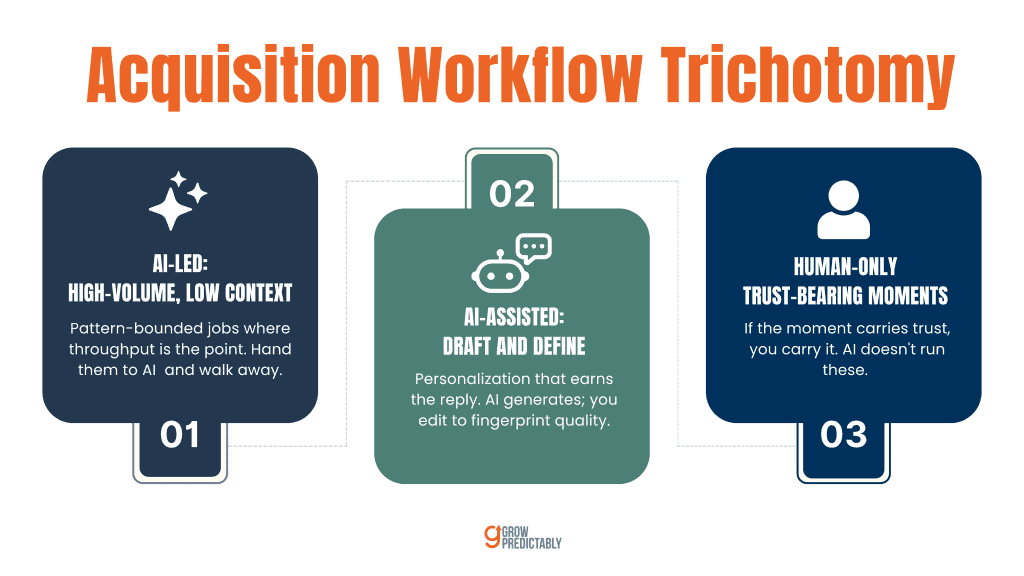
Sort every acquisition workflow into one of three buckets before you buy another AI tool. AI-led handles high-volume, low-context work. AI-assisted handles draft-and-refine outreach where you supply the framing. Human-only handles trust-bearing moments.
Misassigning a trust-bearing task to the AI-led bucket is the structural cause of outbound sameness, not the model you picked.
When I audit acquisition stacks, the mistake is almost never the AI tool. It’s that trust-bearing moments have been handed to the AI-led bucket, and the buyer can feel it before the second line of the email.
The fix is the workflow trichotomy, applied workflow-by-workflow, and documented inside your marketing operating system so the next hire inherits the call.
AI-led: high-volume, low-context acquisition tasks
These are pattern-bounded jobs where your Voice DNA adds nothing and throughput is the point. Hand them to AI and walk away.
- List enrichment and ICP keyword research, where the input is firmographic signal and the output is a scored segment.
- Ad copy variant generation for paid acquisition, where the algorithm is the audience and not the buyer.
- Programmatic bid optimization and budget pacing across channels, where the system reacts to signal faster than you can.
- Schema markup and on-page SEO for acquisition-stage pages, where the spec is the spec.
AI-assisted: draft-and-refine outreach workflows
This is the bucket where personalization either earns the reply or commodifies your brand. AI generates against your operator framing. You edit to fingerprint quality. According to Blueshift’s research on high-performing B2B and B2C marketers, the strategies that separate top performers start with relevance, not volume.
That’s the whole game in this bucket.
- First-draft cold sequences seeded by a real customer interview, not a scraped headline.
- Persona-matched messaging that runs through the AI Collaboration Matrix before it ships.
- Intent-signal triage and account-personalization narratives for ABM motions.
- Content briefs for acquisition-stage SEO that combine customer-voice context with a diagnostic structure.
Human-only: trust-bearing acquisition moments
If the moment carries trust, you carry it. AI doesn’t run these.
- The first discovery call and every referral request.
- C-suite relationship outreach and joint ventures with partners whose audience overlaps yours.
- Event follow-up inside the first 24 hours, when the conversation is still warm.
- Positioning shifts and founder-voice acquisition content that anchor the brand’s quarter.
AI agents are already running real-time budget allocation and acquisition signal processing when you feed them clean data, as Triple Whale documents in their agentic acquisition playbook.
What they can’t do is decide which workflow belongs in which bucket. That’s your call, and it’s the one decision that separates a CAC curve that bends from a stack of tools producing the same outreach as everyone else.
How do you write the operator framing prompt that turns AI outbound from delete-bait into a buyer reply?
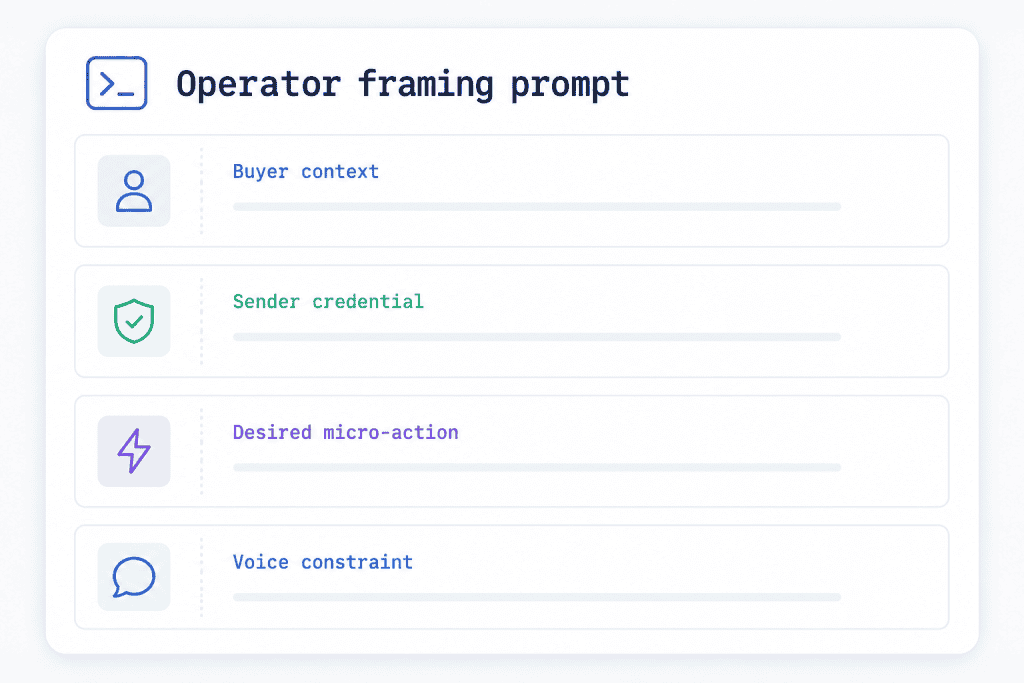
An operator framing prompt pre-loads the AI with four context layers before any output is generated: buyer role and pain, your specific POV or credential, the one micro-action the email should move the buyer toward, and a voice constraint that blocks generic phrasing.
It’s the structural reason your reply rate stops looking like everyone else’s.
Whenever I’ve rebuilt a writing motion around AI, the discipline that made the agent usable wasn’t the model. It was forcing the agent to ask clarifying questions before it would generate a single word.
When I make the AI cross-examine me first, the output comes back framed to my operator perspective instead of the generic register everyone else is shipping.
That same discipline is what turns a marketing operating system for acquisition into something that actually moves your sales funnel instead of polluting it with sameness.
The four context layers every acquisition prompt needs
Here’s the template I use for B2B cold outreach. Drop these four fields above your prompt every time, in this order:
- Buyer context. Role, company stage, and the named pain you’ve heard verbatim on a sales call or in a customer interview.
- Sender credential. The one thing about you that makes this buyer pause for a sentence. Not your title. The operator move you made that mirrors their situation.
- Desired micro-action. Not “book a call.” The smallest yes that proves the buyer recognized themselves in the email.
- Voice constraint. One sentence of tone, one phrase to avoid. Diagnose first. Never open with “Hope this finds you well.”
Voice-to-prompt workflow: why sequence matters
Most teams run prompt to output. That’s where sameness comes from. The fix is a sequence change: voice idea, clarify with AI, then prompt. You speak the operator thought out loud, you let the AI cross-examine you, and only then do you generate copy.
The teams cutting CAC with AI are the ones treating it as a co-thinker, not an output factory. That is my operator read after running these audits.
Wharton professor Ethan Mollick, author of Co-Intelligence, frames one of his four rules for working with AI as being “the human in the loop”: “Being the human in the loop is also about how do you make AI part of your decision-making, but how do you focus on what you do best?” That is the whole reason the voice-to-prompt sequence exists.
In my experience, the difference in reply rate between a generic prompt and an operator-framed prompt isn’t marginal. It’s the difference between a sequence that gets ignored and one that opens a conversation, and you’ll feel it across every channel where audience overlap means buyers see your outreach next to four competitors using the same default GPT register.
How do you measure whether AI is cutting CAC or just adding to acquisition sprawl?
You measure it by separating volume metrics from funnel-efficiency metrics. If AI is cutting CAC, you’ll see cost per qualified conversation drop, reply rates hold or improve, channel CAC fall against the pre-AI baseline, and time-to-first-meaningful-engagement compress.
If only the volume metrics moved, you’re funding sprawl, not acquisition leverage.
In my experience, when a team adds AI and CAC stays flat, the first place I look isn’t the AI tool. It is whether they’re measuring volume outputs instead of funnel efficiency. That’s the measurement gap that lets sprawl hide. As one of my operating principles puts it: “The biggest gap: knowing which campaigns generate the most money.”
Campaign analysis at the spend-to-revenue level closes that gap, not dashboards counting touches.
The four CAC-diagnostic metrics for AI acquisition
These are the four metrics I track on any acquisition workflow with AI in the stack. Together they tell you whether AI is doing real sales optimization work or just generating activity:
- Cost per qualified conversation, not cost per lead. AI inflates form-fills trivially. Qualified conversations with ICP-matched buyers are the real signal.
- Sequence-to-reply rate, AI-authored vs. human-authored. If AI touches reply at half the rate of human ones, your touchpoint optimization is producing sameness, not leverage.
- Channel CAC delta, before and after AI deployment, measured per channel against a clean pre-AI baseline. Flat or negative means cost without compression.
- Time-to-first-meaningful-engagement, first touch to buyer-intent signal. AI should compress this. If it doesn’t, speed isn’t your bottleneck.
The upside is real when the wiring is right. McKinsey’s research on personalization at scale finds that getting personalization right can reduce customer acquisition costs by as much as 50 percent, lift revenues by 5 to 15 percent, and increase marketing spend efficiency by 10 to 30 percent. Those gains concentrate when AI is wired into campaign analysis and channel routing rather than bolted onto raw outreach volume.
Getting personalization right can reduce customer acquisition costs by as much as 50 percent, lift revenues by 5 to 15 percent, and increase the efficiency of marketing spend by 10 to 30 percent.
McKinsey & Company, What is personalization? (2023)
When falling CAC is a mirage: the constraint-theory check
Sometimes CAC looks like it’s falling, but deals stall further down the funnel. That’s not a win. It’s a constraint that moved.
I lean on Goldratt’s Theory of Constraints here. If you’ve added AI to acquisition and CAC isn’t improving, or it’s improving but pipeline velocity is dropping, the bottleneck is probably not in acquisition at all. It’s likely downstream, in the handoff from acquisition to onboarding and activation, where a new customer either gets to first value fast or quietly churns.
AI at the top can’t fix a bottleneck in the middle. Before scaling AI spend, ask whether the slowest step is still in acquisition, or whether AI quietly relocated it. This is why I treat the marketing operating system and the AI Collaboration Matrix as prerequisites, and why I separate AI from marketing automation.
How long until AI acquisition shows up in board-credible terms?
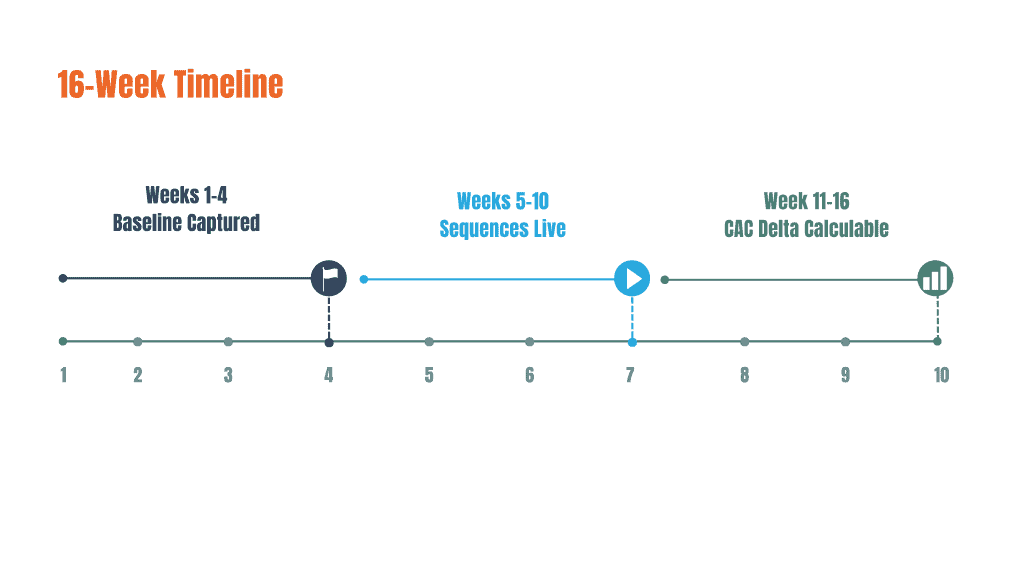
Plan for 16 weeks before your CFO hears a clean AI acquisition story. The board doesn’t need to see a tool. They need to see a CAC line that moved, a causal explanation attached, and a clean pre-AI baseline you can point back to. Anything shorter is a demo, not a result.
The three-milestone timeline to board-ready results
In the acquisition transformations I’ve guided, three milestones have to land in sequence before a board narrative exists. Skip one and the story falls apart under questioning.
| Weeks | Milestone | Key actions and metrics |
|---|---|---|
| Weeks 1 to 4 | Trichotomy implemented, baseline captured | Assign AI-led, AI-assisted, and human-only. Freeze pre-AI CAC, reply rate, lead-to-MQL |
| Weeks 5 to 10 | Operator-framed sequences live, reply-rate delta measurable | Run AI-assisted sequences from operator brief. Measure statistically significant reply delta |
| Weeks 11 to 16 | CAC delta calculable, board-ready narrative | Use predictive analytics to produce CAC line. Attribute workflow changes to CAC movement |
Why no baseline means no board story
The failure I see most often isn’t tool selection. It’s deploying AI across acquisition without freezing the pre-AI numbers, so there’s no honest before-and-after. Belief in AI runs well ahead of measurement discipline on most teams, and belief without a baseline never becomes a board narrative.
The CFOs and CEOs I’ve seen respond well to AI acquisition stories aren’t reacting to tool names. They’re reacting to a CAC line that moved, with a causal explanation attached.
That discipline is the same one regulated sectors like financial services already apply to every other growth investment, and it’s the difference between AI and marketing automation and a story the board can underwrite.
How do you put AI marketing for customer acquisition into practice?
If you take one thing from this piece, do the trichotomy audit before you buy another tool.
List your active acquisition workflows, sort them into AI-led, AI-assisted, and human-only, and flag anything human-only that’s currently running on autopilot. That hour of clarity will save you months of generic outreach and rising CAC.
Start there, then map your full acquisition stack against the operating system above.
Not sure whether acquisition is your binding constraint? Start with a free Growth Assessment, which names the one stage capping your growth so your AI marketing strategy starts where it will actually move the number.
Frequently Asked Questions
What tools do I actually need to start running AI-led acquisition workflows?
You need three categories of tooling, not seven. A research layer (the LLM you point at prospect public material), an enrichment layer that pulls firmographics, recent funding, and content signals, and a send layer where humans still approve every outbound reply. Start with one general-purpose LLM you already pay for and one enrichment tool your team already knows. Stacking three agentic platforms before you have nailed the operator framing prompt just industrialises generic outreach faster and burns your sender domains.
How is this different from the marketing automation I already run?
Marketing automation triggers a pre-written sequence when a lead crosses a threshold. AI-led acquisition writes a different message for every prospect based on what they are actually working on this quarter. Automation is rule-based and identical for everyone in the segment. AI-led work is reasoning-based and specific to one company at one moment. The short version: automation handles the predictable, AI handles the per-prospect reasoning your humans used to do.
Can a two-person team run this, or do I need a full marketing ops bench?
A two-person team can run this, and often runs it better than a 12-person team. Small teams cannot hide behind volume, so they are forced to write the operator framing prompt properly before they send anything. Buyers now research with AI themselves, which means a tight team writing one excellent personalised message beats a big team blasting hyper-personalization templates that all sound the same to the buyer.
Where should I sequence AI inside my acquisition motion in the first 30 days?
Start at research and enrichment, never at send. In your first two weeks, point AI at your existing pipeline and ask it to identify the three patterns your closed-won customers share. In weeks three and four, write the operator framing prompt and test it on twenty prospects manually before any automation. Lead generation breaks when teams sequence AI at send first and skip the diagnostic phase.
About the author
Brian helps B2B founders install marketing + automation engines powered by Co-Thinking with AI. With 15+ years building predictable revenue systems, he's worked with SaaS, agency, and service businesses on 90-day done-with-you growth accelerators.
Ready to see your real growth gap?
Two minutes in the Growth Gap Scan and you walk away knowing the one thing capping your pipeline. Free, no obligation.