6 Ways to Use AI Marketing for Lead Generation (and Get Higher-Quality Leads)

Founder, Grow Predictably · 15+ yrs building B2B revenue systems
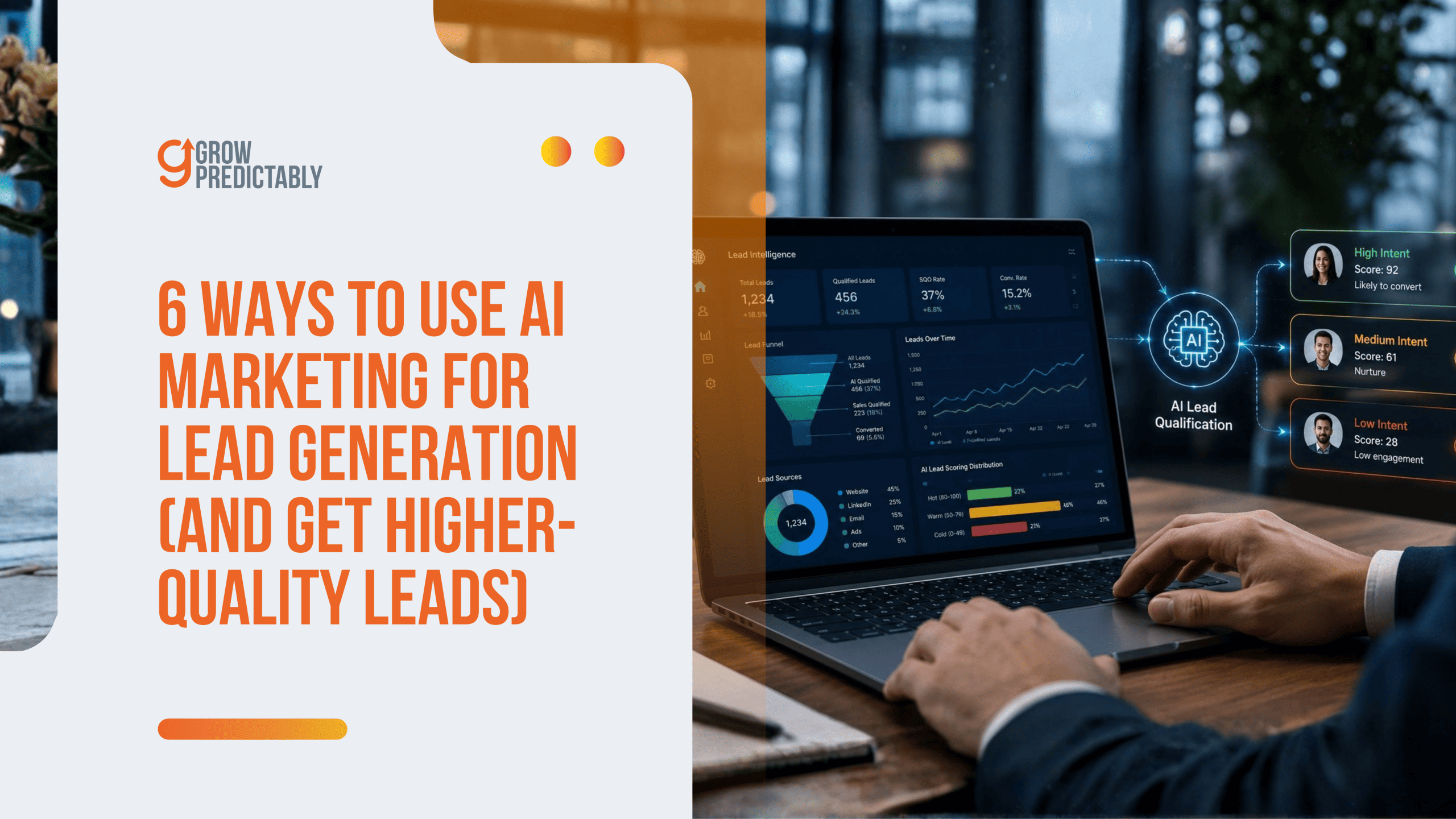
TL;DR: AI marketing for lead generation uses machine learning, automation, and predictive analytics to attract, qualify, and nurture prospects more efficiently than manual methods, turning anonymous traffic into sales-ready opportunities at scale. Map the customer journey, layer AI across targeting, content, and follow-up, and you generate higher-quality leads at lower acquisition cost and faster response time.
Key Takeaways
- Use AI to refine audience targeting and segmentation so campaigns reach prospects most likely to convert, based on behavior, interests, and historical data.
- Deploy AI-powered chatbots and virtual assistants to capture and qualify leads 24/7, resolving basic questions and routing high-intent prospects to sales.
- Apply predictive analytics to forecast which leads are most valuable, then prioritize nurturing sequences and sales outreach around those accounts.
- Personalize content, offers, and timing using AI-driven insights from customer data, increasing engagement across email, ads, and on-site experiences.
- Combine customer journey mapping with AI tools to identify bottlenecks, optimize campaigns continuously, and build a repeatable lead generation engine.
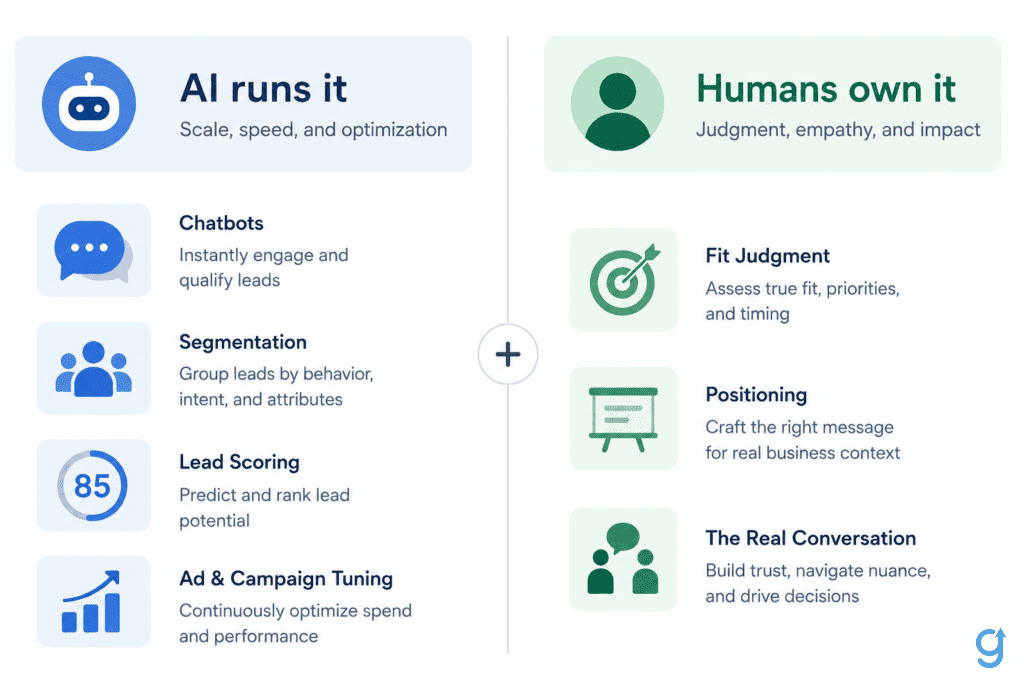
AI marketing for lead generation works best when you aim it at qualification, not capture. Let AI score, route, and personalize so your team spends its hours on the leads most likely to close. The fastest wins come from a clear split: AI qualifies and nurtures at volume, and humans own the judgment calls on which leads are worth a real conversation. This piece walks the six places that split pays off.
That split is the whole strategy. Wharton professor Ethan Mollick, who researches AI and work, frames the boundary plainly:
At least with the current set of AI tools, AI augments human capabilities. — Ethan Mollick, Professor, The Wharton School
Lead generation is a textbook case. AI is excellent at sifting, scoring, and personalizing across volume, and weak at the strategic read of whether a given account is actually a fit. Decide which is which before you buy a tool, and lead quality climbs. Skip that decision, and you get more leads of the same average quality, faster.
Where you aim AI inside the funnel is a strategy question, not a tooling one. If you want the full operating-system view of which marketing workflows AI should run versus where it bolts on, start with our guide to building an AI marketing strategy that amplifies your team. This piece is the lead-generation chapter of that map.
How does AI impact lead generation?
AI has changed many business processes, and lead generation is no exception. Adoption is already the norm rather than the edge: Salesforce’s State of Marketing 2026 report found 75% of marketers have adopted AI. The open question is no longer whether to use it. It is where to point it so the leads that reach your team are better, not just more numerous.
So how can applying AI positively impact your lead generation efforts?
1. Enhanced data analysis
AI can sift through enormous amounts of data in a fraction of the time it would take a human to do the same job. This means a more accurate and quicker analysis of potential leads, so the signal you act on is current rather than a week stale.
2. Improved personalization
AI can help businesses personalize their marketing efforts, tailoring messages to individual leads based on their behavior and preferences. This level of personalization often results in higher engagement rates. It is also where most teams already aim AI first. SurveyMonkey’s research found 73% of marketers say AI plays a role in creating personalized customer experiences, which is exactly the kind of high-volume, low-risk work AI runs well.
3. Predictive lead scoring
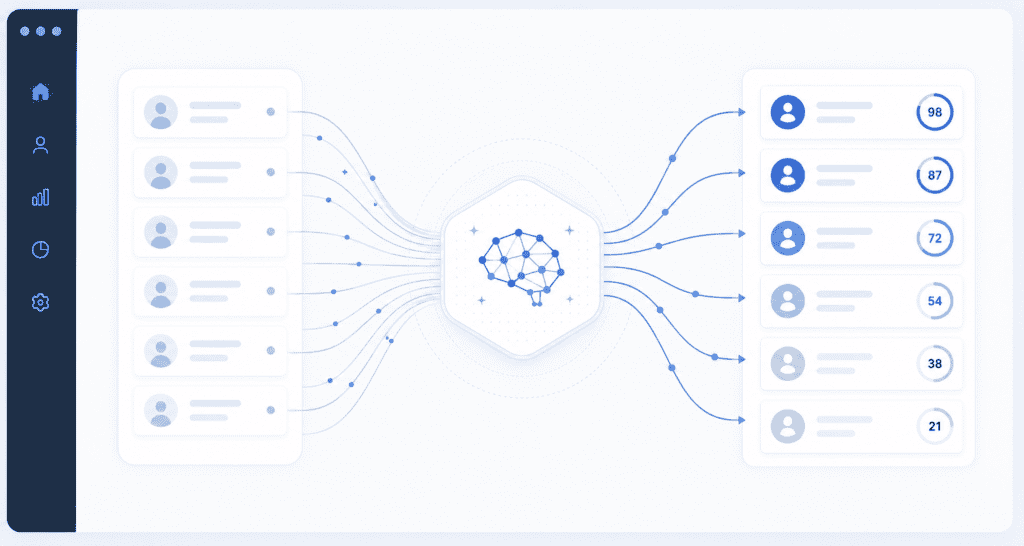
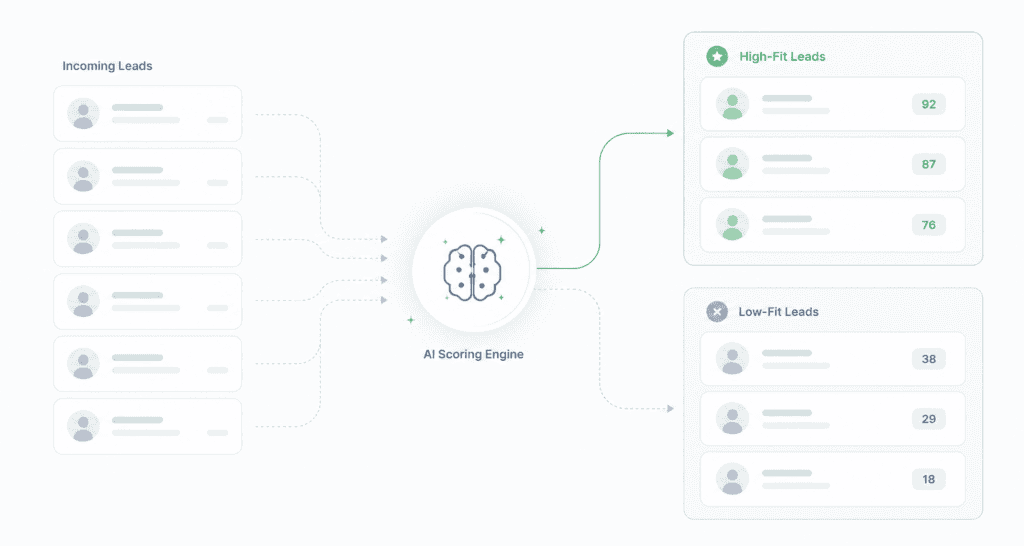
AI algorithms can analyze past sales data to predict which leads are most likely to convert. This predictive lead scoring helps sales teams prioritize their effort on the accounts worth a real conversation, instead of working a list top to bottom.
4. Automation of routine tasks
AI can automate routine tasks such as sending follow-up emails or scheduling calls, freeing up valuable time for your sales team to focus on building relationships with potential leads.
By enhancing data analysis, improving personalization, enabling predictive lead scoring, and automating routine tasks, AI shifts your team’s hours toward the work humans do best. The pattern underneath all four is the same: AI does the sifting at volume, and your team owns the judgment about who is actually a fit.
6 easy ways to use AI marketing for lead generation
Here are six easy-to-implement ways to use AI and machine learning for lead generation, designed to have minimal barriers to entry and require low to medium effort:
1. Chatbots for customer engagement
Having an online presence is vital for any business. But being available 24/7 can be a challenge, especially for small businesses. This is why you need AI-powered chatbots.
By implementing chatbots on your website or social media platforms, you can ensure that visitors are always engaged, queries are answered promptly, and lead information is collected consistently, even outside of business hours.
Use a reliable AI chatbot platform that offers customization options to tailor the chatbot’s responses to your specific needs, so visitors get answers specific to your business rather than a generic script.
The payoff is measurable. Tidio’s chatbot research found that 55% of companies using chatbots for marketing experience a rise in high-quality leads, which tracks with the qualification-first aim of this whole list.
If you’re ready to use chatbots for lead generation, here’s how to do it:
1. Define your objectives
- Identify goals: Determine what you want to achieve with the chatbot, such as collecting email addresses, answering FAQs, qualifying leads, or scheduling appointments.
- Understand your audience: Know the typical queries and needs of your visitors to tailor the chatbot’s responses.
2. Choose the right chatbot platform
- Research options: Explore different chatbot platforms like ManyChat, Drift, Intercom, or HubSpot. Consider factors like ease of use, integration capabilities, and customization options.
- Select a platform: Choose a platform that aligns with your technical skills and business needs.
3. Design the chatbot flow
- Map out conversations: Design conversation flows that guide users to provide information or receive help. Use a mix of open-ended questions and quick reply options.
- Personalize interactions: Include personalized greetings and responses based on user input or time of the day.
4. Integrate with your website
- Embed the chatbot: Use the provided code snippet or plugin from your chosen platform to integrate the chatbot into your website.
- Test placement: Experiment with chatbot placement (like the bottom right corner) to ensure visibility without obstructing user experience.
5. Connect with CRM and analytics tools
- Sync with CRM: Integrate the chatbot with your Customer Relationship Management (CRM) system to capture and manage leads effectively.
- Enable analytics: Use chatbot analytics or integrate with tools like Google Analytics to track interactions and conversions.
6. Train your chatbot
- Input FAQs: Load frequently asked questions and answers to handle common queries effectively.
- AI training: If your platform supports AI, train the chatbot with various inputs to improve its understanding and response accuracy.
7. Launch and monitor
- Go live: Activate the chatbot on your website.
- Monitor interactions: Regularly check chat logs to understand user interactions and identify areas for improvement.
2. Email marketing automation
Email is where AI-driven segmentation earns its keep fastest. Segment your audience on how they interacted with previous emails, and the right message reaches the right person at the right time instead of the whole list getting the same blast.
The gap between automated and batch-and-blast is not subtle. Omnisend’s benchmarks found automated emails had 52% higher open rates and 332% higher click rates than regular scheduled campaigns, because mail that fires on behavior lands better than mail that fires on a calendar.
If your plan is to boost your high-quality leads through email marketing, here are some AI-powered tools to check out:
| Tool | Features | Free plan | Ideal for |
|---|---|---|---|
| HubSpot Email Marketing | AI-powered audience segmentation, integration with HubSpot CRM, personalized email campaigns, detailed performance analytics, automated workflows and lead nurturing | Yes | Businesses seeking an integrated CRM and email marketing solution, especially those looking to scale and require extensive marketing automation. |
| Mailchimp | AI-driven audience insights and segmentation, predictive analytics for optimizing campaigns, personalized content recommendations, user-friendly email design tools, A/B testing and campaign performance reports | Yes | Small to medium-sized businesses or individuals needing an easy-to-use platform with strong automation and AI insights for email engagement. |
| Marketo (by Adobe) | AI-powered lead scoring, predictive content for personalization, behavior tracking and email targeting, integration with Adobe Experience Cloud, advanced analytics and reporting | No | Larger enterprises or businesses with complex marketing needs looking for a comprehensive, customizable marketing automation platform. |
3. AI-driven content recommendations
AI-driven content recommendations make each visitor feel like the page was built for them, because in a real sense it was: the system reads behavior and assembles what that specific visitor is most likely to act on.
By analyzing visitor behavior, AI can recommend articles, products, or services that fit each individual visitor, increasing engagement and potential lead capture.
Planning to integrate this into your website? There are many AI-powered tools that can help you enable personalization for every page visitor. But choosing wisely is a skill.
Here are some factors to look at when picking a tool that can help you personalize your customer experiences:
- Ease of integration: Look for tools that can integrate with your existing website infrastructure and content management system. A smooth integration process reduces technical challenges and ensures the tool can communicate with your site’s data sources.
- Customization and flexibility: The ability to customize the AI’s behavior and recommendations based on specific business needs and user profiles is important. A flexible tool lets you tailor the experience to different segments, improving relevance and effectiveness.
- Data processing capabilities: Assess the tool’s ability to handle and process large volumes of data in real time. Efficient data processing is essential for accurate and timely content recommendations, especially for sites with dynamic and diverse content.
- User privacy compliance: Ensure the tool adheres to user privacy laws and regulations, such as GDPR or CCPA. Compliance matters for legal reasons and for maintaining user trust.
- Analytics and reporting: Choose a tool that provides detailed analytics on user interactions and the performance of the recommendations. Insightful analytics help you understand user preferences, adjust content strategies, and measure the ROI of personalization efforts.
4. Predictive lead scoring
Too few leads has an equally frustrating opposite: plenty of leads and no idea which ones deserve a call. Predictive lead scoring is the fix for the second problem.
The AI sifts your lead data and surfaces the accounts most likely to convert. It is the closest thing to a real qualification engine most teams can stand up quickly.
The upside shows up at the level of pipeline, not just productivity. In one McKinsey case, an original-equipment manufacturer grew its pipeline from new and existing customers by more than 20% of total revenue after deploying an AI-powered lead-generation engine that scored leads, fed prioritized lists into the CRM, and triggered hyper-personalized outreach.
Across marketing and sales more broadly, McKinsey reports that companies investing in AI are seeing a revenue uplift of 3 to 15 percent and a sales ROI uplift of 10 to 20 percent. The lift comes from pointing AI at the right place, not from buying more of it.
The mechanism scales down, too. The OEM’s win came from scoring and prioritizing, the qualification step, not from generating more raw volume, and that step is as available to a five-person team as it is to an enterprise.
5. Social media insights analysis
AI tools for social media analysis do the reading no team has time for. They identify trends, track brand mentions, and read audience sentiment across every channel at once, and what that surfaces is the set of accounts already leaning toward you, which is where lead targeting gets easier.
Choose an AI tool that offers comprehensive social media data analysis, including trend identification, brand mention tracking, and sentiment analysis.
To effectively analyze your social media insights for lead generation, check out these top choices:
| Tool | Features | Free plan | Ideal for |
|---|---|---|---|
| Sprout Social | Advanced social listening and analytics powered by AI, competitor analysis and industry benchmarking, customer sentiment analysis, demographic and behavioral audience insights, integrated social media management across platforms | Free trial | Businesses of all sizes wanting an all-in-one social media tool with deep insights into audience behavior and effective channel management. |
| Hootsuite Insights (powered by Brandwatch) | Real-time social media monitoring and AI-driven insights, sentiment analysis, trend identification for timely content creation, comprehensive performance reporting, integration with Hootsuite’s management platform | Free trial | Marketers and businesses wanting deep social media monitoring and analytics coupled with management tools. |
| Buffer Analyze | AI-enhanced analytics for social media engagement and performance, audience demographic and engagement data analysis, insights into the best times to post, easy-to-understand visual reports, integration with Buffer’s scheduling tools | Yes | Small to medium-sized businesses and individual marketers wanting an intuitive tool to gain insights from social media data. |
6. Automated ad targeting
Applied to ad targeting, AI analyzes past ad performance and user behavior continuously and tunes your targeting parameters toward the audience most likely to respond, at a cadence no human campaign manager sustains.
The tool is half the equation. The other half is the discipline of continuously refining and segmenting your target audience, because targeting drifts as your market does.
Here’s how you can do that:
1. Define your ideal customer profile (ICP)
- Gather existing data: Start by analyzing existing customer data from your CRM, sales records, and feedback surveys.
- Create the ICP: Develop a detailed profile of your ideal customer, including demographic, psychographic, and behavioral traits.
2. Choose the right AI tools
- Research AI tools: Look for AI tools that specialize in data analysis, audience segmentation, and predictive modeling.
- Select tools: Choose tools that integrate well with your existing platforms (CRM, ad platforms, and so on) and meet your specific needs.
3. Collect and integrate data
- Data collection: Collect data across various touchpoints, including website interactions, social media engagement, and purchase history.
- Data integration: Ensure all data is integrated into the AI tool to provide a comprehensive view of your audience.
4. Initial audience segmentation
- AI-driven segmentation: Use your AI tool to segment your audience based on the defined ICP and collected data.
- Identify segments: Identify distinct audience segments that show potential for high engagement and conversion.
5. Develop personalized ad campaigns
- Tailored content: Create ad content tailored to the interests and behaviors of each segment.
- Ad placement: Choose ad platforms and placements most likely to reach your segments effectively.
6. Implement and monitor campaigns
- Campaign launch: Launch your campaigns targeting the identified segments.
- Continuous monitoring: Use AI tools to monitor campaign performance in real time.
7. Analyze and refine
- Performance analysis: Regularly analyze the performance data provided by the AI tools.
- Refinement: Use insights to refine your ICP, audience segments, and ad strategies. Look for patterns in the data that signal emerging trends or shifts in customer behavior.
Aside from applying AI, there is another tool that helps you understand your leads. This one is not as complex as artificial intelligence. But its purpose is just as integral, because it forces you to get specific about who you are trying to reach.
Use customer avatars in lead generation
The customer avatar is a key tool in lead generation because it offers a detailed snapshot of your ideal customer.
It lets you understand their characteristics, needs, and behaviors, so you can create personalized marketing messages and offers that resonate with them.
This targeted approach improves your marketing effectiveness and lifts conversion rates, making your campaigns more successful. Understanding your customers is the first step toward winning them over.
Whether you use it before or in the middle of your lead generation process, documenting your ideal prospects in a customer avatar worksheet helps you get clear on who responds to your offers.
Frequently asked questions
What is the fastest way to generate leads?
The fastest way to generate leads is through paid digital advertising, like Google Ads or social media ads.
These platforms let you target specific audiences quickly and drive traffic to your website or landing pages.
Combining this with compelling calls-to-action and engaging content can yield quick results. It is also important to optimize landing pages for conversions to make the most of the traffic generated.
How do you convert leads to customers?
Converting leads to customers requires a well-planned nurture strategy. This involves understanding the needs and interests of the leads and providing them with valuable information or solutions.
Personalized email campaigns, targeted offers, and follow-up phone calls are effective tactics.
Building trust through consistent, helpful engagement is key to moving leads through the sales funnel to conversion.
How do you automate lead generation?
Automating lead generation involves using digital tools like CRM software, email marketing platforms, and AI-driven analytics.
Tools like HubSpot or Marketo can automate tasks such as capturing leads from website forms, segmenting leads based on their behaviors, and sending personalized follow-up emails.
Integrating these tools with your website and social media channels can create a seamless lead-nurturing process.
What is the difference between lead generation and lead conversion?
Lead generation is the process of attracting potential customers to your business and capturing their information.
It is about creating interest in your products or services. Lead conversion, on the other hand, is the process of turning those leads into paying customers.
It involves nurturing leads, building relationships, and ultimately persuading them to make a purchase.
How do you put AI lead generation to work?
Whether it is chatbots, AI-assisted email marketing, personalized content recommendations, or predictive lead scoring to identify your hot leads, the common thread is the same. AI earns its place when you aim it at qualification and let your team own the judgment calls.
AI helps you cut through the noise, identify your ideal prospects, and engage them in a way that feels specific rather than broadcast. The hours it hands back go where human judgment actually moves the deal.
Not sure whether lead generation is your binding constraint? Start with a free Growth Assessment, which names the one stage capping your growth so you point AI where it will actually move the number.
Frequently Asked Questions About AI Marketing for Lead Generation
What is the fastest way to generate leads?
The fastest way to generate leads is paid digital advertising like Google Ads or social media ads, which let you target specific audiences quickly and drive traffic to your landing pages. Pair it with compelling calls-to-action and conversion-optimized pages so the traffic you buy actually turns into captured leads.
How do you convert leads to customers?
Converting leads requires a planned nurture strategy: understand each lead’s needs, then give them relevant information or solutions. Personalized email campaigns, targeted offers, and timely follow-up calls work well. Consistent, helpful engagement builds the trust that moves leads through the funnel to a purchase.
How do you automate lead generation?
Automate lead generation with CRM software, email marketing platforms, and AI-driven analytics. Tools like HubSpot or Marketo can capture leads from forms, segment them by behavior, and send personalized follow-ups. Integrating these with your website and social channels creates a seamless, repeatable lead-nurturing process.
What is the difference between lead generation and lead conversion?
Lead generation is attracting potential customers and capturing their information, the work of creating interest in your product. Lead conversion is turning those captured leads into paying customers through nurturing, relationship-building, and persuasion. Generation fills the top of the funnel; conversion closes the bottom.
About the author
Brian helps B2B founders install marketing + automation engines powered by Co-Thinking with AI. With 15+ years building predictable revenue systems, he's worked with SaaS, agency, and service businesses on 90-day done-with-you growth accelerators.
Ready to see your real growth gap?
Two minutes in the Growth Gap Scan and you walk away knowing the one thing capping your pipeline. Free, no obligation.