B2B SaaS Shiny Object Syndrome: The Real Fix

Founder, Grow Predictably · 15+ yrs building B2B revenue systems

TL;DR: Shiny object syndrome in B2B SaaS founders is not a personality flaw, it is what a missing strategic constraint looks like from the outside. When nothing names the one thing that matters most, every new tactic looks equally worth starting, so you start all of them and finish none. The cure is decision-first: diagnose the single constraint capping growth, decide what you will not do, and finish the initiative you are already on before opening another.
Key Takeaways
- Shiny object syndrome is a symptom, not a character defect. It shows up when a founder has no diagnosed constraint telling them what matters most right now.
- With no constraint, every option looks equally plausible, so a founder rationally starts all of them. The behavior is logical given the missing input.
- The real cost is not wasted spend. It is a field of half-built bridges: initiatives started toward a destination and abandoned at the next shiny thing, so you pay to build every bridge and cross none.
- That backlog of unfinished work is unimplemented debt, and it compounds, because each abandoned initiative still costs to maintain and still owes the return you never collected.
- You can tell object-chasing from real iteration with three questions about the constraint, the current bridge, and what actually triggered the move.
- The fix is to choose what not to do. Diagnose the one stage capping growth, disqualify everything that does not touch it, and finish the bridge you are on.
The B2B SaaS market is estimated at roughly $390 billion in 2025 and is projected to reach about $1.58 trillion by 2031, a compound annual growth rate above 26 percent.
A market growing that fast manufactures a new tool, channel, and playbook every quarter. So the pull toward the next shiny thing is not a weakness a founder should feel guilty about. It is the predictable result of standing in a flood of plausible options with nothing on hand to sort them.
This article reframes shiny object syndrome as a diagnosis problem, shows the specific cost it creates, and lays out the decision-first cure.
What shiny object syndrome actually is in B2B SaaS
Shiny object syndrome isn’t about discipline. It’s what happens when you start a new tactic, tool, or channel before the last one has had time to work. Each move feels smart in the moment. Strung together, they read as scattered.
You can watch it happen inside a single quarter:
- Week 1: A founder reads about a competitor winning with a community motion, and the content plan gets shelved.
- Week 3: An AI outbound tool demos well, so the community work stalls.
- Week 7: A partnership deck looks like the real unlock, and outbound goes quiet.
Three good ideas, zero finished experiments.
The founder version of the pattern
Founders get hit with this harder than anyone on their team, and it’s not because they’re less disciplined. It’s because they have the widest field of view and the most authority to act on it.
A founder sees the whole board, hears every pitch, and can redirect the roadmap in a single meeting. That combination of vision and power is exactly what makes an unfocused founder dangerous to their own company.
The person most able to start new things is also the person with the least outside pressure to finish them.
Why it reads as a flaw when it is really a symptom
The real fix isn’t willpower. Most advice treats shiny object syndrome as a character problem and prescribes the usual: focus more, say no, be disciplined. That framing misreads the cause.
Over 15 years of watching marketing leaders hire agencies and change direction, from both the agency side and the in-house leadership side, I’ve noticed that the founders who looked the most scattered were almost never the least disciplined. They were the ones operating without a diagnosed constraint.
A founder chasing shiny objects is usually behaving rationally on a missing input. When there’s no diagnosed constraint naming the one stage currently capping growth, every option genuinely looks equally worth starting, because nothing exists to rank them against. As I keep coming back to: when anything is possible, priorities define you.
Take away the constraint, and everything looks possible, so the founder starts everything. The syndrome is what a missing constraint looks like from the outside.
The real cost: a field of half-built bridges
The cost of shiny object syndrome isn’t really wasted money, though that’s how it usually gets described. The truer cost is a field of half-built bridges: initiatives you start toward a destination and abandon partway across the moment the next object appears.
Every initiative is a bridge you’re building toward something real: revenue, retention, a working channel. Chase the next object, and you abandon that bridge mid-span, then start a new one somewhere else. Do that enough times, and you’re standing in a field of unfinished spans, having paid to build every one of them and crossed none.
Picture a Series A company over three quarters:
- Q1: The team invests in a content engine and gets it two-thirds of the way to a publishing rhythm.
- Q2: A competitor’s community play looks better, so the writers get pulled onto a Slack group that never reaches critical mass.
- Q3: An AI outbound tool demos well, the community goes quiet, and half a sequence ships before the founder decides events are the real channel.
By year’s end: a dormant blog, a ghost-town community, a paused outbound tool still billing monthly, and one event with no follow-up motion behind it. Four bridges, four down payments, zero crossings. None of those bets was stupid on its own. The damage came from starting the next one before finishing the last.
You pay to build every bridge and cross none
The waste isn’t just the spend; it’s the unrealized crossing. A half-built bridge carries no traffic. You paid for the tool, the retainer, the ramp-up, and your team’s attention, and you got none of the outcome that bridge was pointed at, because outcomes live on the far bank.
Marketing technology is the clearest example of this. Marketers now report using only about a third of their martech stack’s actual capability, down from 42 percent in 2022 and 58 percent in 2020, even as spend on those tools kept climbing. Two-thirds of the average stack is a half-built bridge: bought, partly configured, never crossed.
The compounding interest of unimplemented debt
This backlog behaves like debt. I call it unimplemented debt: the growing pile of started-but-unfinished work that sits on the books, drawing interest. Each abandoned initiative keeps costing you:
- Seat licenses nobody cancels
- Workflows half-wired into the stack
- Mental overhead from a team that remembers three unfinished pushes
It also owes you the return you were promised and never collected. The interest is quiet, which is why it gets underestimated. It doesn’t show up as one bad quarter. It shows up as a company that’s always busy and never compounding.

How to tell shiny object syndrome from genuine iteration
Not every change of direction is object-chasing. Some of the best growth moves are pivots, and killing a real pivot in the name of focus is its own mistake. The difference isn’t how often you change direction; it’s what sits behind the change.
Genuine iteration is disciplined change against a known constraint. Object-chasing is change with no constraint behind it, driven by the newness of the thing rather than the need for it. Three questions separate the two.
The three questions that separate the two
- Can you name the one stage currently capping growth, and does this new thing address that stage? If you can’t name the constraint, you’re not iterating; you’re guessing with enthusiasm.
- Are you finishing the current bridge, or leaving it because the new one looks shinier? A real move closes the old initiative on purpose.
- Did the data tell you to move, or did the novelty tell you to move?
Switching on novelty carries a real tax. Research summarized by the American Psychological Association found that the mental blocks created by shifting between tasks can cost as much as 40 percent of someone’s productive time. A team that keeps restarting pays that tax again and again.
What a healthy pivot looks like
A healthy pivot answers all three questions cleanly. The constraint is named, the current initiative is either finished or deliberately closed with the learning captured, and the trigger is evidence rather than excitement.
When you can walk through those three, and the move still holds, that’s iteration. When the honest answers come back as no constraint, an abandoned bridge, and a demo that lit everyone up, that’s the syndrome wearing the costume of strategy.
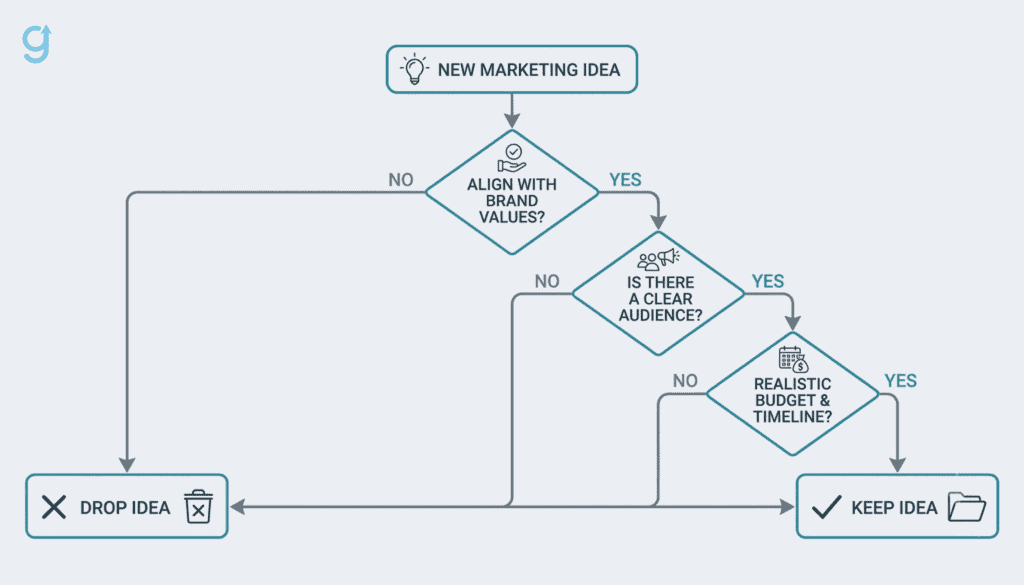
The cure: choose what not to do
The cure isn’t more willpower. It’s a single decision, made once, that does the disciplining for you from then on, because it gives every future option a test it has to pass.
“The essence of strategy is choosing what not to do.” — Michael E. Porter, “What Is Strategy?”, Harvard Business Review, 1996
Porter was writing about corporate strategy, but the line lands just as hard on a founder’s calendar. Strategy isn’t the list of things you’ll do, because that list is infinite and every item on it looks reasonable. Strategy is the much shorter list of things you’ve decided not to do, and that decision only becomes possible once you know what you’re protecting.
Diagnose the one constraint first
The work starts with diagnosis, not action. Before choosing any tactic, find the single stage in your growth model that’s currently capping everything downstream of it. This is borrowed from how the best operators treat a system: you don’t speed up every station, you find the one bottleneck and relieve it, because nothing else moves the throughput.
In a B2B SaaS funnel, that constraint might look like:
- You generate demand you can’t convert
- You convert deals you can’t retain
Name the constraint before you shop for solutions.
Then commit, and finish the bridge you are on
Once the constraint is named, most shiny objects disqualify themselves. The community motion, the outbound tool, the partnership deck: each one gets a single test. Does this relieve the constraint I just named? The ones that don’t are easy to decline.
That ease is the point. The decision does the disciplining, so turning down a shiny object stops being a weekly act of restraint and becomes the obvious output of a test the idea already failed. That’s what choosing what not to do buys you: a filter that turns every future pitch into a quick yes or no instead of an open question.
Then finish the bridge you’re on. One crossed bridge that carries revenue beats ten half-built spans every time, and finishing is what converts spend into the outcome you were paying for all along.
How to build focus in the next 90 days
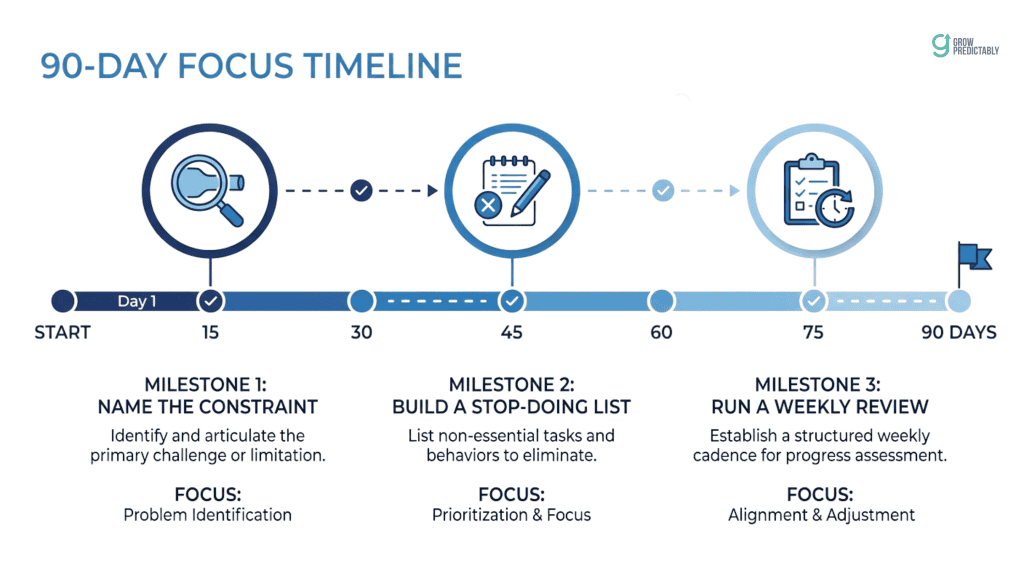
Focus isn’t a personality trait you’re born with or without. It’s something you can install with a short sequence, and 90 days is enough to feel the change.
Name the constraint and the one metric that moves it
Start by writing down the single-stage capping growth right now, and the one metric that proves it’s moving. Not a dashboard of twenty numbers, one number.
This is the same discipline behind a documented B2B SaaS growth strategy: a strategy that names the constraint and gives every other decision a reference point. If you can’t get to one metric, that’s the real first project, because you can’t focus on a target you haven’t defined.
Install a stop-doing list and a weekly review
From there, the sequence looks like this:
- Build a stop-doing list. Put the tactics and tools you won’t start until the current constraint clears, on purpose. That way, declining them is a decision you already made, not a fight you have every week.
- Finish or formally kill every half-built bridge before opening a new one. Cancel the unused tools, close the stalled pushes, and capture what each one taught you.
- Install a weekly review. Any new idea gets held against the named constraint before it earns a single hour. That cadence is what keeps the decision alive after the enthusiasm of making it fades.
Most founders know all of this and still can’t hold the line from inside their own company, because they’re too close to the vision and too free to act on it. That’s the specific value an outside operator brings.
A fractional CMO enforces the constraint a founder keeps talking themselves out of, and turns the focus into a real demand generation engine instead of another abandoned bridge.
If you want to see which stage is actually capping your growth before you commit a quarter to it, you can start with a free growth assessment that names the constraint for you.
Frequently Asked Questions About B2B SaaS Shiny Object Syndrome
What is shiny object syndrome in business?
Shiny object syndrome is the habit of starting a new tactic, tool, or channel before finishing the last one. In B2B SaaS, it usually looks like a founder jumping between community, outbound, partnerships, and events. It is less a discipline problem than a sign that no single constraint has been named to rank the options.
Is shiny object syndrome a real thing or just an excuse?
It is a real, well-documented behavioral pattern, not a clinical diagnosis. For founders, it tends to be rational rather than lazy: with no diagnosed constraint telling them what matters most, every option looks equally worth starting. The pattern is real, but the root cause is a missing decision, not a missing work ethic.
What actually causes shiny object syndrome in B2B SaaS founders?
The absence of a diagnosed constraint. When nothing names the single stage currently capping growth, every new tactic looks equally plausible, so a founder starts all of them. A fast-growing market that ships a new tool or playbook every quarter makes the pull stronger, which is why founders with the most vision often scatter the most.
How do I tell a genuine pivot from chasing a shiny object?
Ask three questions. Can you name the stage capping growth, and does the new thing address it? Are you finishing the current initiative or abandoning it because the new one looks shinier? Did the data trigger the move, or did the novelty? A real pivot names the constraint, closes the old work on purpose, and moves on evidence.
How does a fractional CMO help a founder stay focused?
A fractional CMO enforces the constraint a founder keeps talking themselves out of. As an outside operator, they diagnose the one stage capping growth, hold a stop-doing list, and keep the team finishing the current initiative instead of starting the next shiny one. That is the focus most founders cannot hold from inside their own company.
About the author
Brian helps B2B founders install marketing + automation engines powered by Co-Thinking with AI. With 15+ years building predictable revenue systems, he's worked with SaaS, agency, and service businesses on 90-day done-with-you growth accelerators.
Ready to see your real growth gap?
Two minutes in the Growth Gap Scan and you walk away knowing the one thing capping your pipeline. Free, no obligation.