Selling With Stories: The High-Ticket Story Method

Founder, Grow Predictably · 15+ yrs building B2B revenue systems

TL;DR: Selling with stories means replacing your feature pitch with a short, structured narrative that puts the buyer’s own transformation at the center. For a high-ticket B2B coach or consultant, it is how you justify premium pricing and win the final-stage deal. Build one repeatable five-beat story from a real client result, tell it at the right moment, and the buyer feels the outcome and trusts it before their rational brain starts comparing you on price.
Key Takeaways
- A buyer decides emotionally, then justifies with logic. A story does the emotional work your feature list cannot.
- People remember stories far better than facts. In a Stanford experiment, 63% of listeners recalled a story and only 5% recalled a statistic.
- For a high-ticket coach or consultant, the story is what makes a premium price feel small next to the outcome.
- Use one repeatable structure: a character the buyer recognizes, the stall, the turn, the after-state, and the proof.
- Tell a different story at each stage of the sale, and never use a story to dodge a real objection.
Leads are up. The calendar is full of good-fit calls. Then a well-qualified prospect goes quiet after a strong proposal, or asks for a discount at the last stage, and the deal you were sure of just dies.
Most coaches read that as a pricing problem or a closing problem. It is usually a messaging problem. The pitch handed the buyer a pile of features to comparison-shop, and never gave them a reason to feel the outcome. Selling with stories fixes that.
This is the structure, the evidence for why it works, and where most people get it wrong.
Why do buyers remember your story and forget your pitch?
Buyers remember the story and forget the pitch because of how memory actually works, not because they weren’t paying attention.
Watch what happens after a feature-heavy sales call. The buyer nods, takes notes, promises to think it over, and forgets most of what you said by the next morning. That’s not a discipline problem on their end. Facts arrive as isolated data points with nothing to hold onto. A story arrives as a sequence of cause and effect that the brain files away and keeps.
The research on this is blunt. Jennifer Aaker, a marketing professor at Stanford’s Graduate School of Business, ran an experiment where students gave one-minute pitches, and the audience wrote down what they remembered afterward:
- Only 5% of listeners recalled a single statistic
- 63% recalled a story
- Same room, same amount of time, a twelve-fold difference in what stuck
Memory is only half the picture. A story also moves people to act. Paul Zak, a neuroeconomist, spent years studying what happens in the brain during narrative. His finding, published in the Harvard Business Review, breaks down like this:
- Character-driven stories consistently trigger oxytocin synthesis in the brain
- The amount of oxytocin released predicted how willing people were to act afterward, including giving away their own money
- A feature list doesn’t produce that response. A person the buyer cares about, facing a problem the buyer recognizes, does
For fifteen years I’ve watched marketing leaders hire and fire agencies, from both the agency side and the in-house side. The losing pitch is almost always the same shape: a wall of capabilities with no human in it. The winning one tells a story the buyer sees themselves inside.
Nothing about the offer changed. The delivery system for the decision did.

Selling with stories vs listing features: what changes in a high-ticket sale
Leading with features invites comparison. Leading with a story removes you from the comparison entirely.
A feature list invites one behavior: comparison. The moment you lead with what you do, the buyer lines you up against every other option, and the cheapest credible one usually wins. That’s a losing game for anyone charging a premium.
A story changes the frame. Instead of “here is what I do,” it says “here is who I helped and what changed for them,” and there’s no spreadsheet cell for that.
This matters more in B2B than most people assume. Google and CEB studied 3,000 B2B purchasers across 36 brands, and the findings cut against the usual assumptions:
- Buyers who felt a strong emotional connection to a supplier were far more likely to buy
- Personal value drove roughly twice the impact of business value
- B2B buying is not the cold, rational process the spreadsheets pretend it is
For a high-ticket coach or consultant, whose buyer is spending real money and staking their own reputation on the choice, that emotional connection is not a nice-to-have. It’s the thing that overcomes the risk of saying yes.
Paul Smith, author of “Sell with a Story,” puts the mechanism plainly:
“It turns out humans don’t make the rational, logical decisions that we’d like to think they do.” — Paul Smith, author of “Sell with a Story”
The emotional brain decides, then the rational brain builds the case for what it already wants. Your features are the evidence the buyer uses to justify the decision. Your story is what makes the decision in the first place. Lead with the evidence, and there’s no decision to justify yet.
The transformation story: a repeatable five-beat structure
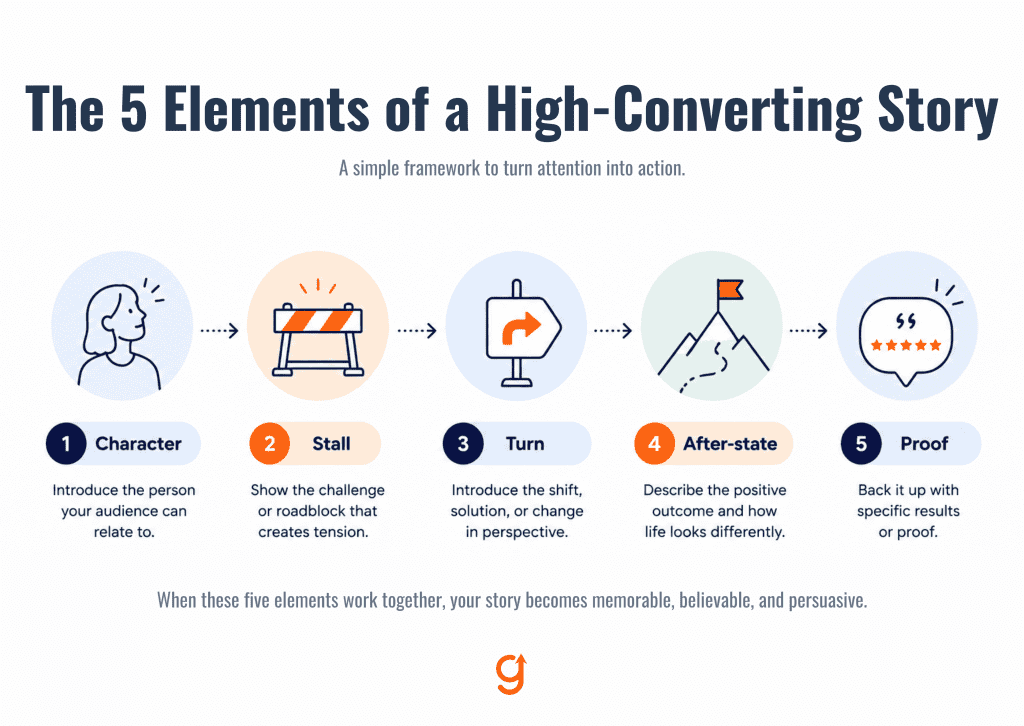
A sales story that actually works follows five beats: character, stall, turn, after-state, and proof. Build it once around a single real client result, and you can reuse it in every high-ticket conversation.
Most advice on sales storytelling stops at “tell a story,” which is useless under pressure. You need a structure you can build once and reuse. Take a single real client result and shape it into five beats. Told well, it runs about 90 seconds, which is a story, not a case study read aloud.
The five beats break down like this:
- Beat 1: a character the buyer recognizes as themselves
- Beat 2: the stall where the old way stopped working
- Beat 3: the turn
- Beat 4: the after-state
- Beat 5: the proof
Here’s what each one needs to do.
Beat 1: a character the buyer recognizes as themselves
Open on a real, specific client who looks like the person you’re selling to. Same role, same stage, same frustration. The buyer needs to think “that is me” within the first two sentences. Ground the character in the customer avatar you already serve, not a generic everyman.
Beat 2: the stall where the old way stopped working
Name the moment the character’s usual approach ran out of road. This is the tension a story needs to hold attention. Be concrete about what was breaking: the pipeline that looked full but converted nothing, the launch that stalled, the team that kept missing.
Beat 3: the turn
Describe the specific decision or shift that changed the trajectory. Name the actual insight or move that mattered, the real turning point rather than the moment they signed. The turn is where your method shows up, carried by what the character did rather than told as a list of your capabilities.
Beat 4: the after-state
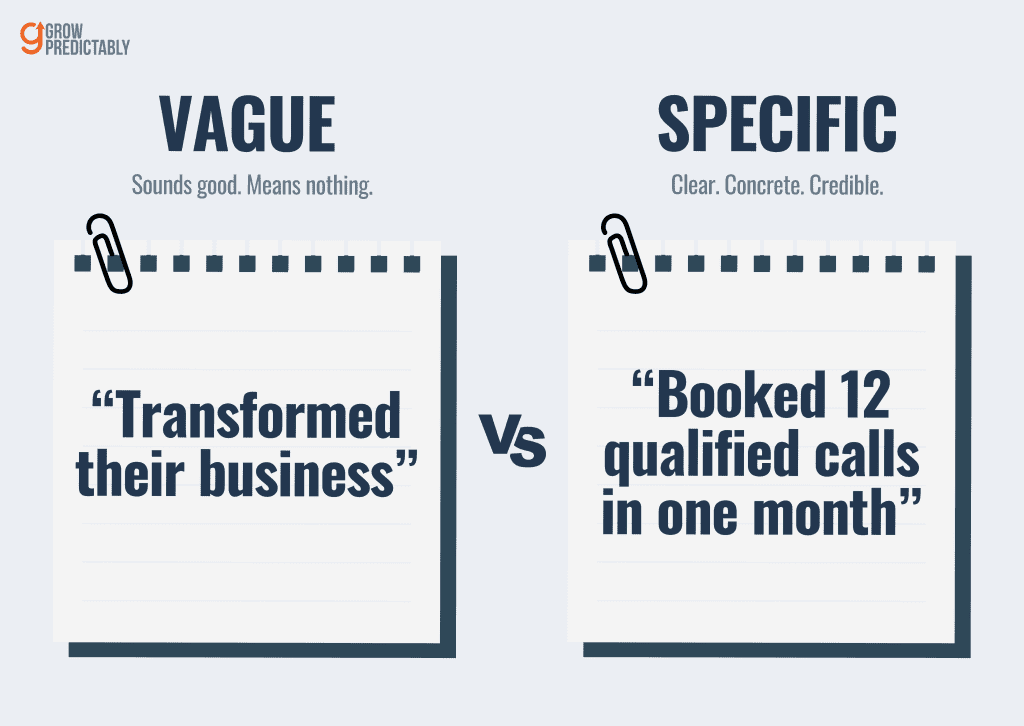
Show the concrete result, not a vague win. In their book on why some ideas stick, Chip and Dan Heath found that concrete, specific details make a claim more believable:
- A command of detail is how listeners read real expertise
- “Booked twelve qualified calls in the first month” lands
- “Grew their business” slides right off
The after-state is where the buyer feels the outcome they want for themselves, which is why the specificity here matters more than anywhere else in the story.
Beat 5: the proof
Close with the evidence that makes it believable: a number, a quote from the client, a before-and-after they can picture. This is the beat that lets the buyer’s rational brain sign off on the emotional decision the first four beats already made.
Which story do you tell at each stage of the sale?
The story you tell should match where the buyer sits in the sale, not stay the same from first call to close.
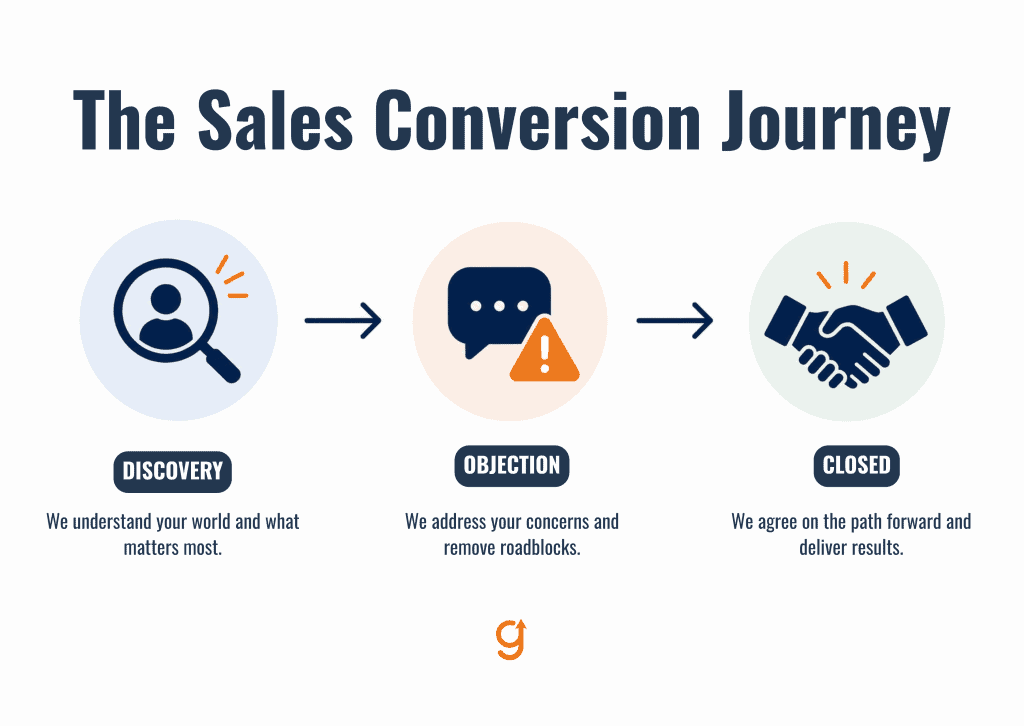
One story doesn’t fit every moment of a high-ticket sale. Match the story to where the buyer sits in their customer value journey:
- Discovery: the “someone like you” story. Its only job is to make the prospect feel understood. Use a character whose starting situation mirrors theirs, and stop before the hard sell.
- Objection stage: the “I thought that too” story. Tell it about a past client who raised the exact concern in front of you, and what happened when they moved forward anyway. This is the highest-impact story for premium pricing, because price resistance is almost always a disguised risk objection. A story about someone who took the same risk and won answers it in a way a discount never can.
- Close: the “here is what happens next” story. Walk the buyer through the first thirty days of working together, so the decision feels less like a leap and more like a step they can already picture.
Storytelling also keeps you on the right side of the talk-to-listen ratio. Gong studied more than 326,000 B2B sales calls and found a clear pattern in what separates winning calls from losing ones:
- Top performers talk about 43% of the time and listen for 57%
- Losing deals average 64% talk time
- A short, well-placed story earns your share of the talking without tipping into a monologue, because the buyer stays the subject of the conversation even while you’re the one speaking
Where most coaches and consultants get story-selling wrong
The three most common story-selling mistakes all come down to the same root problem: making the story about you instead of the buyer.
- Making yourself the hero. You solve, you save, you deliver. But the buyer doesn’t want to hear about your greatness. They want to see themselves win. The client is the hero. You’re the guide who knows the terrain. Flip that, and the story quietly becomes a brag, and buyers feel it.
- The vague, unfalsifiable outcome. “Transformed their business” is hype wearing proof’s clothes, and a sharp buyer discounts it on sight. Specifics earn trust, while round, glowing summaries quietly erode it.
- Using a story to dodge a real objection instead of answering it. When a buyer raises a genuine concern, a story can reframe it honestly, but it can’t make it disappear. Paul Smith frames the honest version well: an objection is itself a story the buyer is telling, and “you can’t replace that bad story with a fact. You can only replace it with a good story” that is also true.
The word true is doing the work there. A story that serves the buyer helps them make a decision they’ll be glad they made. A story engineered to get past their judgment is manipulation, and in a referral-driven, high-trust business, it’s the fastest way to torch the reputation you sell on.
Forget price; focus on the value actually delivered, and the honest story is always the stronger one.
How do you build your signature sales story this week?
You do not need a workshop for this. You need one client, an hour, and a willingness to tell the truth about a real result. Here is the exercise that turns your best client outcome into a story you can reuse on every call.
- Pick your best-fit client, the one whose result you are proudest of and whose starting point looks most like the buyers you want more of.
- Write the five beats in plain sentences: the character, the stall, the turn, the after-state, the proof. Do not polish yet, just get the true version down.
- Cut it to ninety seconds spoken. If it runs long, you are explaining your method instead of showing the transformation. Trim to the human.
- Test it live on your next three calls and watch where attention leans in and where it drifts. Refine from there.
A signature story is a system, not a script. It gets sharper every time you tell it and listen to how it lands. And if you build the story and premium deals still stall, the problem is upstream of your pitch, in how the whole journey is set up. That is worth diagnosing directly.
Take the Growth Gap Scan to see where your premium deals are actually stalling in the pipeline, so you can fix the stage that is capping the rest.
Story-selling is the most learnable edge a high-ticket coach or consultant has, and it starts with one true story told well.
Frequently Asked Questions
How do you start a sales story?
Open on a specific, real client who looks like the buyer you are selling to: same role, same stage, same frustration. The goal is for the prospect to think ‘that is me’ within the first two sentences. Start with the character and their situation, never with your company or your credentials.
What makes a sales story persuasive?
A persuasive sales story centers the buyer’s transformation, not your features. It follows a clear structure (a recognizable character, a stall, a turn, a concrete after-state, and proof), holds tension long enough to earn attention, and ends with a specific, verifiable result rather than a vague claim of success.
How long should a sales story be?
About ninety seconds when spoken aloud. That is long enough to move through the five beats and short enough to stay a story rather than a case study read-out. If it runs longer, you are usually explaining your method instead of showing the client’s transformation, so trim back to the human.
Isn’t storytelling in sales just manipulation?
Only if the story is not true or is used to dodge a real objection. An honest sales story helps a buyer make a decision they will be glad they made by letting them feel an outcome that genuinely happened. A story engineered to bypass their judgment is manipulation and destroys the trust a premium business runs on.
What is the difference between a case study and a sales story?
A case study is a detailed, data-heavy record read for reference. A sales story is a short, spoken narrative built to be felt in the moment. Both use real results, but a story leads with a character and emotion and lands in ninety seconds, while a case study leads with data and lives on a page.
How many sales stories should I have ready?
Start with three: a ‘someone like you’ story for discovery, an ‘I thought that too’ story for objections, and a ‘here is what happens next’ story for the close. One story does not fit every moment of a high-ticket sale, so having one per stage lets you match the story to where the buyer actually is.
About the author
Brian helps B2B founders install marketing + automation engines powered by Co-Thinking with AI. With 15+ years building predictable revenue systems, he's worked with SaaS, agency, and service businesses on 90-day done-with-you growth accelerators.
Ready to see your real growth gap?
Two minutes in the Growth Gap Scan and you walk away knowing the one thing capping your pipeline. Free, no obligation.