What Is an Avatar in Marketing? Definition + How to Build One

Founder, Grow Predictably · 15+ yrs building B2B revenue systems
By Brian Shelton — Founder of GrowPredictably.com
TL;DR: A customer avatar in marketing is a single, named, detailed profile of your one ideal customer, built from real customer data instead of guesswork. It maps demographics, frustrations, and aspirations, then the specific before and after transformation your offer creates. Most avatars stall out for one reason. Nobody ties the finished profile to a real targeting decision, so it never gets reopened.
Key Takeaways
- A customer avatar is a single, named profile of your one ideal customer, not a broad demographic segment.
- An avatar differs from a buyer persona mainly in specificity, narrowing to one archetypal buyer instead of several segments.
- The Customer Avatar Canvas approach maps five elements before and after your offer: what the customer has, how they feel, their average day, their status, and the larger enemy they’re fighting.
- Documented, committee-aware avatars move revenue: Cintell’s 2016 benchmark study found 71% of companies exceeding revenue goals had documented personas versus 26% of companies that missed them, and Gartner research shows B2B buyers spend only 17% of their purchase journey meeting with suppliers.
- A finished avatar only earns its keep when it changes one of three decisions: channel priority, ad messaging, or targeting parameters.
Watching marketing leaders hire and fire agencies for fifteen years, from both sides of that decision, taught me one thing fast. The agencies that kept the account could describe their client’s ideal customer in one sentence. The ones that lost it had a persona deck from onboarding. Nobody had opened it since.
This is for the B2B digital marketing agency owner or head of marketing who has a customer avatar exercise sitting in a shared drive somewhere. Built once. Referenced never. Campaigns still get targeted off gut feel. This walks through the actual Customer Avatar Canvas build, the Cintell and Gartner research on why documented profiles move revenue, and how a B2B avatar differs from a B2C one.
The work that follows is what a working avatar actually looks like. A profile built to answer one specific targeting decision, not filed away and forgotten.
What is a customer avatar in marketing?
A customer avatar in marketing is a single, named, fictional-but-evidence-based profile of your one ideal customer. It’s built from real customer data rather than assumption. It captures demographics, frustrations and fears, wants and aspirations, and the specific purchase drivers that make that one person say yes.
The part that actually changes your marketing is the transformation you map underneath it, not the demographic fields on top.
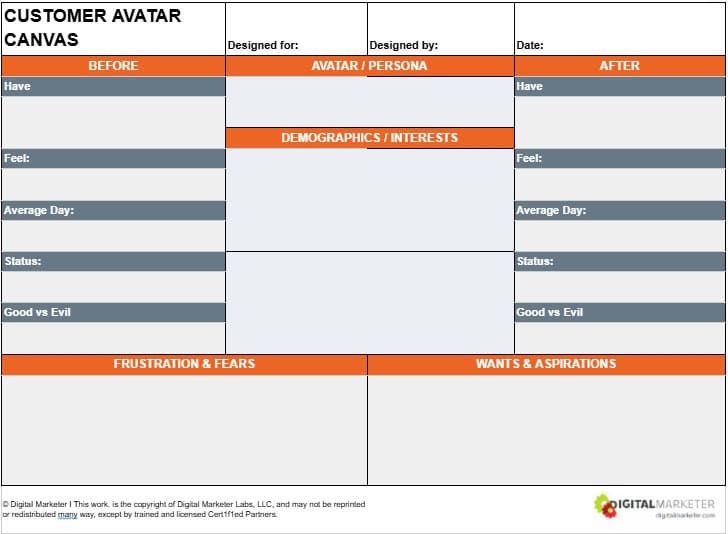
I run the Customer Avatar Canvas with agency clients as the starting exercise on almost every new engagement. It forces the same question every time. Who, specifically, is this campaign for.
As Minal Sampat, a marketing expert quoted in Forbes, puts it, “You don’t really create an avatar, you discover it.” That distinction matters. An avatar isn’t invented in a brainstorm. It’s pulled from the customers you already have, the ones who buy fast, refer others, and never haggle on price.
Customer avatar vs buyer persona: is there a real difference?
Most guides use avatar and persona interchangeably, and for day-to-day purposes that’s fine. The practical difference is specificity. A persona is often a broader research artifact covering several segments. An avatar is the single sharpest version of that research, aimed at one archetypal buyer.
| Customer avatar | Buyer persona |
|---|---|
| Single, sharp archetype — one ideal buyer | Broad segment-level profile covering multiple buyers |
| Actionable output used to write messaging and creative | Research artifact that informs segmentation and strategy |
| Applied directly to ads, pitch decks and client-facing copy | Provides context and insight; must be sharpened to be actionable |
For a B2B digital marketing agency, this distinction earns its keep the moment you’re serving more than one vertical. Building one persona per client industry, but never sharpening any of them down to a single avatar, produces messaging generic enough to fit every account. It’s specific enough to move none of them.
The agencies I’ve watched win renewals treat the persona as the research phase and the avatar as the output. Everything client-facing, from ad copy to the pitch deck, gets written against the avatar, not the broader persona document.
Why do most customer avatars stall out as a one time worksheet?
Most customer avatars stall out because they were built as a documentation exercise, not a decision-making tool. Once the worksheet is filled in, there’s no reason to reopen it. Teams complete the exercise once during onboarding or a workshop, file it, and never touch it again.
The root cause sits one level up from the worksheet itself. A customer avatar answers questions like who this person is and what they want. It only becomes useful when someone connects those answers to a live decision. Which channel to prioritize. Which objection to lead with. Which targeting parameters to set. Skip that connection and the avatar is just a description, accurate or not, with nothing riding on it.
The failure pattern I see most often on the agency side is treating the avatar exercise as a client onboarding deliverable, not a live campaign input. That’s exactly how it ends up ignored by month three.
The fix isn’t a better template. It’s building the avatar around a transformation the team can act on immediately. That’s what the next section walks through.
How do you build a customer avatar that actually works?
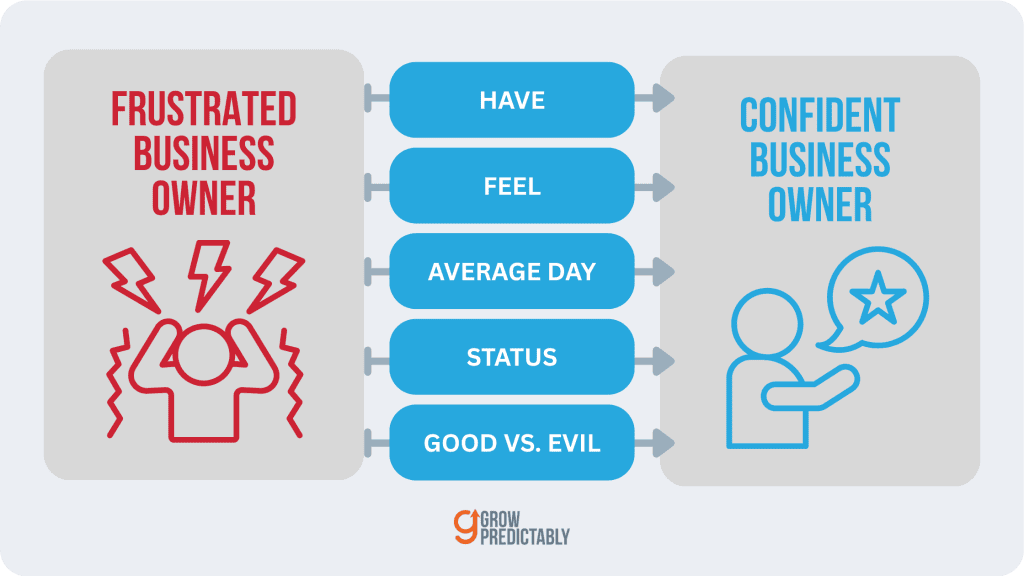
You build a working customer avatar by mapping five elements both before and after your offer changes things for that customer. What they have. How they feel. Their average day, their status, and the larger enemy they’re fighting. This before and after mapping is the core of the Customer Avatar Canvas exercise.
It’s what turns a description into messaging that lands.
The five elements to map for each avatar:
- Have – what they possess or lack, in tools, results, or resources, before your offer and after it.
- Feel – the dominant emotion driving them, from frustration or anxiety before to confidence and control after.
- Average day – one specific day in their life, not a generic routine, showing what the friction actually looks like.
- Status – how they’re seen by others (and by themselves) before versus after, since status shifts are often the real purchase driver.
- Good vs evil – the larger enemy they believe they’re fighting, which is what makes the messaging distinctive instead of generic.
Have and feel: the practical and emotional before state
Take the B2B digital marketing agency owner as the worked example.
Before: generic, low-performing campaigns, limited visibility into what’s actually working, and the nagging feeling of being just another agency fighting for scraps in a crowded market. After: tailored, high-ROI campaigns, full transparency into performance, and the confidence of a partnership that’s actually working.
- Have — Maps the tangible gaps and resources the customer starts with and ends up with. Knowing what they possess or lack shows exactly which features or outcomes matter, where to prove value, and what to prioritize in your offer.
- Feel — Captures the dominant emotions that drive decisions (frustration, anxiety, confidence). Emotions reveal motivators and objections, so messaging can empathize, trigger urgency, and promise the right emotional payoff.
Average day and status: the identity layer most avatars skip
Before, the average day is full of status meetings, unclear reports, and client complaints eating the whole afternoon. After, it’s reviewing real performance data, celebrating a client win, and planning the next expansion. Status shifts too.
From being one of a hundred interchangeable vendors to being recognized as the strategic partner clients actually trust.
- Average day — Describes one concrete day to show real friction, context, and timing. This exposes where problems occur, which channels and moments to target, and the specific tasks your solution must fit into.
- Status — Shows how the customer is perceived (by others and themselves) before and after the change. Status shifts often drive purchases more than features, so this tells you the social outcomes to promise and the kinds of social proof that will persuade.
Good vs evil: naming what your customer is fighting
The enemy here isn’t a competitor. It’s the industry norm of agencies that overpromise and underdeliver, the pattern that made the client skeptical of every new vendor pitch before you. Naming that enemy directly, instead of describing your service in generic terms, is what makes the copy sound like it understands them specifically.
Most avatars skip this element because it feels less like research and more like positioning. It’s the one piece that keeps messaging from reading like everyone else’s.
- Good vs evil — Names the larger enemy the customer is fighting (system, competitor, inefficiency, stigma). A clear antagonist creates a compelling narrative, differentiates your messaging, and unites your audience around a shared purpose.
How does a B2B customer avatar differ from a B2C one?
A B2B customer avatar has to account for a buying committee instead of one decision-maker. The person reading your content is rarely the only one who has to say yes. That single difference changes what the avatar needs to carry.
B2B buyers spend only 17% of their total purchase journey meeting with potential suppliers.
Gartner, via Growth Method’s B2B buying journey research
According to Gartner’s B2B buying journey research, most of the decision happens without a rep in the room. That means the avatar can’t just carry one person’s pains and goals. It has to anticipate the other stakeholders reading the same proposal. An avatar built for a VP of Marketing at a growth-stage SaaS company still has to hold up when the CFO who signs off on budget reads that same page.
Build the B2B version with a “who else has to say yes” field. The B2C template never asks for it. Name the objection that stakeholder will raise before they raise it.
Does building a documented customer avatar actually move revenue?
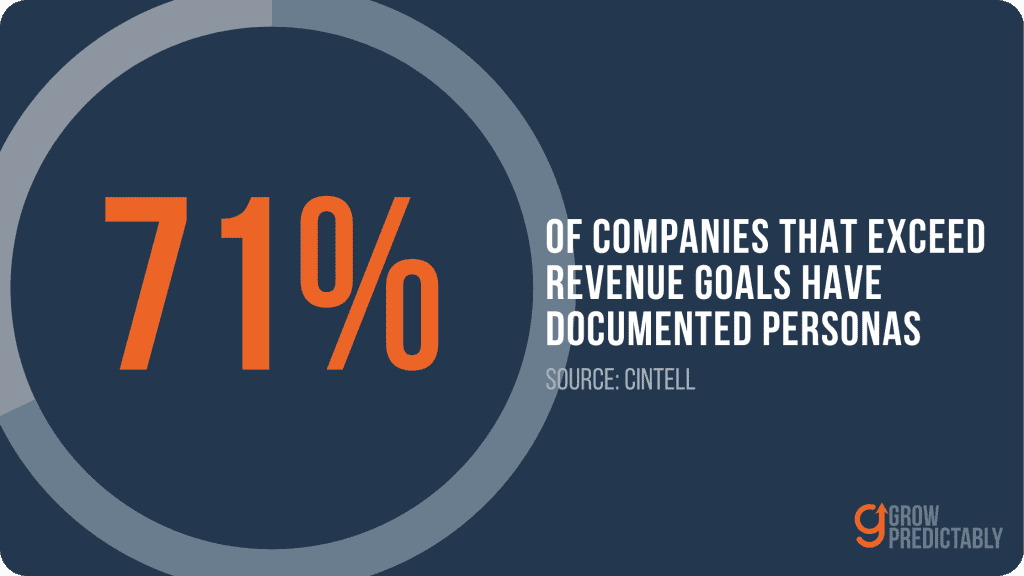
Yes, according to persona research from Cintell. Companies that build, use, and consistently maintain documented customer personas are measurably more likely to exceed their lead and revenue goals. Companies that skip the exercise, or let it go stale, are not.
Cintell’s 2016 Benchmark Study On Understanding B2B Buyers found that 71% of companies exceeding their revenue goals had documented personas. Only 26% of companies that missed their goals did. The study also found that 82% of companies exceeding their goals had conducted qualitative research to build those personas, compared with 70% of companies that missed goals doing none at all.
The research doesn’t credit the worksheet itself. It credits the discipline of building the profile from real qualitative research and keeping it current. That’s the same discipline the Before and After mapping forces.
How do you turn a finished avatar into a targeting decision?
You turn a finished avatar into a targeting decision by testing it against three specific questions. Which channel deserves priority. Which objection should lead in your ad copy. Which targeting parameters belong in the ad platform. If the avatar doesn’t change your answer to at least one of these, it isn’t finished. It’s documentation.
On the agency accounts I’ve watched succeed, the avatar’s Good vs Evil and purchase-driver fields show up directly in the ad copy and the channel plan. Not just in a strategy deck nobody reopens.
Practically, that means the average day element points you toward channel. Where is this person actually spending attention during that day. The good vs evil element points you toward the objection to lead with. The purchase-driver field points you toward the exact targeting parameters worth setting on the platform.
Run the finished avatar through those three questions before you spend another dollar against it.
Frequently Asked Questions
What does avatar mean in marketing?
In marketing, an avatar is a fictional but evidence-based representation of a business’s one ideal customer. It combines demographics, frustrations, and purchase drivers into a single named profile used to guide targeting and messaging, rather than describing a broad audience segment.
What is an example of a customer avatar?
A customer avatar example combines demographics, goals, objections, and a specific before and after transformation for one archetypal buyer. For a B2B digital marketing agency, that might be a marketing director frustrated by generic campaigns who becomes confident once they have a transparent, high-ROI partner.
How do you find your customer avatar?
Mine existing customer data and interviews with your best current customers rather than guessing demographics from assumption. Look at who buys fastest, refers others, and rarely negotiates on price, then build the avatar’s before and after state from what you learn.
Is a customer avatar the same as an ideal customer profile?
They’re related but distinct. An ideal customer profile is often the company-level filter deciding which companies to target. The avatar is the person-level profile of who inside that company you’re actually writing to.
How often should you update a customer avatar?
Revisit your customer avatar whenever a targeting or messaging decision stops landing. At minimum, update it whenever your product, pricing, or ideal client segment shifts, since a stale avatar quietly misdirects every campaign built on top of it.
Ready to build an avatar that actually earns its keep?
The shift that matters isn’t a better worksheet format. It’s treating the avatar as a living input to your next campaign decision, not a one-time onboarding deliverable.
Fill out the Customer Avatar Worksheet and map your own Before and After before your next campaign goes live.
Want to go deeper? Read B2B Customer Journey: Stages, Map, and the Stall Point or explore SEO for B2B.
About the author
Brian helps B2B founders install marketing + automation engines powered by Co-Thinking with AI. With 15+ years building predictable revenue systems, he's worked with SaaS, agency, and service businesses on 90-day done-with-you growth accelerators.
Ready to see your real growth gap?
Two minutes in the Growth Gap Scan and you walk away knowing the one thing capping your pipeline. Free, no obligation.