Why Treat AI as a Co-Thinker, Not a Replacement in B2B SaaS

Founder, Grow Predictably · 15+ yrs building B2B revenue systems
TL;DR: AI is an amplifier, not an autopilot. When you bring it into the full context of the problem you are solving, it surfaces options and sharpens judgment. When you hand it a task and walk away, it produces generic output that anyone could have generated.
Key Takeaways
- Viewing AI as a co-thinker rather than a replacement keeps strategic judgment where it belongs (with you) while AI handles synthesis, first drafts, and pattern-matching at speed.
- Common fears about AI replacing human roles in B2B SaaS center on job loss and “AI guilt,” but the more common real-world outcome is augmentation: teams that use AI well get faster, more productive, and strategically sharper.
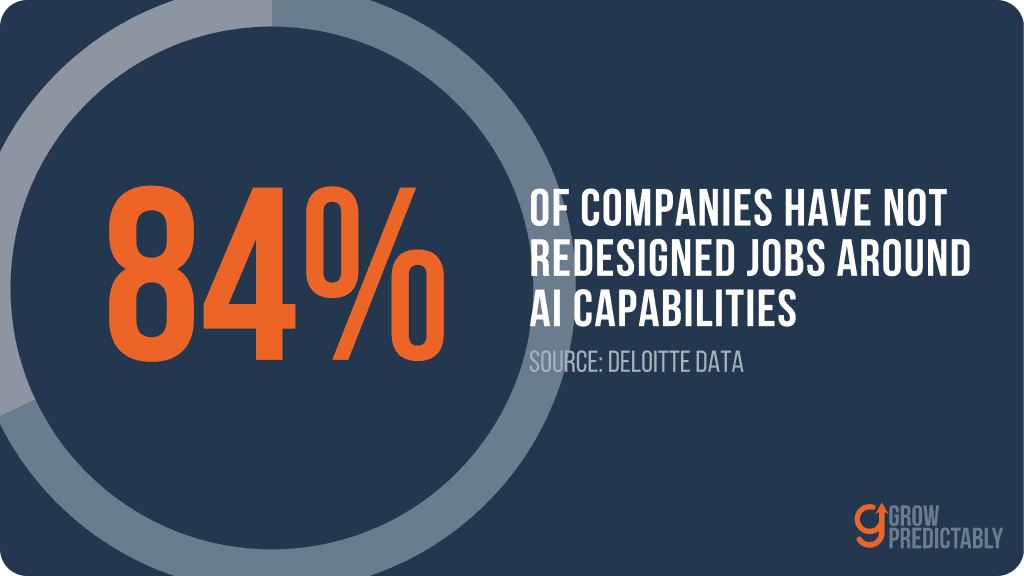
- Deloitte found that 84% of companies have not redesigned jobs around AI. Most are building AI fluency, not replacing roles, which tells you where the value actually sits.
- The ethical line on co-thinking with AI runs through transparency, accountability, and bias awareness. Human oversight is what keeps AI-driven suggestions from turning into AI-driven mistakes.
- To use AI without dulling your own thinking, give it full context, treat its output as a first draft, and keep the final call yourself. AI suggests. You decide.
Most B2B SaaS founders I talk to are quietly running the same test: they paste a task into ChatGPT or Claude and wait to see if it can do their job. When it hands back something almost usable, they feel the twinge, part relief and part dread, and start hedging their AI use like a guilty secret instead of putting it to work.
If you are the founder or marketing leader who suspects AI should be doing more but can’t shake the feeling that leaning on it is cheating, this is for you. The shift that fixes it isn’t a sharper prompt. It’s treating AI as a co-thinker, not a replacement, and pulling it into the full context of the problem instead of tossing it a task and walking away.
Surprisingly, many B2B SaaS founders still view AI with skepticism, fearing it may take over human roles. But McKinsey’s 2023 State of AI report found that integrating AI effectively sharpens decision-making and lifts productivity across business functions.
Why treat AI as a co-thinker? It beats viewing AI as a replacement
Co-thinking with AI beats viewing it as a replacement for one simple reason: it augments your strategic judgment instead of trying to substitute for it. Treated this way, AI does three things well:
- Surfaces connections you might not catch on your own
- Expands the range of options you can explore before committing to a direction
- Speeds up your thinking without taking over the parts of the job that require human judgment
According to Deloitte’s State of AI in the Enterprise report, 84% of companies have not redesigned jobs around AI capabilities, and most are focused on building AI fluency rather than replacing roles. If anything, that tells me AI isn’t here to replace founders and marketers. It’s here to make us better at the job we already have.
I see a lot of B2B SaaS founders treat AI like a vending machine: put in a prompt, get out a deliverable. That mindset misses the point entirely. AI’s real power doesn’t come from automation alone. It comes from collaboration.
Think about how you’d actually work with a great strategist you just hired. You wouldn’t hand them a task list and walk away. You’d sit down together. You’d share context, explain the messy parts, the friction, the tradeoffs, and what you’re actually hoping to build. That conversation is where the value gets created, and AI works the same way.
When I shifted from treating AI as a tool to treating it as a co-thinker, everything changed. I stopped asking it to do things for me and started asking it to think with me. I’d feed it the problem in full, not just the surface-level ask, but the underlying tension, the strategic goal, and the constraints I was facing. The output stopped being merely usable. It started being insightful.
This isn’t about replacing human judgment. It’s about augmenting it. AI is good at processing patterns quickly and surfacing connections we might miss. What it can’t replace is the strategic intuition that comes from lived experience. That part is still your job.
AI’s job is to help you think more clearly, move faster, and explore possibilities you wouldn’t have considered alone. That’s the foundational mindset behind the AI-era marketing leader’s full AI marketing strategy: decide where AI runs, where it assists, and where it stays out, then hold the line.
How I shifted my mindset to AI-first collaboration
I experienced this shift firsthand when I built an event planning app in seven days using no-code tools and AI. A friend of mine was working on a similar project but kept hitting a wall. His AI output was rigid, unusable, and frustrating.
He was using structured prompts, following best practices, doing everything “right.” But something was missing. Then it hit me: intention, not instruction.
I sat down with him and recorded a conversation. We talked through the full context: what he was trying to build, why it mattered, where he was stuck, what success looked like. I transcribed that conversation and fed it to GPT.
The output was completely different. It wasn’t just better code. It was smarter code. It reflected the nuance of what he actually needed, not just what he’d asked for.
That moment was a mental revolution for me. I realized AI isn’t a task rabbit. It’s a creative partner. And like any good partner, it performs better when you bring it into the full picture, the messy, human parts included.
Here’s how I approach AI collaboration now:
- I share context, not just commands. I explain the why behind the what. I describe the tension I’m navigating, the audience I’m serving, the outcome I’m aiming for.
- I iterate, not dictate. I treat AI output as a first draft, not a final answer. I push back, refine, and co-create until we land on something that actually works.
- I stay critical. I don’t outsource my judgment. AI can suggest. I decide.
This approach unlocks creativity in ways that rigid prompting never could. When you treat AI as a collaborator, you’re not just getting faster output. You’re getting better thinking.
You’re exploring angles you wouldn’t have considered. You’re building products that reflect strategic depth, not just surface-level execution.
And in B2B SaaS, where differentiation is everything, that depth separates the companies that scale from the ones that stall.
Why will AI not replace people in B2B SaaS?
AI won’t replace people in B2B SaaS because it can’t think like one. Even industry leaders are clear-eyed about where AI hits its limits, especially when it comes to fully automating the parts of a business that matter most.
Fortune reported on comments Nvidia CEO Jensen Huang made at the company’s October 2024 AI Summit, where he addressed the idea of AI fully replacing human functions head-on:
As we speak, AI has no possibility of doing what we do. In no job can they do all of it.
Jensen Huang, CEO, Nvidia
I’ve watched founders get seduced by AI autonomy, the idea that you can hand off entire functions to algorithms and walk away. But here’s what I’ve learned after building AI tools and advising B2B SaaS leaders: AI is a brilliant collaborator, but a terrible replacement for human judgment.
The limitations of AI autonomy
AI lacks the three things that make B2B SaaS businesses actually work: genuine judgment, intuition, and contextual understanding. Here’s what that looks like in practice:
- AI can generate a customer email, but it can’t sense when that customer is about to churn based on a tone shift in a Slack thread
- AI can summarize a sales call, but it can’t read the room when a prospect goes quiet after you mention pricing
- AI can draft a product roadmap, but it can’t feel the tension between what your team wants to build and what your market actually needs
I saw this firsthand when a friend tried to use AI to build a feature. He fed it structured prompts, detailed, logical, airtight. The output was rigid and unusable. The missing ingredient wasn’t better instructions. It was intention.
That tracks with the broader pattern: most companies are adding AI on top of human roles rather than replacing them, which raises the premium on the uniquely human strengths AI can’t supply: adaptability and judgment. AI doesn’t understand why you’re solving a problem or who you’re solving it for unless you treat it like a thinking partner, not a task rabbit.
Sam Altman makes this exact point in The Gentle Singularity: AI systems amplify the output of the people using them. And amplifiers only work when there’s something worth amplifying.
What’s the advantage of pairing humans and AI?
The people who win with AI aren’t the ones who use it to replace themselves. They’re the ones who use it to think better.
I call this co-thinking with AI: treating it as a collaborator that helps you explore ideas, challenge assumptions, and iterate faster.
When I built an event planning app in seven days, I didn’t just prompt AI for code. I fed it the full context: my goals, my frustrations, the constraints I was working under. I transcribed conversations.
I asked it to critique my logic. I used it to sharpen my thinking, not replace it. The result was smarter decisions, more creative solutions, and faster execution.
Here’s the pattern I keep seeing: people who use AI as a co-thinker outperform those who treat it as a replacement.
- They don’t abdicate judgment; they augment it
- They don’t hand off strategy; they stress-test it
- They don’t let AI make decisions; they use it to surface better options
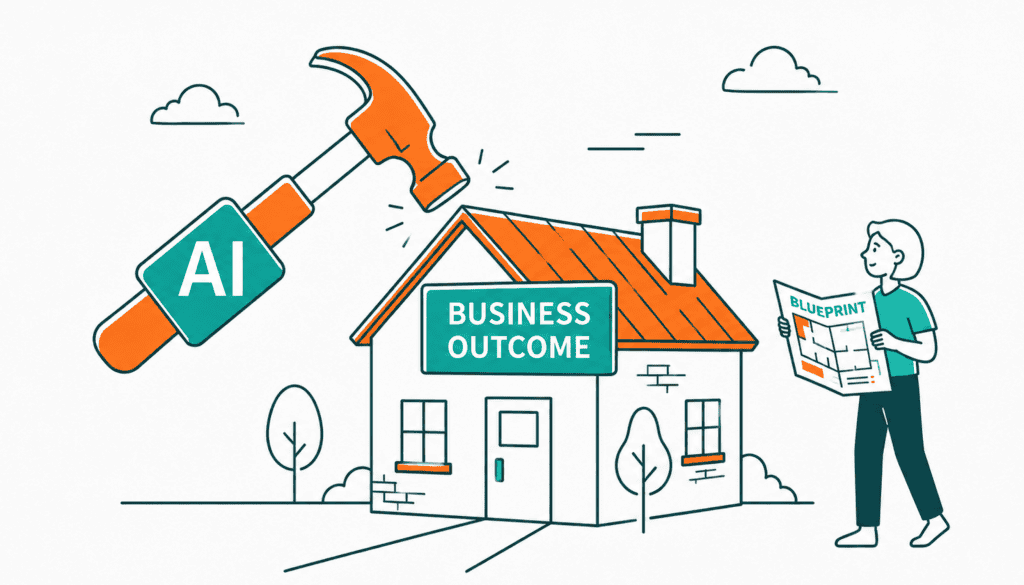
This isn’t about being anti-AI. It’s about being pro-human. AI is your hammer. The business outcome is the house. And no hammer, no matter how smart, can build a house without someone who knows what they’re building and why.
The future of B2B SaaS isn’t AI or people. It’s AI and people, working together in ways that make both more effective. That’s the shift that separates leaders who scale from those who get left behind.
What are the common fears about AI replacing human roles in B2B SaaS?
The common fears are job loss, role redundancy, and personal obsolescence — fears that lead to what I call “AI guilt” and resistance. But these worries usually come from misunderstanding what AI actually does.
In B2B SaaS, the more common outcome is augmentation: teams that use AI well get faster, more productive, and strategically sharper.
The fear is real and common. You or your teammates may feel a nagging guilt when AI drafts something in 30 seconds that used to take an hour. That whisper, “Am I cheating? Am I becoming obsolete?”, is AI guilt, and it shows up across roles:
- Writers worry ChatGPT will replace them
- Developers worry automation will erase their expertise
- Product people worry an algorithm will take over their strategic thinking
Fear of job loss and AI guilt
The dominant narrative around AI is that it’s coming for our jobs. Here’s what I’ve observed: this fear creates resistance, not adoption. When people believe AI is a threat, they either avoid it entirely or use it half-heartedly, never unlocking its real value. They treat it like a guilty secret instead of a legitimate tool.
I experienced this firsthand when I started using AI to help with strategic planning. I’d generate frameworks, refine positioning, draft messaging, and then I’d feel weird about it. Like I was cutting corners. Like I wasn’t doing “real work.” That guilt was a signal, not that I was doing something wrong, but that I was holding onto an outdated mental model.
Misconceptions about AI’s capabilities
Most of the fear around AI comes from a fundamental misunderstanding of what it actually does, and what it doesn’t. AI doesn’t think. It doesn’t have goals, ambitions, or creative vision. It processes patterns and generates outputs based on inputs. It’s incredibly good at synthesis, but it’s terrible at original thought.
When people panic about AI “replacing” them, they’re usually imagining a future where AI does everything, autonomously, strategically, creatively. That’s not how AI works, not now and not in the near future.
What AI can do well:
- Handle the heavy lifting of the first draft
- Synthesize data and recognize patterns
- Take on the tedious parts of thinking that slow you down
What AI can’t do:
- Bring intention, context, and judgment
- Understand your customer’s unspoken frustrations
- Navigate the tradeoffs between speed and quality in your specific business
- Decide what actually matters
That’s your job. And it’s not going anywhere.
Why these fears miss the point
The breakthrough for me came when I reframed how I thought about AI. I stopped seeing it as a replacement and started seeing it as a co-thinker. AI isn’t cheating. It’s collaboration.
When you use AI to draft a strategy doc, you’re not outsourcing your thinking. You’re accelerating it. You’re getting to the second draft faster so you can spend more time on the parts that actually matter: the nuance, the judgment, the strategic decisions that only you can make.
I started treating AI like a creative partner. I’d feed it the messy, human parts, the friction, the hopes, the tradeoffs, and ask it to help me think through them. Not to do the thinking for me, but to help me see patterns I might’ve missed, challenge assumptions I hadn’t questioned, and generate options I hadn’t considered. This mindset shift unlocked everything.
My teams stopped feeling guilty about using AI and started using it constructively. We stopped worrying about being replaced and started focusing on being augmented. We’re faster, sharper, more strategic, not because AI did our jobs, but because it freed us to focus on what actually creates value.
A Deloitte report found that 74% of organizations are hoping to grow revenue through their AI initiatives, compared to just 20% already doing so.
The fear of AI replacing human roles is understandable. But it misses the point. AI doesn’t replace insight. It amplifies it. And the sooner you embrace that, the sooner you’ll stop feeling guilty and start feeling unstoppable.
How do I use AI as a co-thinker to unlock B2B SaaS innovation?
Use AI as a co-thinker by running intentional collaboration cycles, giving it full context, asking for broad and diverse ideas, iterating together, and validating outputs with real users. Do that repeatedly, and you’ll unlock B2B SaaS innovation faster and more reliably than by treating AI as a one-off generator.
Here’s my process:
- Frame the problem with full context. I provide AI with the background, goals, constraints, and human factors involved.
- Use AI to brainstorm broadly. I ask for diverse perspectives, alternative solutions, and challenge assumptions.
- Iterate collaboratively. I review AI’s suggestions, push back, refine, and feed updated context back for deeper insights.
- Validate with real-world feedback. AI’s ideas are tested with customers and teams before committing.
By treating AI as a thinking partner, I unlock creative solutions faster and avoid the trap of generic outputs. This is the same operating logic behind a sound AI marketing strategy: the diagnosis of where AI fits comes first, and the tools come last.
What are the ethical implications of treating AI as a co-thinker?
Using AI as a co-thinker comes with ethical responsibilities that I take seriously:
- Transparency: Being clear with teams and customers about when and how AI influences decisions builds trust.
- Accountability: Human oversight ensures AI-generated suggestions don’t lead to biased or harmful outcomes.
- Bias awareness: AI systems can perpetuate biases in training data. I actively question outputs and seek diverse viewpoints.
- Privacy: Protecting sensitive data when using AI tools is non-negotiable.
- Fairness: Ensuring AI augmentation doesn’t disadvantage any group or individual.
I follow guidelines similar to those in IEEE’s Ethically Aligned Design, which emphasizes that AI should augment human values and not replace human responsibility.
Why will AI agents replace B2B SaaS?
AI agents won’t replace B2B SaaS entirely, but they’ll replace the parts that feel like work nobody wants to do.
Understanding AI agents’ autonomous efficiency
Think of AI agents as ghostwriters for your software stack. They handle the repetitive, predictable tasks that drain your team’s energy: data entry, routine customer queries, report generation, workflow orchestration. They operate autonomously, learning patterns and executing without constant supervision.
This shift is already visible across support and operations teams:
- The manual work that used to eat hours a week, syncing customer data between platforms and generating routine reports, increasingly runs in the background.
- On tier-one support, AI agents now resolve a large share of inquiries before a human ever sees them. Intercom reports its Fin agent can resolve up to 65% of support conversations end-to-end, depending on how well the knowledge base is documented.
The efficiency is real. AI agents don’t get tired. They don’t forget. They scale without adding headcount. They’re exceptionally good at the tasks humans find tedious.
But here’s what matters: they’re not replacing the software itself. They’re replacing the friction inside it, the manual steps, the decision load, the parts where users think, “Why do I still have to do this myself?”
Why this does not mean human replacement
Here’s where people get nervous, and where I push back hard. AI agents are tools, powerful ones, but they lack the one thing that makes B2B SaaS valuable in the first place: strategic judgment.
When I built an event planning app in seven days using AI, people asked if that meant developers were obsolete. Not even close. The AI didn’t decide what to build. It didn’t understand my users’ pain points. It didn’t make the strategic calls about features, positioning, or go-to-market. I did. The AI was my collaborator, a ghostwriter executing my vision. I gave it context, intention, and direction. It gave me speed and scale. That’s the relationship I see working.
In B2B SaaS, the same principle applies. AI agents can automate workflows, but there’s a clear line they can’t cross:
- They can’t define your product roadmap
- They can’t decide which customer segment to prioritize
- They can’t navigate the messy, human tradeoffs that define your business
Humans steer. AI executes.
I’ve seen founders treat AI like a magic bullet: feed it a prompt, expect genius. That’s not how it works. The best outcomes happen when you treat AI as a co-thinker. You bring the strategic context. You ask the hard questions. You iterate together. That’s not a replacement. That’s enablement.
AI agents will replace the leaky-bucket tasks, the ones that waste time and create friction. But the strategic thinking, the creative problem-solving, the ability to read between the lines of what customers actually need. That’s still yours.
How do you use AI without dulling your own thinking?
AI should amplify your judgment, not substitute for it. I’ve seen too many founders outsource their thinking to AI and end up with generic strategies that sound smart but lack soul.
The real power of AI isn’t in letting it make decisions for you. It’s in using it to surface insights you’d miss on your own, then applying your judgment to what actually matters.
Recognizing AI’s limitations and biases
AI doesn’t understand your business the way you do. It operates on patterns, not principles, which means there are things it simply can’t do:
- Read the room in a sales call
- Sense when a customer is about to churn
- Know which feature will delight your users versus which one just checks a box
I learned this the hard way when a friend came to me frustrated with AI-generated code. He’d used perfectly structured prompts, followed all the “best practices,” but the output was rigid and unusable. The problem wasn’t his prompting technique. It was that he treated AI like a vending machine: insert prompt, receive solution.
When I helped him capture the full context of what he was trying to build, his goals, his frustrations, the constraints he was working under, the output changed completely. The lesson stuck: AI rewards intention, not instruction.
If you take one thing from this piece, make it this. AI is a co-thinker that makes a strong operator stronger, and it’s dead weight for anyone hoping it will think for them. The leaders who win the AI era are the ones who stay in the chair: they bring the context, hold the judgment, and let AI do the heavy lifting around the edges.
Not sure which stage of your funnel is the binding constraint AI should help you attack first? That’s the diagnosis everything else depends on, and it’s the wrong place to guess. Start with a free Growth Assessment, which names the one stage capping your growth so you point AI where it will actually move the number.
Frequently Asked Questions About Co-Thinking With AI
How is AI changing the way we think?
AI shifts cognitive work away from raw recall and brute-force analysis toward pattern recognition, fast synthesis, and hypothesis testing. Teams spend less time hunting facts and more time evaluating options and choosing. It also pushes a collaboration mindset: you treat AI as a co-thinker that expands creative bandwidth, with human oversight and attribution, not a final authority.
What is the 30% rule in AI?
The 30% rule is an informal heuristic, not a regulation. The idea is to keep at least 30% human involvement in tasks where accountability, creativity, or high-stakes judgment matter. In practice, that means humans validate a share of outputs or retain the final call. Treat it as a changeable safety boundary for human-in-the-loop design, not an absolute.
When do you stop collaborating with AI?
Step back when the model repeatedly hallucinates or contradicts verified data, when outputs carry ethical, legal, or compliance risk, and on high-stakes decisions until a human fully validates them. Also stop when a task needs domain-expert intuition, long-term strategy, or brand voice AI cannot reliably produce, or when cost and latency outweigh the benefit.
How can AI help managers think through problems?
AI speeds exploration, surfaces blind spots, and structures decisions. It summarizes large datasets into themes, generates scenario options with pros and cons, and turns vague ideas into testable hypotheses. Use it as a sounding board: ask it to challenge assumptions and propose counterarguments. Always verify outputs and treat its suggestions as inputs to human judgment, not final answers.
About the author
Brian helps B2B founders install marketing + automation engines powered by Co-Thinking with AI. With 15+ years building predictable revenue systems, he's worked with SaaS, agency, and service businesses on 90-day done-with-you growth accelerators.
Ready to see your real growth gap?
Two minutes in the Growth Gap Scan and you walk away knowing the one thing capping your pipeline. Free, no obligation.