AI Marketing Strategy: How to Amplify Your Team, Not Replace It

Founder, Grow Predictably · 15+ yrs building B2B revenue systems
TL;DR: An AI marketing strategy is a marketing operating system, not a tool list. It starts by diagnosing which stage of your Customer Value Journey has the binding constraint, classifying every recurring workflow into AI-led, AI-assisted, or human-only modes, and assigning a named owner with an evidence bar. Teams that skip this document end up with a subscription stack producing AI sameness. Teams that build it use AI to amplify their strategic capabilities, not replace them.
Key Takeaways
- An AI marketing strategy is an operational document that ties each workflow mode to a specific Customer Value Journey stage, not a list of generative AI tools your team happens to be paying for.
- AI amplifies where speed and volume are the binding constraint. It bolts on and produces AI slop where positioning differentiation, customer-evidence credibility, or strategic judgment is the constraint.
- AI sameness is a classification problem, not a quality problem. Fix it by adding named operator claims, specific client outcomes, and tribal vocabulary that base models can’t synthesize from public competitor content.
- A marketing operating system has four components: workflow inventory by mode, an evidence quality bar per workflow, tool-to-workflow mapping, and Customer Value Journey stage alignment. Missing any one of them turns the operating system back into a tool stack.
- Measure AI marketing ROI by stage-conversion delta and differentiation score, not productivity metrics. Presenting an AI efficiency chart to the board confirms the narrative you are trying to disprove.
An AI marketing strategy isn’t an AI tool stack. It’s a diagnostic for where AI actually amplifies your marketing team’s leverage versus where it bolts on and produces AI slop.
The leaders who navigate this transition successfully build a marketing operating system that names which workflows are AI-led, AI-assisted, and human-only, anchored to the Customer Value Journey stage each campaign targets. The leaders who get quietly replaced let their teams become editors of AI slop instead.
The gap is already visible in the data. Salesforce’s State of Marketing 2026 report found 75% of marketers have adopted AI, yet most still use it to push one-way, generic campaigns. Adoption is not the differentiator. What you do with it is.
This article is for the AI-era marketing leader caught between a CEO who watched a Sindra ad and now believes AI can replace the team, and a team quietly afraid of being laid off. The diagnostic that follows is what separates a real AI marketing strategy from an AI subscription portfolio with no owner.
What is an AI marketing strategy that actually amplifies a marketing team?
An AI marketing strategy is the operational discipline of deciding:
- Which marketing workflows does AI fully run
- Which workflows does AI accelerate
- Which workflows does AI stay out of
Each of those decisions is tied to a specific Customer Value Journey stage where the team has a binding constraint. It is not a tool list. It is not an AI investment thesis. It is a marketing operating system that integrates AI into existing workflows rather than bolting it on as a parallel layer.
The distinction matters because most teams have already bought the tools. ChatGPT, Claude, Jasper, Notion AI, Gamma, three writing assistants, two video generators, an SDR-augmentation tool the sales team paid for, and an AI dashboard nobody opens- that is a sprawling subscription stack, not a strategy.
The pressure to buy is uneven by company size. SurveyMonkey’s research found 57% of enterprise marketing teams were willing to use AI, versus only 40% at companies under 1,000 employees, which is exactly the band where most marketing leaders are leaning in without a strategy to govern it.
The strategy is the document that defines:
- Which tools are “in the loop” for each workflow
- What evidence-quality bar AI-assisted outputs must meet to ship under the brand
- Who owns the call when AI generates something that does not pass that bar
A strong AI marketing strategy starts from the marketing team’s binding constraint, not from the tools.
If the Convert stage of your Customer Value Journey is leaking, leads are coming in, calls are happening, and deals are stalling, the AI strategy starts there. If the Excite stage is your gap, deals are closing, but customers are not advocating, the AI strategy starts there.
The tools come last. The diagnosis comes first.
Where does AI amplify your marketing team, and where does it bolt on?
AI amplifies your marketing team in three places: at the parts of the workflow where speed is the constraint, at the parts where pattern-matching across volume is the constraint, and at the parts where draft quality (not strategic quality) is the constraint.
AI bolts on, and produces AI slop, at the parts where strategic judgment, customer-evidence credibility, or positioning differentiation is the actual constraint.
Wharton professor Ethan Mollick, who researches AI and work, draws the boundary plainly: “At least with the current set of AI tools, AI augments human capabilities.” Augmentation is the whole game. The strategy is knowing which parts of the workflow it augments and which it quietly degrades.
Here’s the practical version. AI is the right tool when:
- You’re scoring 100 inbound leads against an ICP definition you wrote, and you need to rank them by fit before SDR outreach.
- You’re producing first drafts of long-form content where the operator (you) will rewrite the claim density and cut the AI sameness.
- You’re personalizing email sequences across 12 segments, and the variants are mechanical, not strategic.
- You’re transcribing customer interviews and clustering the verbatim language into themes for positioning work.
AI is the wrong tool, and produces what the AIM tribe calls AI slop, when:
- You’re writing the positioning paragraph that goes in your sales deck. (The differentiation has to come from the operator’s judgment about what the buyer actually wants, not from a model trained on every competitor’s positioning paragraph.)
- You’re deciding which Customer Value Journey stage is the binding constraint this quarter. (That’s a judgment call about your specific funnel, not a generalizable pattern.)
- You’re publishing claims that include client names, outcomes, or specific numbers without verification. (Hallucinations here destroy trust.)
- You’re publishing the kind of content the audience would call out as AI-generated. (The ‘sameness’ the AIM tribe rejects is the cost of skipping operator judgment.)
The test is whether the output has to be differentiated from every other team’s AI output. If yes, AI bolts on. If the output can be one of fifty acceptable variants, AI amplifies.
How do you diagnose AI sameness in your existing campaigns?
AI sameness is the most common failure mode for teams that bought AI tools before defining a strategy. Diagnose it by reading three competitor pieces on the same topic alongside one of your team’s recent pieces.
If a buyer could not pick yours out of the lineup without seeing the byline, you have AI sameness.
Sameness is not a cosmetic problem. December 2025 data from Klaviyo and Datalily, reported by eMarketer, found only 7% of consumers trust a brand more when they notice its content is AI-generated, while 31% trust it less. Visible AI is roughly four times more likely to cost trust than build it.
Specific markers include:
- Undifferentiated “best practices” framing
- Hyperbolic adverbs in every paragraph (revolutionizing, indubitably, undeniably, unprecedented)
- No named operator claim
- No measurable outcome
- No framework lineage you can trace
The diagnostic is not “is this AI-written?”, it is “is this differentiated?” Plenty of human-written marketing content fails the same test. AI tools accelerate sameness because base models are trained on every competitor’s content, so the default AI output is the average of the field.
To produce something the field cannot produce, the operator has to add what the model cannot see:
- Specific client outcomes
- Specific framework lineage
- Specific tribal vocabulary the audience uses internally but the field does not yet
Three fixes that work in order of leverage:
- Replace generic “industry experts” references with named operators and citation-grade quotes. (Princeton/IIT Delhi GEO research found that direct quotations from named experts boost AI-citation visibility by 40%.)
- Replace “best practices” framing with diagnose-first framing: name a specific symptom, trace it to the root cause, and prescribe an intervention so the piece reads like operator notes, not a content-marketing checklist.
- Inject tribal vocabulary the audience uses but the field has not picked up yet, marketing operating system, AI-everything CEO, AI sameness, co-thinking with AI, the workflow trichotomy, so the language signals you are inside the tribe.
How does AI fit into the Customer Value Journey?
AI fits the Customer Value Journey as a stage-specific amplifier, not as a journey-wide overhaul.
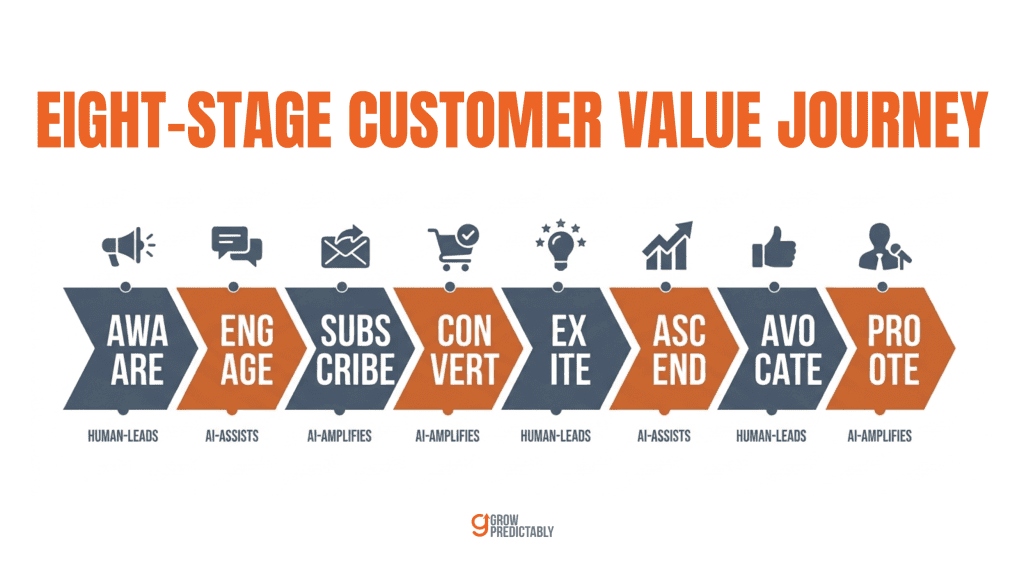
Each of the eight stages, Aware, Engage, Subscribe, Convert, Excite, Ascend, Advocate, Promote, has a different binding constraint, and AI is the right amplifier at some stages and the wrong tool at others.
A practical mapping by stage:
- Aware: Topic clustering, keyword research, content programming. AI excels at pattern recognition across competitor content and search data.
- Engage: First-draft long-form content, social distribution variants. AI accelerates volume. Operator judgment cuts AI sameness before publish.
- Subscribe: Lead magnet generation, gated-content variants, opt-in copy testing. AI runs A/B variant generation faster than the team can.
- Convert: Personalized email sequences, ICP-fit scoring, sales enablement content. AI assists. The strategic positioning that makes the conversion belongs to operator judgment.
- Excite: Onboarding sequences, customer-success content, expansion-path content. AI personalizes. The customer-evidence claims belong to operator verification.
- Ascend: Case studies, expansion playbooks, vertical-specific content. AI drafts. The operator-grade claims and named outcomes belong to humans.
- Advocate: Customer-story extraction from interviews, testimonial variant generation, advocacy-program content. AI clusters language. Humans verify and name.
- Promote: Partner-asset generation, co-marketing content, cross-promotion frameworks. AI produces variants. Humans pick which variants protect the brand.
The pattern: AI amplifies at the volume-and-variants stages, AI assists at the personalization-and-clustering stages, humans lead at the strategic-claim-and-outcome stages. Build your AI marketing strategy stage by stage with this in mind.
Don’t apply AI uniformly across the journey; that’s how you get AI slop at Excite and Ascend, the stages where claim credibility matters most.
What’s the difference between AI-led, AI-assisted, and human-only marketing workflows?
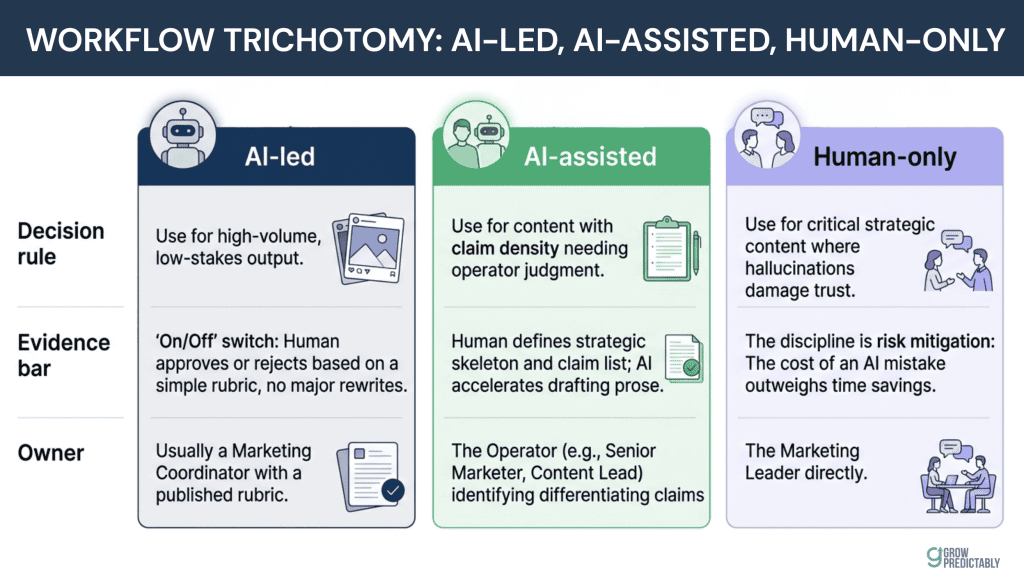
The three-mode workflow trichotomy is the spine of any real AI marketing strategy. Each mode has a different decision rule, a different evidence bar, and a different owner.
AI-led means AI generates the output and a human approves or rejects but doesn’t substantially rewrite. Use this mode when the output is high-volume and low-stakes, scheduled social posts, internal-team summaries, draft research notes, lead-list scoring. The human’s job is the on/off switch: ‘this passes the bar, ship it’ or ‘this doesn’t pass the bar, kill it’. Owner: usually a marketing coordinator with a published rubric.
AI-assisted means a human directs the work and AI accelerates execution. Use this mode for content with claim density that needs operator judgment, long-form articles, customer-success content, sales enablement assets. The human writes the strategic skeleton and the claim list. AI accelerates the prose. Owner: the operator (a senior marketer or content lead) who can name the differentiating claims.
Human-only means no AI in the loop. Use this mode for positioning paragraphs, board-level claims, customer-evidence content where named clients are involved, and any output where a hallucination would damage trust. The discipline isn’t ‘AI is bad here’, it’s ‘the cost of an AI mistake is higher than the time savings’. Owner: the marketing leader directly.
Most teams need all three modes operating in parallel. The discipline is naming which mode applies to which output type before the work starts, not deciding mid-draft.
A team without that mode discipline ends up in a fourth mode by default, AI-everywhere, no owner, no evidence bar, which produces AI slop and trains the team to not trust AI for anything.
How do you build a marketing operating system instead of just an AI tool stack?
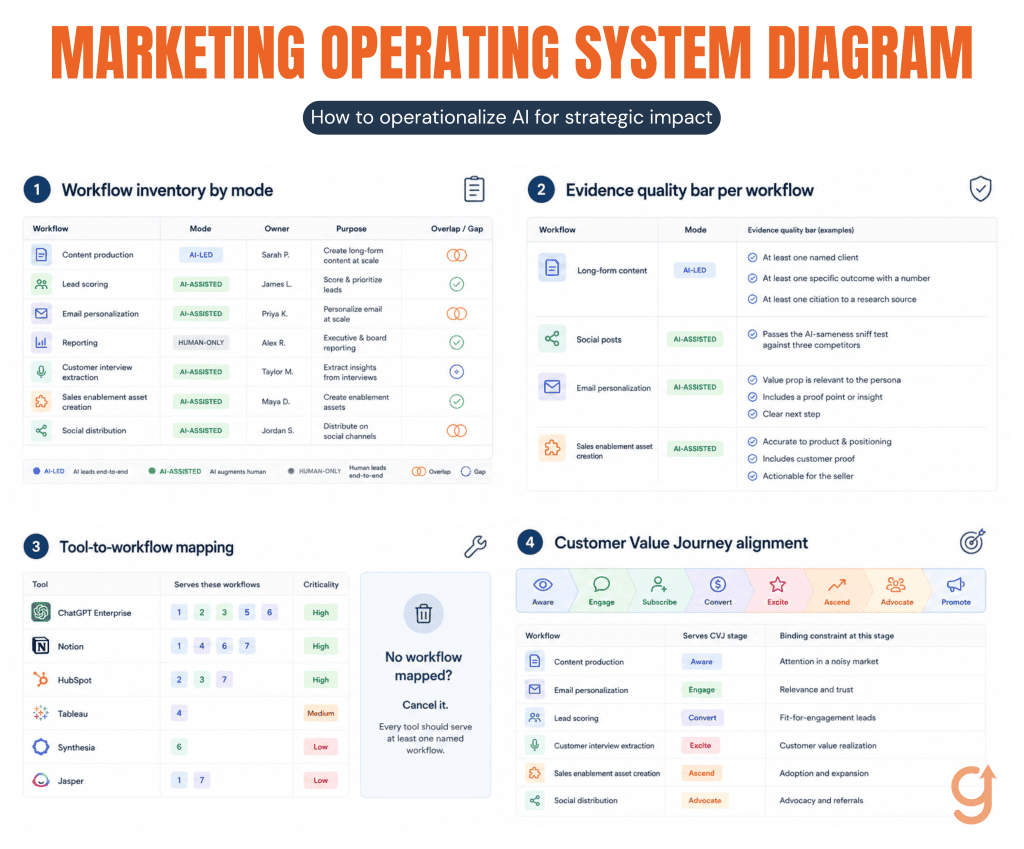
A marketing operating system is the document that names every recurring workflow your team runs, classifies each by mode (AI-led, AI-assisted, human-only), assigns an owner, sets the evidence bar, and ties the workflow to a Customer Value Journey stage.
A tool stack is just the list of subscriptions you pay for. The operating system is what makes the tool stack produce strategy instead of slop. The waste is measurable. Gartner’s martech survey found that marketers use only about a third of their stack’s capabilities, as reported by MarTech. An operating system is how you stop paying for capability you never deploy.
Four components every marketing operating system needs:
- Workflow inventory by mode. Every recurring workflow listed with its mode classification (AI-led, AI-assisted, human-only). Includes content production, lead scoring, email personalization, reporting, customer interview extraction, sales enablement asset creation, social distribution. The inventory exposes overlap (three workflows producing the same kind of content) and gaps (a customer-evidence workflow with no human-only owner).
- Evidence quality bar per workflow. For each AI-led and AI-assisted workflow, name the bar a piece of output has to clear before it ships. For long-form content, the bar might be: at least one named client, at least one specific outcome with a number, at least one citation to a research source. For social posts, the bar might be: passes the AI-sameness sniff test against three competitors. The bar is what turns mode classification into actual quality control.
- Tool-to-workflow mapping. For each tool in the stack, name which workflows it serves. If a tool doesn’t serve a named workflow, cancel it. (This is where most teams find they’re paying for two AI writing assistants and a video generator nobody uses.)
- Customer Value Journey alignment. For each workflow, name which CVJ stage it serves and what the binding constraint is at that stage. This is the part most teams skip, and it’s why their AI marketing strategy reads as ‘we use AI for content’ instead of ‘we apply AI at the Convert stage where our binding constraint is fit-for-engagement leads, not raw lead volume’.
With those four components in place, the marketing operating system becomes a quarterly review artifact rather than a one-time strategy doc.
The CMO presents it to the board to show how AI fits the team. Marketing leaders use it to onboard new hires. The team uses it to decide which mode a new piece of work belongs in.
How do you measure AI marketing ROI without confirming the ‘AI replaces marketing’ narrative?
Measuring AI marketing ROI is a positioning problem before it’s a metrics problem. Lead with productivity gains, and you confirm the board’s mental model that AI is doing the team’s job, and the team becomes the next cost-cut conversation.
Lead with strategic differentiation that AI alone can’t produce, and you reframe AI as the team’s leverage instead of the team’s replacement.
The metrics that matter, in order:
- Customer Value Journey stage-conversion delta. Pick the stage where the binding constraint sits (e.g., Convert) and measure the conversion delta before and after AI integration at that stage. The story is ‘AI lifted Convert-stage conversion from 18% to 31% by personalizing the sales-enablement assets’, not ‘AI replaced 40% of marketing tasks’.
- Differentiation under audit. Quarterly, run a blind sameness test, three competitor pieces on the same topic alongside three of your pieces, given to a senior marketing leader who doesn’t see the bylines. Measure how many of yours they correctly identify as yours. The score should improve over time, not regress as AI volume scales.
- Time-to-strategy delta. Measure the time from ‘we need a positioning narrative for X’ to ‘positioning narrative is in market’. AI compresses this if your operating system is real. It lengthens if your team is editing slop instead of writing strategy.
- Team retention and capability growth. The team that survives and grows in the AI era is the strategic team. Track team composition (more strategic roles, fewer execution-only roles) and capability acquisition (the team is acquiring AI fluency, not just consuming AI tools).
Productivity metrics belong as a footnote, not the headline. The board needs to see a marketing operating system that integrates AI. An ‘AI replaced 40% of marketing tasks’ chart pushes the conversation toward the wrong conclusion.
The AI-era marketing leaders who navigate this successfully aren’t running an AI marketing strategy. They’re running a marketing strategy that happens to integrate AI deeply at specific stages, and they can name which stages, with which evidence bar, owned by whom.
That’s the operating system. Build that, and the AI marketing strategy stops being a slide in next year’s planning deck and starts being how the team actually works.
Frequently Asked Questions About AI Marketing Strategy
Is marketing automation the same as AI marketing?
No. Marketing automation runs predefined tasks on triggers, schedule a post, send an email on a form fill, sync a CRM record. AI predicts and decides, which lead is sales-ready, which variant converts, which customer is about to churn. They are complementary, not interchangeable. Most B2B teams already run automation and need to layer AI for the decisions automation cannot make on its own.
Will AI replace marketing automation tools like HubSpot or Marketo?
No, AI augments those platforms, it does not replace them. HubSpot, Marketo, Customer.io, and ActiveCampaign handle the execution layer (send, sync, trigger). AI sits upstream as the decision layer (score, predict, segment, personalize). The pattern is AI generates a signal, a lead-fit score or churn probability, and the existing automation platform executes against it. You do not rip out automation, you connect AI to it.
When should I use AI alone, automation alone, or both?
Use automation alone when the workflow is high-volume, predictable, and needs no decision (scheduled posts, reminders, basic CRM sync). Use AI alone for a one-time or low-frequency decision you do not need to scale (a quarterly ICP refresh, a one-off cohort analysis). Use both when the workflow needs decision and execution at scale: lead scoring plus routing, churn prediction plus retention campaigns. Most modern workflows fall in the both bucket.
What is the workflow trichotomy and how does it apply to AI vs automation?
The workflow trichotomy classifies every recurring marketing workflow as AI-led (AI generates, human approves or rejects), AI-assisted (human directs, AI accelerates), or human-only (no AI, human owns end-to-end). Automation can sit inside any of the three modes because it handles the execution layer regardless of who decided what to execute. The trichotomy is the AI-side classification, automation is the execution-side scaling.
How do I avoid producing AI slop when integrating AI and automation?
Three rules. First, never put AI-led mode on outputs where claim credibility matters, case studies with named clients, positioning paragraphs, and board-level reports belong in human-only mode. Second, set an evidence quality bar for AI-assisted output before it ships, at minimum a named client, a specific outcome with a number, a citation. Third, run a quarterly blind sameness test against three competitors. If a senior marketer cannot pick yours out, the workflow needs to move from AI-led to AI-assisted.
Where to take your AI marketing strategy next
This pillar is the map. The pieces below are the territory, organized by the decision you are actually making as you build the operating system, not by topic. Start where your binding constraint is.
Frame the decision: is AI an amplifier or a replacement?
| The question you are asking | The move | Go deeper |
|---|---|---|
| Should AI replace people or work alongside them? | Treat AI as a co-thinker and govern the judgment | treating AI as a co-thinker, not a replacement |
| Where does AI actually change my strategy? | Pick the few places it compounds advantage | where AI changes B2B business strategy |
| Is this AI or just automation? | Separate the two before you buy either | when to use AI versus marketing automation |
Diagnose and plan: where does it fit, without the sprawl?
| The question you are asking | The move | Go deeper |
|---|---|---|
| How do I roll AI out without chaos? | Stage the rollout responsibly | a responsible 5-step AI rollout |
| Which tools, without adding sprawl? | Evaluate against the operating system, not the hype | evaluating AI marketing tools without adding sprawl |
| How do I know it is working? | Instrument the decisions, not vanity metrics | using AI to sharpen marketing analytics |
Apply across the funnel: where AI amplifies each function
| The question you are asking | The move | Go deeper |
|---|---|---|
| Acquire without sounding like everyone else | Differentiate the inputs, not just the volume | AI for customer acquisition without the sameness |
| Generate higher-quality leads | Aim AI at qualification, not just capture | AI for higher-quality lead generation |
| Lift retention and NRR | Use AI where the churn signals actually live | AI for retention that lifts NRR |
| Stop AI content sounding generic | Prompt from your own point of view, not the model’s | prompts that stop B2B content sounding the same |
| Repurpose without diluting | Know what repurposing AI does and does not do well | what works in AI content repurposing |
| Run B2B ads smarter | Let AI manage the campaign mechanics | AI in B2B ad campaign management |
| Use AI inside social | Strategy first, then the toolset | AI inside your social media strategy and the AI social toolset |
| Put AI on the website | Apply it where it lifts conversion | AI on your website and AI chatbots for lead capture |
Not sure which Customer Value Journey stage is your binding constraint? That is the diagnosis the whole operating system depends on, and it is the wrong place to guess.
Start with a free Growth Assessment, which names the one stage capping your growth so your AI marketing strategy starts where it will actually move the number.
About the author
Brian helps B2B founders install marketing + automation engines powered by Co-Thinking with AI. With 15+ years building predictable revenue systems, he's worked with SaaS, agency, and service businesses on 90-day done-with-you growth accelerators.
Ready to see your real growth gap?
Two minutes in the Growth Gap Scan and you walk away knowing the one thing capping your pipeline. Free, no obligation.