B2B SaaS Product Ideas for 2026: 8 That Pass the Reachable Buyer Test

Founder, Grow Predictably · 15+ yrs building B2B revenue systems
TL;DR: A B2B SaaS product idea is worth building in 2026 when a named buyer has a dated reason to act this year. You also need a way to reach that buyer. Building got cheap, so code is no longer the scarce input. The scarce input is a buyer you can name, reach, and charge for work done.
Key Takeaways
- Seat pricing is losing ground: a Gartner forecast in Deloitte’s TMT Predictions 2026 expects at least 40% of enterprise SaaS spend to shift toward usage-, agent-, or outcome-based pricing by 2030.
- CB Insights found poor product-market fit in 43% of 431 VC-backed shutdowns since 2023, while running out of capital (70%) was usually the final cause.
- G2 Research reports that 51% of B2B software buyers now start research with an AI chatbot more often than with Google.
- The Reachable Buyer Test scores an idea on five yes-or-no questions. An idea needs four yeses, and the named-buyer question must be one of them.
- Eight B2B SaaS product ideas pass the test on paper. Each has a named buyer, a dated trigger, and pricing tied to work done.
Most lists of B2B SaaS product ideas rank ideas by market size or novelty. They leave the founder to find the buyer after the beta ships.
This guide is for the technical founder choosing a first product and the product leader picking a next product line.
It gives both the Reachable Buyer Test, five questions you answer before writing code. The test borrows the single-buyer rule behind an ideal customer profile. It also borrows Decision-First Content, a method for proving buyers already decide in a category before you build.
Then it scores eight ideas and retires four popular ones.
What makes a B2B SaaS product idea worth building in 2026?
A B2B SaaS product idea is worth building in 2026 when its price can follow the work it does. Gartner forecasts, as cited in Deloitte’s TMT Predictions 2026, that by 2030 at least 40% of enterprise SaaS spend will shift toward usage-, agent-, or outcome-based pricing. Ideas priced only per seat start to fall behind.
Gartner also expects 35% of point-product SaaS tools to be replaced by AI agents or absorbed into larger agent ecosystems by 2030. A Maxio survey in the same report found that 83% of AI-native SaaS companies already offer usage-based pricing. These forecasts point to one mechanism: pricing by work done is replacing pricing by seat.
Run three filters before you shortlist anything:
- Work, not logins. The product does a countable job that an agent or person does today.
- A moving budget line. The buyer’s budget is already shifting with the move to usage and outcome pricing.
- A reachable buyer. You can get in front of the first buyers without paying for every demo.
The eight ideas below suit a team selling into department budgets. For a narrower idea, see B2B micro SaaS ideas for small teams or how solo founders pick a micro SaaS.
Why do most B2B SaaS ideas stall after the beta?
Most B2B SaaS ideas stall after the beta because the founder picked the idea for how interesting it was to build. Nobody checked whether a named buyer had a dated reason to act.
CB Insights analyzed 431 VC-backed shutdowns since 2023 and found that 70% ran out of capital.
According to CB Insights, running out of capital is the visible end, not the root problem. Poor product-market fit showed up in 43% of those shutdowns, bad timing in 29%, and unsustainable unit economics in 19%.
CB Insights does not name buyer reach. This guide reads an unreachable buyer as one common route to poor fit.
The symptom: the beta works, friendly design partners use it, and demos go well. Yet no deal closes unless the founder pushes it.
Paul Graham, co-founder of Y Combinator, set out three tests for a startup idea in an essay on finding one.
“The very best startup ideas tend to have three things in common: they’re something the founders themselves want, that they themselves can build, and that few others realize are worth doing.”
Paul Graham, co-founder of Y Combinator, in How to Get Startup Ideas
His tests check the founder and the market, not whether the buyer can be reached. That fourth check is what this guide adds.
The anti-pattern is picking from a list ranked by market size, then building because building is cheap. Market size names a destination, not the road there.
How do you score a B2B SaaS product idea with the Reachable Buyer Test?
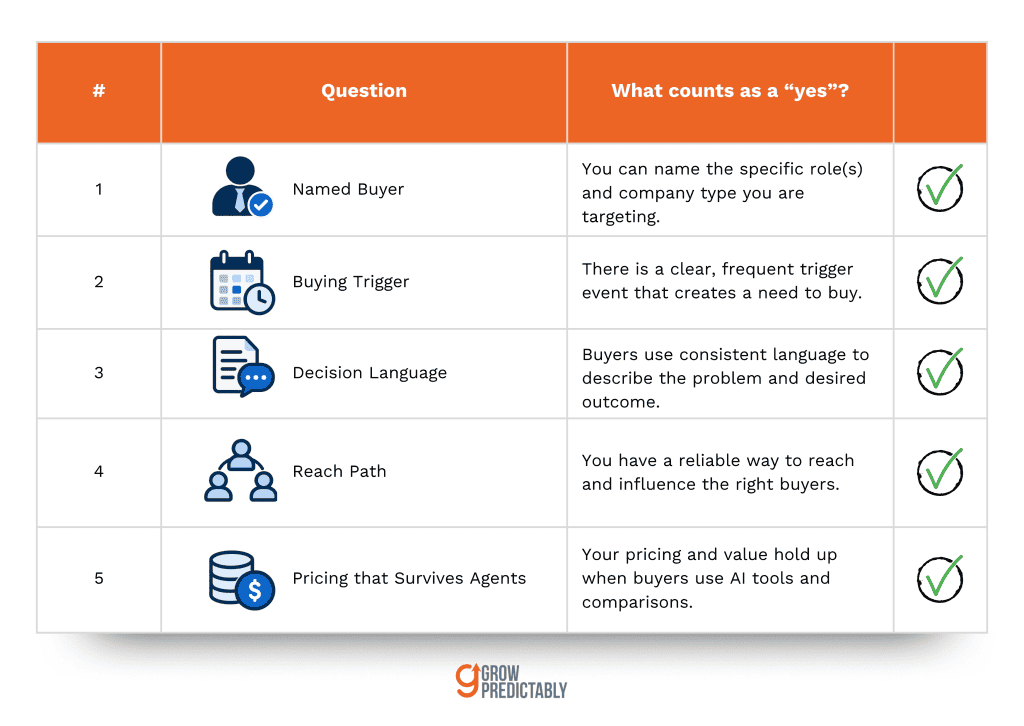
You score a B2B SaaS product idea with five yes-or-no questions, answered before you write code. The idea needs at least four yeses. Question one, a named buyer, is mandatory. The other four check for a dated trigger, existing buyer language, a reach path, and pricing that survives AI agents.
| # | Question | What counts as a yes | Yes or no | Evidence you wrote down |
|---|---|---|---|---|
| 1 | Can you name the one job title that owns the budget line this product would come out of? | A job title plus the budget line the money comes from | ||
| 2 | Is there a dated event that forces that buyer to act this year rather than someday? | An event with a date or deadline you can name, such as a renewal, a price change, a rollout, or an audit | ||
| 3 | Do buyers already search, and ask AI tools, for this category in the words of someone choosing a product? | Buyer questions you can quote in the buyer’s own words, from search suggestions, forums, reviews, or AI answers | ||
| 4 | Can you name where your first 20 buyers gather and reach them without paying for ads? | A named community, list, or event, plus how you will book your first 20 conversations there | ||
| 5 | Can the price follow work done or results delivered instead of the number of people logging in? | A unit of work you can count, such as a resolved ticket, an invoice exception, or a completed questionnaire |
Kill rule: drop the idea if question one is no, or if fewer than four answers are yes. Write the evidence next to each yes. A yes with no written evidence counts as a no.
Questions one and four come from the single-buyer discipline behind an ideal customer profile: name the one kind of company and buyer you build for. Naming one buyer widens appeal, because a product built for everyone speaks clearly to no one.
Question three comes from Decision-First Content, which proves buyers already decide in a category before you build.
Question five tracks where B2B SaaS pricing is moving. Kyle Poyar writes the Growth Unhinged newsletter and published the State of B2B Monetization in 2026 report. He wrote: “The general trend is moving away from charging for access to software (seats) and toward a model of charging for the work delivered by a combination of software and AI agents (usage, outcomes).” An idea that can only charge per seat swims against that trend.
A hypothetical run, not a real case. A founder wants to build a tool that turns support tickets into an always-current knowledge base for AI agents.
Question one: yes. The head of support owns the quality of the agent’s answers.
Question two: yes only if the founder can name dated agent rollouts at target accounts that now produce wrong answers.
Question three: yes only if the founder can quote buyers asking how to stop an agent from giving wrong answers.
Question four: yes only if the founder can name the community or event where these buyers gather.
Question five: yes. Pricing can follow resolved tickets instead of seats.
That is two firm yeses and three conditional ones. The idea clears the bar only once that evidence is written down.
The failure case. A founder wants to build a general project management tool for marketing teams. Question one fails, because a marketing ops lead, a creative director, or the current tool’s owner could each be the buyer.
The reshape names one trigger and one title: teams leaving a tool that just raised its prices, with the marketing ops lead owning that move. The narrow version can pass. The broad one cannot.
Which B2B SaaS product ideas pass the test in 2026?
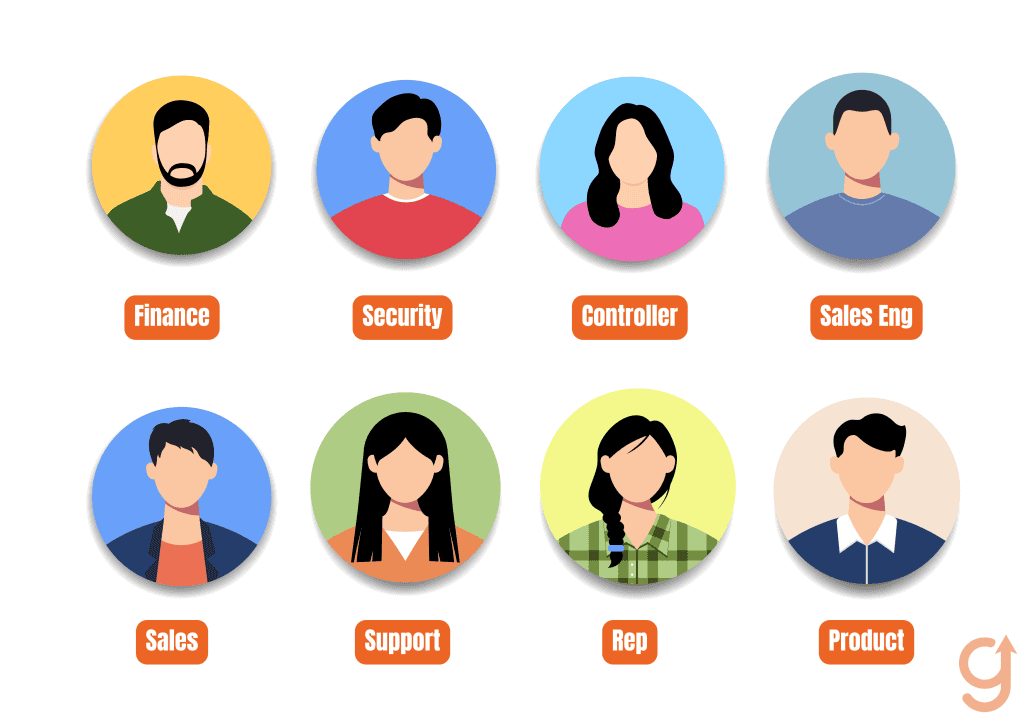
Eight B2B SaaS product ideas clear four of the five questions on paper. Each has a named buyer, a dated trigger, a place to look for first buyers, and pricing tied to work done. Question three, and proof that the reach path converts, still need the founder’s own evidence. Each idea below names where to reach buyers and what to prove first.
| Idea | Named buyer | Buying trigger | Pricing shape |
|---|---|---|---|
| Usage and outcome billing for B2B SaaS companies moving off seats | VP Finance or head of revenue operations | The shift toward usage and outcome pricing | Priced on billing volume or revenue processed |
| Permissions and audit trails for AI agents in regulated mid-market companies | Head of security or compliance | A new or expanded AI agent rollout that needs an audit trail | Priced per agent governed or per audit |
| Per-resolution exception handling for one back-office workflow, such as invoice exceptions in accounts payable | Controller | A finance team adopting an AP agent that still kicks exceptions to a human | Priced per exception resolved |
| Security questionnaire and vendor-review response automation for B2B SaaS sellers | Security lead or sales engineering lead | Enterprise deal cycles that stall on vendor security review | Priced per questionnaire or per deal supported |
| Buying-group deal rooms for the internal champion | Head of sales | A buying committee that stalls a deal | Priced per active deal room |
| Knowledge cleanup and governance for company AI agents | Head of support or operations | Agents giving wrong answers from stale source content | Priced per source cleaned or per agent served |
| Consumption forecasting and renewal-risk alerts for usage-priced contracts | Customer success leader or CFO | A book of business that moved to usage pricing and now swings monthly | Priced per account monitored |
| Pricing experiment and packaging analytics for usage or outcome pricing | Head of product or pricing | A planned move off seat pricing with no way to test the new price | Priced per experiment or per pricing model tested |
Usage and outcome billing. The infrastructure layer is crowded. Stripe completed its acquisition of Metronome on January 14, 2026, to orchestrate usage billing, and Orb competes as an independent vendor. Room remains in reporting and forecasting built on top of those platforms.
- Reach: finance and RevOps communities.
- Prove first: finance leaders describing what their billing system cannot tell them after a pricing change.
Agent permissions and audit trails. No incumbent is named here, so map who is building first.
- Reach: security and compliance communities.
- Prove first: a compliance lead who can name an upcoming audit that will ask what their AI agents did.
Per-resolution exception handling. Stampli and Tipalti already serve accounts payable automation broadly. The opening is narrower, in exception handling rather than AP automation as a whole.
- Reach: accounts payable and finance-ops forums.
- Prove first: a controller who can show the exceptions their team still clears by hand, and how they count them.
Security questionnaire automation. This category is crowded. Drata agreed to acquire SafeBase on February 11, 2025, to pair a trust center with AI-driven questionnaire answering.
- Reach: sales engineering and security communities.
- Prove first: a sales engineering lead who can point to a deal that waited on a security review.
Buying-group deal rooms. Trumpet, Aligned, GetAccept, and DealHub appear in a digital sales room comparison published by Dock, another vendor here. A new entrant needs an industry this group has not claimed.
- Reach: sales-ops and revenue communities.
- Prove first: a head of sales who can name where committee deals stall.
Knowledge cleanup for AI agents. Competitors may already exist inside broader support platforms, so map them before building.
- Reach: support-ops and customer-experience communities.
- Prove first: a head of support who can show wrong agent answers traced back to stale source content.
Consumption forecasting and renewal risk. Billing and customer success vendors may already cover part of this, so check before you commit.
- Reach: customer success operations communities.
- Prove first: a customer success leader on usage pricing who cannot yet forecast next quarter’s consumption.
Pricing experiments and packaging analytics. No incumbent is confirmed, so treat the gap as unverified.
- Reach: pricing-strategy and product-ops communities.
- Prove first: a head of product with a planned move off seat pricing and no way to test the new price before launch.
How do you check whether B2B SaaS buyers already ask AI for your category?
You check by writing five buyer questions, running them in the AI tools buyers use, and reading who gets named.
According to G2 Research’s March 2026 survey of 1,076 B2B software buyers and decision-makers, 51% now start research with an AI chatbot more often than with Google.
Fill in these five patterns with your buyer’s job, title, and company type:
- What is the best way to [job] for a [company type]?
- How do [buyer title]s at [company type] handle [problem]?
- What tools help with [problem] after [trigger event]?
- Is it worth buying software for [job], or should we build it ourselves?
- What should a [buyer title] look for in a [category] tool?
Run each question in ChatGPT, Perplexity, and Google AI Mode. For each answer, note the vendors named, what it gets wrong, and the sources it shows.
Three readings follow. If the same vendors appear across tools, the category is crowded, and buyers already hear those names. If the answers stay generic with no vendor named, buyers are asking, but no one owns the answer yet. If the tools cannot answer at all, nobody is deciding in this category yet. You would be creating demand, which is slower and costs more.
Which popular B2B SaaS ideas fail the Reachable Buyer Test?
Several once-popular B2B SaaS ideas fail the test outright, and each fails on a specific question rather than on market size. A horizontal CRM fails question one. The buyer could be sales ops, the VP of sales, or IT, and established CRM vendors such as Salesforce and HubSpot are already in the market.
A general project management tool fails question one the same way. No single title owns the decision, and Asana and Monday.com are established incumbents.
Generic AI writing tools fail question three. General assistants such as ChatGPT already do the basic job, so a founder must prove buyers still choose a separate writing tool. Per-seat writing tools also sit on the pricing model the Gartner forecast says is losing ground.
NFT marketplaces for B2B use fail question two. No dated trigger forces a B2B buyer to adopt one this year. Without a trigger, the idea sits on a shelf, however large the market once looked.
These four ideas anchored the previous version of this list. None of them clear today’s bar.
Which B2B SaaS idea will you score first?
Score your own best idea against the five questions before anyone else’s. Fill in the table, write the evidence next to each yes, and apply the kill rule.
If you already have customers, the same discipline applies to finding the one constraint capping growth in your current business before you add a product.
Take the Growth Gap Scan to find that constraint before you spend a year building something new.
Want to go deeper? Read how to test whether your sales motion repeats without the founder, or what product-market fit looks like in B2B SaaS.
Frequently Asked Questions
What are good B2B SaaS product ideas in 2026?
A good B2B SaaS idea in 2026 ties to the shift from seat pricing toward usage and outcome pricing, and to companies putting AI agents to work. Examples include usage and outcome billing for companies moving off seats, permissions and audit trails for AI agents in regulated companies, and per-resolution exception handling for back-office workflows. The idea needs a named buyer with a dated reason to buy this year.
Is B2B SaaS still a good business to start in 2026?
Yes, for products whose price can follow the work done rather than the number of seats. Gartner’s forecast, cited in Deloitte’s TMT Predictions 2026, expects at least 40% of enterprise SaaS spend to shift toward usage-, agent-, or outcome-based pricing by 2030. Seat-priced tools face pressure under that shift, while products billed on work done or results delivered gain ground.
How do you validate a B2B SaaS idea before you build it?
Score the idea against the Reachable Buyer Test: name the buyer, the dated trigger, buyer search language, a reach path, and pricing tied to work done. The idea needs four yeses, and the named-buyer question is mandatory. Then book 20 buyer conversations through the named reach path before writing code. An idea that cannot produce those conversations fails before any code is written.
How do AI agents change which B2B SaaS ideas are worth building?
AI agents make building cheaper and threaten products priced per seat. Gartner’s forecast, cited in Deloitte’s TMT Predictions 2026, expects 35% of point-product SaaS tools to be replaced by AI agents or absorbed into larger agent ecosystems by 2030. Ideas that price on resolved work, or that govern what agents do inside a company, gain ground under that shift.
What is the difference between a B2B SaaS idea and a micro SaaS idea?
A micro SaaS idea serves one narrow niche or trade with a small team, such as compliance tracking for a single license type. The B2B SaaS ideas in this guide sell to departments inside larger, funded or mid-market companies and depend on a sales motion rather than solo distribution. Both require a named buyer; the scale and reach path differ.
What are examples of B2B SaaS products?
Salesforce, HubSpot, and Slack are established B2B SaaS examples that buyers already recognize. The more useful question for a founder choosing a new idea is which newer categories have a buyer who can be named, reached, and given a dated reason to buy this year, such as usage billing or AI agent permissions and audit trails.
About the author
Brian helps B2B founders install marketing + automation engines powered by Co-Thinking with AI. With 15+ years building predictable revenue systems, he's worked with SaaS, agency, and service businesses on 90-day done-with-you growth accelerators.
Ready to see your real growth gap?
Two minutes in the Growth Gap Scan and you walk away knowing the one thing capping your pipeline. Free, no obligation.