Customer-Centric Roadmap for B2B SaaS: Outcomes First

Founder, Grow Predictably · 15+ yrs building B2B revenue systems

By Brian Shelton, Founder of GrowPredictably.com
TL;DR: A customer-centric roadmap for B2B SaaS earns its slots instead of filling them. Nothing is admitted without a named customer problem, evidence from more than one account in the target segment, and a named outcome metric the work has to move. Run it that way and shipped work starts changing adoption and renewal instead of only changing the release notes.
Key Takeaways
- Every candidate passes three questions before it earns a slot: which customer problem, evidenced by whom, moving which outcome metric.
- Measuring success by output is the build trap. Features shipped is a work log, not a result.
- Weight by problem frequency across the target segment, not by which account emails the loudest.
- Feedback is a pipeline rather than an inbox. In-app surveys, support tickets, sales themes, and usage data each answer a different question and each has an honest yield.
- Judge every shipped item against the outcome it was admitted for, on your own baseline, on a review date set the day it was admitted.
The pattern shows up in the quarterly review. The roadmap shipped on time, the release notes are long, and adoption is flat. Renewals that used to close themselves now need a business case, and somewhere in that meeting someone says the team needs to move faster.
If you are the founder or product owner in that room, the problem sits upstream of velocity. A roadmap fed by internal conviction and by whichever account emails most will ship work that solves problems few of your target customers actually have, and output-based measurement hides that for several quarters at a time.
What follows is the admission rule that stops it, the evidence pipeline that feeds it, and the review that proves whether it worked.
What is a customer-centric roadmap for B2B SaaS?
A customer-centric roadmap for B2B SaaS is one where every item earns its slot by naming a customer problem, the evidence behind it, and the outcome metric it must move. The word describes how the roadmap is prioritized, not who is allowed to see it. A customer-facing roadmap is a separate question about visibility, and a roadmap can be one, both, or neither.
The distinction it protects is the one Melissa Perri named in Escaping the Build Trap:
The build trap is when organizations become stuck measuring their success by outputs rather than outcomes. It’s when they focus more on shipping and developing features rather than on the actual value those things produce.
Melissa Perri, author of Escaping the Build Trap
Outputs are what you shipped. Outcomes are what changed for the customer and, downstream, for the renewal. A roadmap graded on output always looks healthy, because shipping is the one thing a functioning team can do reliably every quarter. Whether the product fits its market at all is a prior question, covered in achieving product-market fit in B2B SaaS. This guide starts after that.

Why do feature-driven roadmaps fail in B2B SaaS?
They fail because the roadmap is fed by internal conviction and by the loudest account rather than by clustered evidence, so shipped work solves problems few target customers have. Output-based measurement then hides the miss, because a full release log reads like progress right up until the renewal conversation.
The anxiety is already in the room. In Atlassian’s State of Product 2026, 84% of product teams say they worry the products they are currently building will not succeed in the market, while 85% say they have a seat at the strategic table. Influence is not the constraint. Confidence in the evidence behind the plan is.
Three failure modes produce that gap in B2B SaaS specifically. The buying committee is not the user, so a feature the daily user loves does not by itself defend a renewal that a finance lead signs. The loudest account is not the segment: one enterprise wish list arrives with a name, a number, and an account manager attached, while forty smaller accounts with the same underlying problem arrive as nothing at all.
And an internal conviction is not a research finding, even when it comes from someone who talks to customers.
The tempting response is to ship faster. More output into the same evidence vacuum deepens the trap, because velocity was never the constraint and doubling it only doubles the wrong work.
How does the Customer Value Journey shape the roadmap?
The Customer Value Journey gives roadmap evidence an address. Friction that repeats at the same journey stage across accounts is a roadmap priority. Friction that shows up once, at one account, is an anecdote. The stage that is currently capping growth decides which problems get the next slot.
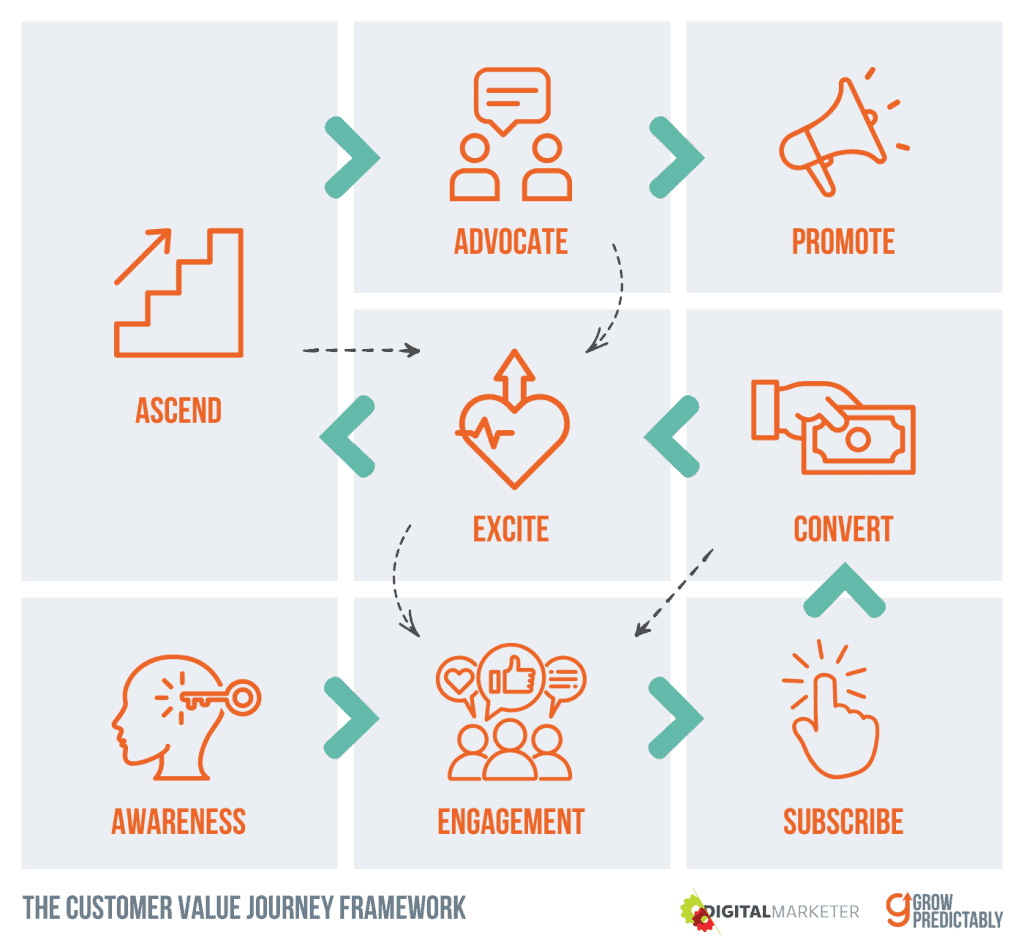
Map each stage to the roadmap lane it feeds:
- Subscribe and Convert friction is usually a signup, trial, or provisioning problem. Lane: activation.
- Excite friction is the gap between purchase and the first real win. Lane: time to value.
- Ascend friction is the ceiling a customer hits when they try to expand usage. Lane: expansion.
- Advocate friction is what stops a satisfied customer from referring. Lane: advocacy and proof.
Where the same journey work is a conversion problem rather than a product problem, it belongs to B2B SaaS CRO instead of to the roadmap.
The failure mode this prevents is the loudest-account roadmap. One account’s wish list usually spans four stages at once, which is why it feels urgent and why it fits nowhere. Sorted by stage, that same list resolves into one real activation problem and three requests only that account has.
Treat one stage as the constraint, fix the friction there, and move on when a different stage becomes the ceiling. A roadmap that improves every stage at once improves none of them enough to change a number.
How do you turn customer feedback into roadmap evidence?
Feedback becomes evidence when the same problem appears independently across channels and across accounts in the target segment. Run four channels on purpose, weight each by what it is actually good for, and set honest expectations for what each one yields.
In-app surveys answer what is hard right now, at the moment it is hard. In Refiner’s 2025 in-app survey response rate report, built from 1,382 surveys that generated more than 50 million views and 6.1 million responses, the average response rate was 27.52%, with mobile apps at 36.14% and web apps at 26.48%.
A quarter to a third is normal, and the silence from everyone else is not rejection. A 3% response rate means the survey is badly placed, not that customers do not care.
Support tickets answer what breaks. Tag them by underlying problem rather than by requested feature, or one issue splits into six competing asks. Sales and win-loss conversations answer what stops a purchase, and they arrive with segment attached, which makes them unusually good for frequency weighting.
Usage data answers what actually happens, and it is the only channel that does not depend on somebody choosing to tell you.
Synthesis is the scarce skill here, not collection. In Productboard’s State of AI in Product Management report, produced with research firm UserEvidence across 379 product professionals at organizations of 500 or more employees, 54% named synthesizing customer insights an increasingly important skill, and 100% of product teams reported using AI tools, 96% of them consistently.
Those tools cluster raw feedback quickly. They do not decide which cluster deserves a roadmap slot.
The standard is convergence, not volume. One vivid interview is a hypothesis. The same problem surfacing independently in tickets, in a survey, and in two win-loss calls from the same segment is evidence.
How do you prioritize the roadmap by customer outcomes?
Run every candidate through three questions before it earns a slot. Which customer problem, stated specifically enough that someone could recognize it. Evidenced by whom, meaning which channel, how many accounts, and which segment. Moving which outcome metric, named before the work starts rather than after it ships.
That is the Roadmap Admission Test, and it is a filter rather than a scoring model. An item that cannot answer all three is not rejected. It is unadmitted, and it goes back for evidence.
Weight the admitted items by problem frequency inside the target segment. A problem hitting a third of your target accounts beats a problem hitting one account at ten times the contract value, unless you choose otherwise deliberately and price it as custom work. Building for a single account is sometimes the right business decision. It should never be the silent result of who emails most.
The test cuts against your own preferences too. Rebuilding my own site, I had a build-time prerender that would have shipped faster and a real server-side render that would not. The outcome the work was admitted for was that a brand-new post reaches crawlers fully rendered with no redeploy, and only one of the two options actually delivered it. The faster option was the wrong one because it did not move the metric it was admitted against.
Sequence with now, next, and later rather than with dates. Now carries committed outcomes with named owners. Next carries admitted items waiting on capacity. Later carries problems with real evidence and no agreed intervention yet. Putting dates on the later column is the fastest way to turn a roadmap back into a delivery plan.

How do you measure whether the roadmap is working?
Judge each shipped item against the one outcome metric it was admitted for, on a review date set the day it was admitted. Activation, time to value, retention, and expansion cover most B2B SaaS roadmaps, and each item should name exactly one of them rather than gesture at several.
Set the baseline before the work ships, because a number measured only after release cannot tell you whether it moved. The metric definitions themselves belong to B2B SaaS customer retention metrics that matter. The discipline here is narrower: the roadmap borrows one of those metrics per item and reports back against it.
Reviewing takes calendar time most teams have not protected. Atlassian’s same 2026 survey found that nearly half of product teams do not have enough time for strategic planning, roadmap development, or data analysis, which is precisely the time an outcome review consumes. Unscheduled, it does not happen, and the roadmap quietly reverts to an output log.
A shipped item can also look successful and be wrong, which is why the review has to check the outcome rather than the ticket. On my own site, a fix written to remove duplicated FAQ blocks stripped FAQ content out of article bodies and dropped FAQ structured data to zero on at least one live article. The change shipped, closed, and read as a clean success.
Nothing surfaced it until someone went and checked the thing it was supposed to protect.
Two results are worth naming in advance. Some admitted items will not move their metric, and that is information rather than failure, provided the next admission changes because of it.
And your own baseline is the only fair comparison, because an industry benchmark tells you nothing about whether last quarter’s work changed anything for your accounts.
Which journey stage should your roadmap serve first?
Serve the stage that is capping growth right now. A roadmap with a perfect admission test still under-delivers if every admitted item improves a stage that was never the constraint, so the diagnosis comes before the prioritization.
Finding that stage is the job of a constraint-first marketing strategy: work out where the journey leaks first, then let the admission test decide what gets built against it.
Run the free growth scan at scan.growpredictably.com, find the stage that is capping growth, and give your next roadmap slot to a problem that lives there.
Frequently Asked Questions
What is the difference between a customer-centric roadmap and a customer-facing roadmap?
Customer-centric describes how the roadmap is prioritized: every slot is admitted on validated customer evidence and judged by an outcome. Customer-facing describes who is allowed to see it, usually a simplified public version shared with customers and prospects. A roadmap can be one, both, or neither. This article is about the first.
How often should a B2B SaaS roadmap change?
Review it on a fixed cadence, monthly or quarterly, and change it when the evidence changes rather than when the volume changes. A roadmap that moves with every loud request is reactive, not customer-centric. The admission test is what separates genuinely new evidence from new noise arriving in a louder voice.
Should the biggest account get roadmap priority?
Not by default. Weight candidates by problem frequency across target-segment accounts, so a problem hitting a third of them outranks one hitting a single large account. Building for one customer is sometimes the right business decision, and when it is, price it and choose it deliberately rather than letting it happen quietly.
Who owns the customer-centric roadmap?
Product owns the artifact and the admission decisions. The evidence pipeline that feeds it is shared: customer success and support supply friction signals, sales supplies prospect and win-loss themes, and analytics supplies usage truth. Ownership of the decision stays in one place even though the evidence arrives from four.
What is the build trap in product management?
It is Melissa Perri’s term for organizations stuck measuring success by outputs, meaning features shipped, rather than outcomes, meaning the value those features produce. A team in the build trap can ship every quarter and still lose renewals. The customer-centric roadmap is the working alternative, because each slot is admitted and judged by an outcome.
How many customer interviews are enough to justify a roadmap item?
There is no magic number, and the standard is convergence rather than volume. When the same problem surfaces independently across several target-segment accounts and across more than one channel, that is evidence. One vivid interview is a hypothesis worth testing, not a mandate to build.
About the author
Brian helps B2B founders install marketing + automation engines powered by Co-Thinking with AI. With 15+ years building predictable revenue systems, he's worked with SaaS, agency, and service businesses on 90-day done-with-you growth accelerators.
Ready to see your real growth gap?
Two minutes in the Growth Gap Scan and you walk away knowing the one thing capping your pipeline. Free, no obligation.