Decision-First Content: B2B Content Strategy That Starts With the Buying Decision, Not the Keyword
Decision-First Content: B2B Content Strategy That Starts With the Buying Decision, Not the Keyword List
TL;DR: Decision-First Content is a methodology that anchors B2B content on the buying decision a named decision-maker is trying to make. It uses the modern pillar-cluster model, but with the pillar anchored to a decision-stage keyword (the decision pillar) rather than a broad informational guide. TOF and MOF spokes support that decision rather than chasing unbounded topical breadth. The distinctive power isn’t a longer keyword list. It’s operational focus: the framework tells you what NOT to write this quarter.
Key Takeaways:
- The decision-stage keyword names what the buyer is choosing. The decision-maker names who is choosing. You need both. Keyword and AI-search research is how you find the decision and confirm real buyers are making it.
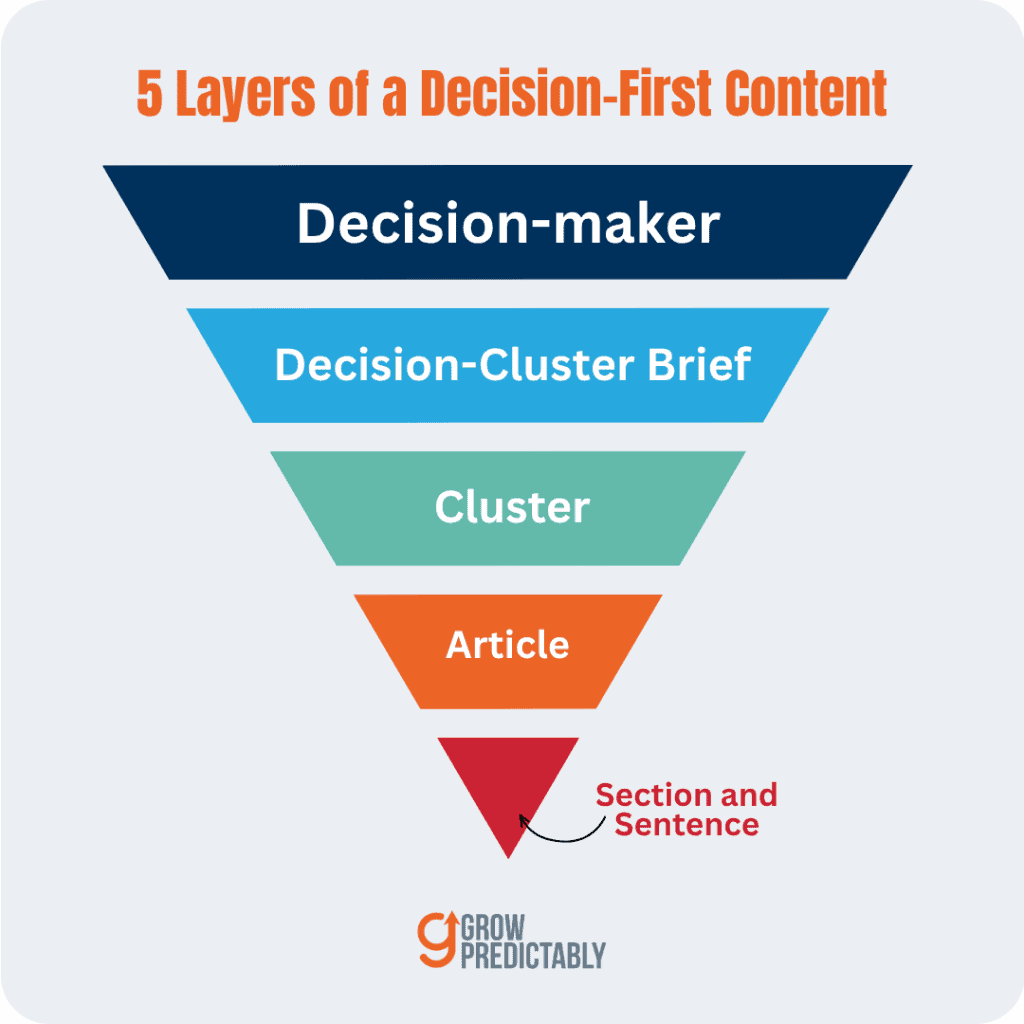
- Decision-First Content cascades through five layers: Decision-maker, Decision-Cluster Brief, Cluster, Article, Section. Each layer constrains the next. That’s how a content program stays coherent across dozens of pieces.
- The Cluster is the conversation that ends in a decision. The decision pillar is anchored to a high-intent decision-stage keyword. Spokes support that pillar from the top and middle of the funnel.
- Topical authority lives inside the decision boundary. You build only the TOF and MOF content that helps the decision-maker reach the decision pillar. Visibility without scope creep.
- One article. Many surfaces. The source-of-truth piece gets rendered for SEO, LinkedIn post, LinkedIn article, newsletter, and carousel. Write once at depth. Render everywhere with intent.
Most B2B content programs I see start the same way. Someone pulls a keyword list. The team grades by volume and difficulty. An editorial calendar appears. Six months later, the SEO dashboard shows traffic and the CRM shows nothing changed. Pipeline didn’t move. The team is confused because they shipped on plan. The plan turned out not to be a plan.
I have watched marketing leaders hire and fire agencies on that exact pattern for fifteen years. The pattern isn’t a tactic failure. It’s a sequencing failure. The keyword list answered “what could we write about.” It never answered “who is the decision-maker, what decision are they trying to make, and what would we have to say for them to call us first.” That last question is the conversation-entering job. It lives upstream of any keyword.
This page is for the B2B SaaS founder, the AI-era marketing leader, the B2B digital agency owner, and the high-ticket B2B coach who owns content output and is tired of shipping on a plan that doesn’t produce buyers. The methodology below is the one I use to fix that. Before the keyword list. Before the calendar. Before the brief.
What is Decision-First Content?
Decision-First Content plans B2B content around the buying decision a named decision-maker is making, not around a volume-graded keyword list. That decision is concrete. It is the decision-stage keyword that names what they are choosing to buy, the term they search in Google and ask AI engines as they decide. Keyword and AI-search research is how you find that decision and confirm real buyers are deciding this way. You anchor every piece on the decision, then cascade through four more layers of constraint until you reach the section level of a single article. The decision is named first. Everything downstream lives or dies on whether it serves that decision.
The five layers, top to bottom:
- Decision-maker. The named buyer making the call. Plus the influencers in the room who shape that call. Plus the account context that qualifies who they are (industry, size, geo, sales-readiness). Built from two paired passes: one names the decision-maker and their account context, one names what they actually hear and what lands.
- Decision-Cluster Brief. The master plan for that decision-maker. Names the one to three decisions worth winning, and for each decision, the conversation the buyer is already having with themselves on the way to making it. The cluster is the conversation that ends in a decision. Not the topic.
- Cluster. A decision pillar (anchored to a high-intent decision-stage keyword) plus its TOF and MOF spokes. Each spoke resolves an implied question on the way to the decision. One owned concept per spoke. A cross-link plan that says how the cluster reads as a whole. Re-derivation is forbidden.
- Article (or post or artifact). The canonical piece for one concept inside one cluster, whether it’s the decision pillar or a supporting spoke. The variant renders for SEO, LinkedIn post, LinkedIn article, newsletter, and carousel all draw from this one source.
- Section and Sentence. Depth where the concept earns it. Restraint everywhere else. Voice-anchored writing. Anti-AI discipline. AEO-extractable shape.
The mental model in one line: the decision-maker names the buyer, the cluster names the decision, the decision pillar holds the high-intent query, the spokes resolve the path, the section earns the words. Strategy is deciding what to ignore. Layers above tell layers below what NOT to do.
Why does keyword-first content fail?
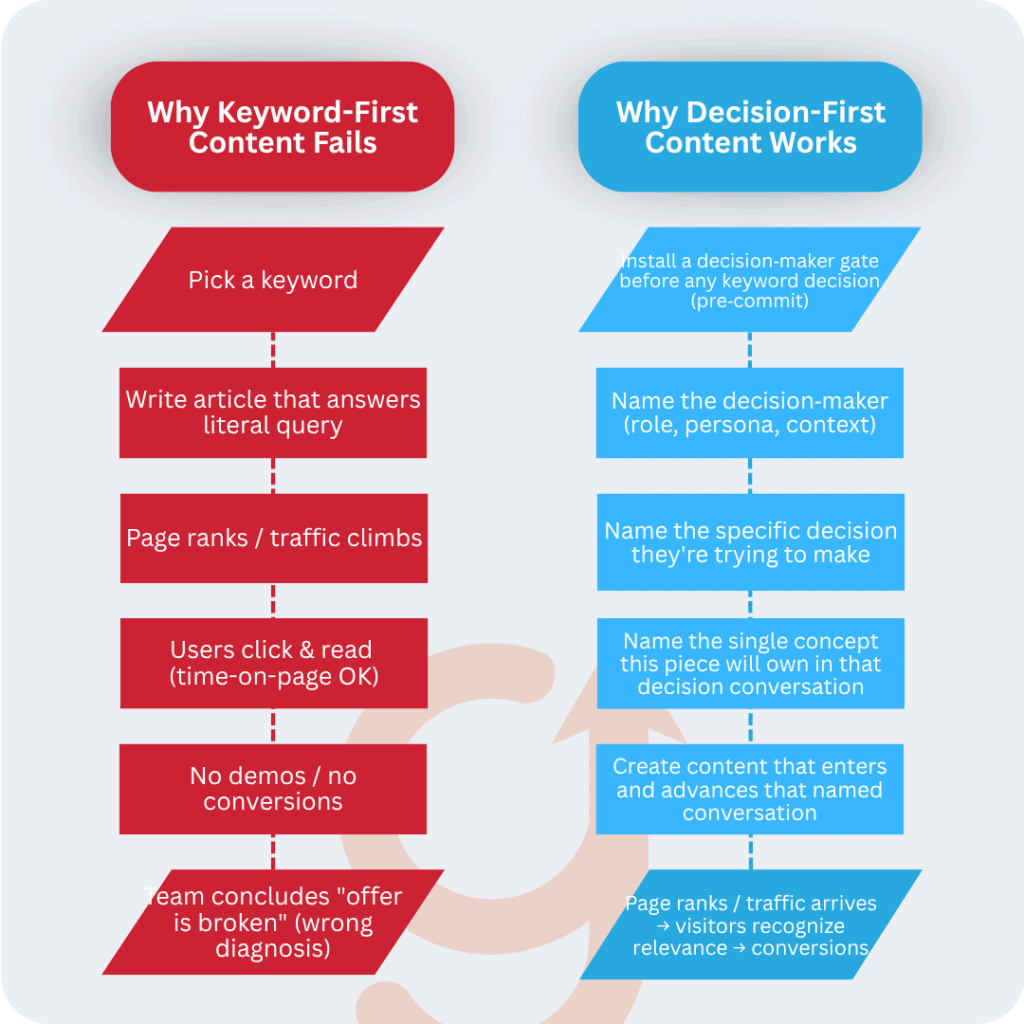
Keyword-first content fails because a keyword off a volume list isn’t the decision. That keyword is one fragment of a buying conversation the decision-maker is having in their team meetings, their 11pm Slack DMs, and the quiet half-hour before a board call. The query they typed into Google is one of two hundred fragments. An article that answers the literal query without joining the decision-making conversation gets the click and then loses the buyer in the first paragraph.
The dashboard tells the story. Pages rank. Traffic arrives. Time-on-page looks fine. Conversion is zero. The team reads the analytics and concludes the offer is broken. The offer is fine. The conversation never started.
A practical example a B2B SaaS team might bring in. The team ranks for “best B2B CRM for startups” and ships a comparison article. Traffic climbs. Demos don’t. They add a CTA, then another, then a quiz. Demos still don’t move. The question that was skipped: which decision-maker was the article written for, what decision were they trying to make when they typed that query, and was the article actually inside that decision-making conversation or adjacent to it. Without that frame, you can’t tell whether the article failed or whether the buyer the article was written for never existed in the first place.
The recovery move is to install the decision-maker gate before any keyword decision. Before the next piece ships, name the decision-maker, name the decision they’re trying to make, name the concept the piece owns, name the conversation moment the buyer is in when they reach for it. If those four can’t be filled in, the piece doesn’t ship. The fix isn’t better keywords. It’s upstream sequencing.
Why does chasing AI citations fail the same way?
Chasing AI citations fails for the same reason keyword-first content does. Getting mentioned by ChatGPT or Perplexity is a visibility score, not a decision. A brand cited on a definitional query the buyer never acts on looks visible on a dashboard and changes nothing in the pipeline. It is the keyword-first mistake on a newer surface.
The decision-maker now resolves part of the buying decision inside an AI engine. They ask the model who they should hire, what they should buy, and which approach fits their situation. That is a new decision surface, and it is where the citation has to land. Being quoted on “what is generative engine optimization” is the AI-era version of ranking for a broad informational keyword. It draws a mention. It does not enter the decision.
The move is the same one the framework already makes. Name the decision surface before you optimize for the citation. Ask where this decision-maker actually reaches this decision, which engines they ask, and what answer would put you in the consideration set when they ask. Then build the cluster to be the cited answer at that decision, not the most-cited answer overall. Visibility that never reaches a decision is the cost, not the win.
What’s the diagnostic at the core of Decision-First Content?
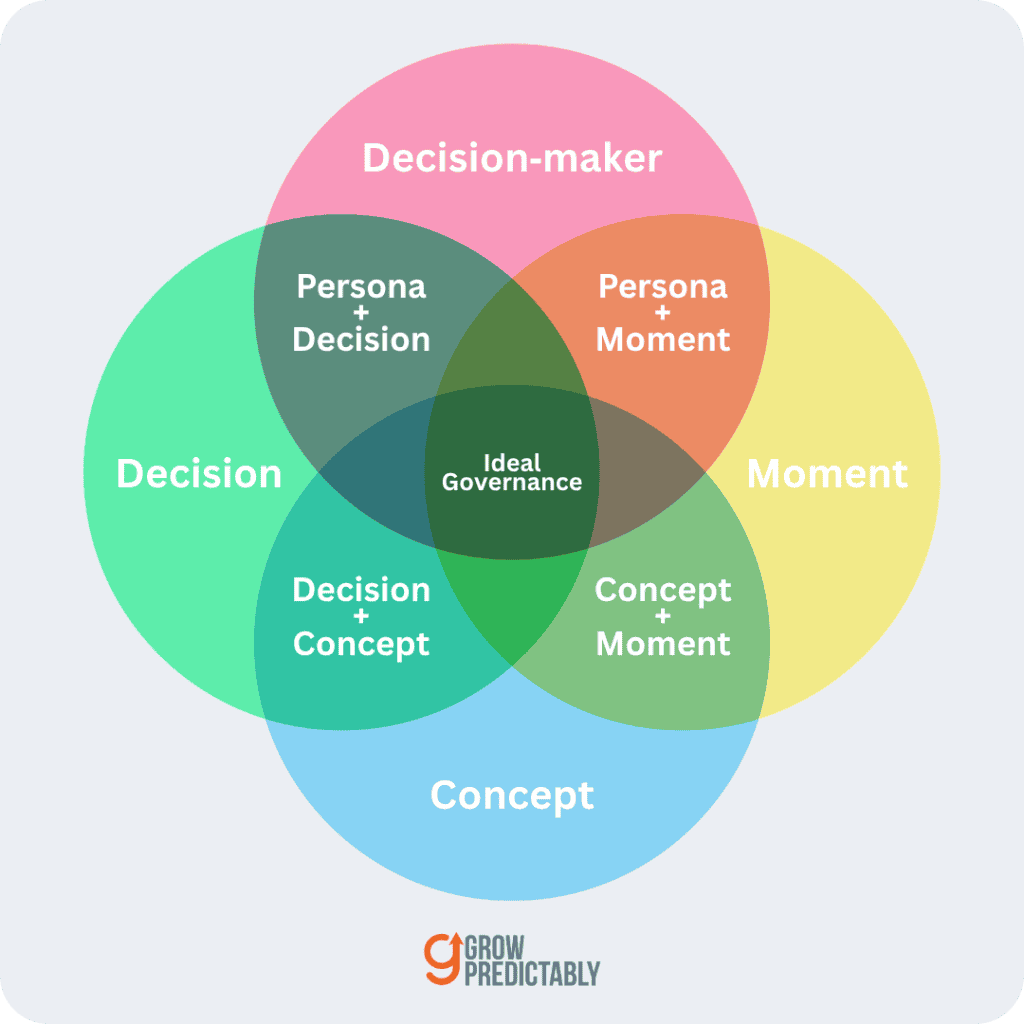
The diagnostic at the core of Decision-First Content is a five-lens convergence test. Five lenses have to converge on the same answer before any piece gets a brief.
The paste-ready template:
Decision-maker: Which named decision-maker is this piece written for, by name? (B2B SaaS founder, AI-era marketing leader, B2B digital agency owner, high-ticket B2B coach, or a named hybrid.) Are influencers in the room you also need to address?
Decision: Which specific buying decision is the piece supporting? Name the decision (not the topic), the decision-stage query the decision-maker would type when ready to make it, and where this piece sits relative to that decision (the decision pillar itself, or a TOF/MOF spoke).
Concept ownership: Inside the cluster, which single concept does this piece own end-to-end? Concepts owned by other pieces in the cluster get referenced and linked. Never re-derived.
Conversation moment: What is the decision-maker thinking, doing, or feeling at the moment they reach for this piece? (Awareness, diagnosis, evaluation, decision, post-purchase doubt.)
Decision surface: Where does this decision-maker actually resolve this decision now? Name the engines and surfaces they reach for (Google, ChatGPT, Perplexity, AI Overviews, a peer’s recommendation) and confirm the piece is built to be the cited answer there, not just ranked next to it. A piece that can win a citation on a definitional query but not at the decision does not pass.
A worked example from a live cluster. The AI-era marketing leader is the decision-maker. The influencers in the room are the marketing ops lead and the CFO who approves the budget. The decision is “which agency do I hire to run our AI-era content program.” The decision-stage keyword is “hiring a digital marketing agency.” Inside that cluster, three pieces sit at different conversation moments. The decision pillar, Hiring a Digital Marketing Agency: 7 Keys to Choose the Right Partner in 2026, owns the operator criteria the decision-maker is weighing when ready to choose. A MOF spoke on AI automation agency hire-vs-build supports the decision (the decision-maker thinks “do I even hire an agency or build in-house?” on the way to choosing). A TOF spoke on smaller-firm cost-benefit supports buyers earlier in the conversation. Same decision-maker. Same decision. Distinct conversation moments. None re-derives what the others own.
The diagnostic produces a clear yes or no on every candidate piece before any keyword research happens. The discipline this asks of an operator is the willingness to kill a piece that has a strong keyword and fails the convergence test. Generic advice isn’t safer. It’s forgettable.
How do you build Layer 1: the named decision-maker?
Layer 1 is the buyer-unit. It comes from two paired passes of work. One names who the decision-maker is, the influencers in the room, and the account context that qualifies all of them. One names what they actually hear and what lands. Both run before any content planning.
Pass 1, the decision-maker plus context. What it produces:
- Decision-maker (primary). The named buyer making the call. Title, scope of authority, what they own on a board deck.
- Influencers (secondary). The two or three other people in the room who shape the call. Marketing ops, finance, the founder, the head of customer success. Each one has a question that has to clear before the decision-maker can say yes.
- Account context. The company shape that qualifies who they are. Industry, headcount band, geography, revenue range, sales-readiness criteria. This is what most teams call ICP. It’s a filter on the decision-maker, not the decision-maker itself.
- Previous actions and purchases. What they’ve already bought or tried. Tells you whether your piece names a fresh problem or restates one they’ve already attacked.
- Key purchase drivers. What actually moves the decision. Time-to-value, peer references, integration depth, board-level cover, vendor risk profile.
Pass 2, the messaging. The buyer’s language and what they believe you do for them. What it produces:
- Jobs to be done. What the buyer is hiring your category to do for them at a functional level.
- Insider language. The exact phrases the buyer uses in their own meetings. Not the phrases your marketing team uses about them.
- Metaphor and analogy. The mental models the buyer reaches for when explaining the problem to a peer.
- Statement of value. The single sentence that captures what your buyer believes you uniquely do for them.
A note on existing canvases. Many teams have already invested in a customer-avatar pass or an Ideal Customer Profile worksheet. Both substitute cleanly for parts of Pass 1. Customer-avatar work covers the decision-maker plus aspirations and frustrations. ICP work covers the account context. Both can carry forward. The labels don’t matter. The substance does. Skipping the work is what kills the cascade. If your team is starting persona work from scratch, B2B persona development is the reference I send teams to.
The two passes run together. Pass 1 alone gives you who. Pass 2 alone gives you what they hear. Paired, they produce a verified buyer-unit that every downstream layer can cascade from. Skip either one and Layer 2 cluster design is guesswork.
How does the decision pillar work?
The decision pillar is the heart of Layer 3. It sits inside the modern pillar-cluster model, the same one most B2B SEO teams already run. The change is which keyword the pillar gets anchored to.
The pillar-cluster model has two common variants:
- Topic-anchored pillar (TOF). The most common variant. Pillar is a broad informational guide (“What is marketing automation”), spokes are narrower subtopics. Builds topical authority. Doesn’t map the cluster to a buying decision.
- Decision-anchored pillar (BOF). A recognized variant in current B2B SEO best practice. Pillar is anchored to a high-intent decision-stage query (“Best marketing automation for B2B SaaS startups”). TOF and MOF spokes support the decision-maker’s path to that pillar. The cluster maps to a real conversion outcome.
Decision-First Content uses the second variant. The decision pillar IS the central authoritative piece in the cluster, just like in a traditional pillar-cluster. The difference is its intent: it ranks for the query the decision-maker types when they’re ready to choose, not the query they typed when they were still scoping the problem.
A concrete contrast for the AI-era marketing leader deciding which agency to hire:
- Topic-anchored pillar (TOF): “What is digital marketing.” Broad informational query. Spokes cover sub-topics like SEO, paid, content. The cluster builds topical authority but doesn’t anchor on a buying decision.
- Decision-anchored pillar (BOF): “Hiring a digital marketing agency: 7 keys to choose the right partner.” High-intent decision-stage query. Spokes are MOF pieces (hire-vs-build, agency-types, evaluation criteria) and TOF pieces (why most agencies fail in the AI era, where AI fits in a marketing workflow). Every spoke resolves a question the decision-maker has on the way to choosing.
The rule: name the decision pillar first. Then ask, for this decision-maker, what TOF and MOF pieces resolve the implied questions on the way to that pillar. Those pieces are your spokes. Anything that doesn’t support the decision pillar doesn’t make the cluster.
How does topical authority work inside the decision boundary?
A common worry when teams hear “Decision-First”: “Are we sacrificing topical authority by ignoring informational queries?” No. You’re scoping it.
Topical authority still gets built. The discipline is that the topical breadth lives inside the decision boundary. You build TOF and MOF content that supports the decision-maker’s path to the decision pillar. You do not chase unbounded topical breadth that has no path back to a decision.
The practical test for any candidate TOF or MOF piece: “Does a decision-maker on the path to my decision pillar actually ask this question?” If yes, build it. The cluster gets stronger. If no, pass. Even when the keyword has high volume and low difficulty.
This is the move that lets the framework scale without losing focus. The team can still produce twenty articles a quarter. They’re not random topical-breadth bets. They’re a calibrated cluster around the decision the team is trying to win.
How does multi-surface distribution apply?
Multi-surface distribution is a Layer 4 concern. The canonical article is the source-of-truth. Every other surface is a render of a slice of it.
The surfaces and what each one is good at:
- SEO article. The deep treatment. AEO-extractable shape, the diagnostic, the worked example, the FAQs. Where ranking and AI Overview citation are earned.
- LinkedIn post. The single sharpest insight from the article. Rendered as an operator observation a peer would tap a colleague on the shoulder to read. Hooks attention at the decision moment.
- LinkedIn article. The long-form variant for the LinkedIn-native reader. Less SEO infrastructure. More first-person framing.
- Newsletter. The same insight wrapped in personal voice for buyers who have already opted in. Trust-deepening. Not awareness.
- Carousel. The skimmable structural backbone. Useful for the buyer at the diagnosis moment who wants the shape before they read.
The rule is single source-of-truth. The article carries the operator-grade depth, the diagnostic, the worked example. Every other surface is a slice rendered with intent. Never a parallel piece written from scratch.
A failure pattern from the field. A team I worked with had a content writer for SEO and a separate social writer for LinkedIn. Both were producing on the same topics. Neither was anchored to a named decision-maker. The SEO article said one thing about the buyer’s problem. The LinkedIn post said something subtly different. The email said something different again. The decision-maker who saw two of the three got confused and bounced. The fix was Layer 4 source-of-truth discipline. One article. One concept. One decision-maker. Multiple renders. Confusion dropped. Attribution improved.
Wrong message, wrong audience. That’s the failure mode multi-surface variants amplify when Layer 1 is skipped. Layer 1 fixes them both at once.
What does a Decision-First Content rollout actually look like?
A rollout takes about 60 days for one decision-maker plus the first decision cluster. The rhythm is decision-maker-first, decision-second, articles-third.
The 7-step process:
- Name the decision-maker. Pick one. Run the buyer-definition pass against your last 10 closed-won accounts and your last 10 lost deals. The pattern that survives both lists is the verified decision-maker. The pattern that lives only in your closed-won list is wishful thinking.
- Run the messaging pass. Pull 5 to 10 sales calls with that decision-maker. Transcribe. Extract jobs-to-be-done in their language. Extract insider language verbatim. Capture the metaphors they reach for. Synthesize the statement of value last.
- Draft the Decision-Cluster Brief. Name the one to three decisions that decision-maker is trying to make where you are the answer. For each decision: the decision-stage query they would type when ready to choose, the pain bundle behind it, the conversation moments (awareness, diagnosis, evaluation, decision, post-purchase doubt) on the way to the pillar. Pick one decision to build first.
- Design the decision cluster. Name the decision pillar concept (the decision itself, anchored to its decision-stage query). Then list the TOF and MOF questions the decision-maker has on the way to it. Each question becomes a spoke with one owned concept. Draft the cross-link map. Output: one-page cluster map.
- Brief the decision pillar first. Carry its decision-maker, decision, owned concept, conversation moment, depth signals required, restraint rules, voice signals, and cross-link plan. The brief is the contract.
- Brief spokes in conversation-arc order. Start with the MOF spoke closest to the decision. Continue outward toward TOF. Each spoke supports the decision pillar’s ranking and authority.
- Render multi-surface variants from each approved article. LinkedIn post, LinkedIn article, newsletter, carousel. Same concept. Surface-appropriate voice. Never write the LinkedIn post first and the article second. The ordering matters.
The 60-day rhythm assumes one full-time content owner. With two owners, the second decision cluster starts at day 30. With a contractor pool, the cluster cadence depends on how fast briefs flow, not how fast articles write.
When should you use Decision-First Content vs. other frameworks?
Decision-First Content is the right framework when the question is “what content should we ship and in what order to win the decisions worth winning.” It’s the wrong framework when the question is “what’s currently capping our growth,” “what’s the right messaging for our category,” or “where should AI sit in our team’s workflow.” Each of those has its own canvas. Decision-First Content composes with them. It doesn’t replace any of them.
How it sits next to the frameworks you may already be running:
- Growth Gap Marketing. A diagnostic-first methodology that finds the single stage of your customer journey currently capping growth and tells you to treat that stage and only that stage. Sits at the same strategy layer as Decision-First Content. Diagnose with Growth Gap Marketing. Plan content with Decision-First Content. The two run together at the quarterly cadence.
- Ideal Customer Profile and customer-avatar canvases. Canvases that name who the buyer is at the company and person level. Layer 1 of Decision-First Content uses both as upstream inputs. ICP work covers the account context filter. Customer-avatar work covers the decision-maker plus aspirations and frustrations. Both feed into the named decision-maker plus influencers plus account context.
- Core Messaging Canvas and other messaging-clarity canvases. Canvases that capture jobs-to-be-done, insider language, and the single sentence of value the buyer would repeat to a peer. The paired Layer 1 input that turns “who is the decision-maker” into “what do they actually hear.” Both passes run together.
- The AI Collaboration Matrix. A 2×2 task-classifier that decides where AI should and shouldn’t sit in your workflow before you open the chat window. Used inside Layer 4 of Decision-First Content to decide whether each step in article production (research, outlining, drafting, editing, scoring) is AI-led, human-led, full co-thinking, or human-only. Decision-First Content tells you which articles to write. The Collaboration Matrix tells you how to assign AI inside the writing.
- The Translation Layer. A messaging framework specifically for technical-founder B2B SaaS, where the buyer can’t tell what the product does in one sentence. The discipline maps each technical feature to the feeling or outcome the decision-maker cares about. Used inside Layer 5 of Decision-First Content when the article is about a technical concept that needs translation.
- The Tech Content Engine. A 5-step content-production methodology for technical product companies (audience research, pain-point identification, bite-sized content, consistent cadence, measure and adapt). Runs inside Layer 4 of Decision-First Content as the article-production system for technical companies. Decision-First Content is the upstream constraint that tells the Engine which articles to produce.
The rule of thumb. Decision-First Content sits at the strategy layer alongside Growth Gap Marketing. The buyer-definition and messaging canvases are the upstream inputs at Layer 1. The Collaboration Matrix and Translation Layer are instruments inside execution. The Tech Content Engine is the article-production system for technical companies. Each piece does one job and refuses to do the others. That’s how the family stays coherent.
How do you apply Decision-First Content in your own business?
Run the 6-step pattern below this quarter, before the next content brief gets approved. The output is a one-page Decision-Cluster Brief for one verified decision-maker, a decision-cluster map for the highest-impact decision, and the decision pillar briefed against that map.
Step 1. Pick one decision-maker and verify them. Pull your last 10 closed-won and 10 lost deals. Run the buyer-definition pass against both lists. The pattern that holds across both is the verified decision-maker. If only one decision-maker holds, that’s your starting unit. Resist the urge to start with multiple. One decision-maker done well beats four done poorly.
Step 2. Run the messaging pass for that decision-maker. Pull 5 to 10 transcribed sales calls. Extract jobs-to-be-done in the buyer’s language. Insider language verbatim. The metaphors they use. The statement of value gets written last, after the other three are populated.
Step 3. Write the Decision-Cluster Brief. Name the one to three buying decisions worth winning. For each one, name the decision-stage query and the pain bundle behind it. Use this paste-ready prompt:
For [decision-maker name], the verified buyer-unit, what are the one to three buying decisions they are trying to make right now where we are the answer? For each decision, name the decision (not the topic), the decision-stage query the buyer would type when ready to choose, the pain bundle behind it, the TOF and MOF conversation moments on the way to the decision, and the strategic value to our business if we become the voice they trust at the decision moment.
Step 4. Pick ONE decision and design its cluster. Name the decision pillar concept (the decision itself). List the TOF and MOF questions the decision-maker has on the way to it. Each one becomes a spoke with an owned concept. Draft the cross-link map. Output: one-page cluster map.
Step 5. Brief the decision pillar first. Carry its decision-maker, decision, owned concept, conversation moment, depth signals required, restraint rules, voice signals, and cross-link plan. The brief is the contract. The writer should not have to ask what the article is for.
Step 6. Write, score, and ship using section-writer discipline. Depth signals per section. Restraint at the line level. Anti-AI rules. AEO-extractable structure. Render multi-surface variants only after the article passes its scoring gate.
That’s the rollout. One decision-maker. One decision. One decision pillar. Then spokes outward. The discipline this asks of an operator is the willingness to invest 30 days in Layers 1 and 2 before any article gets written. Most teams compress that to a week and pay for it in Layer 4 incoherence later.
Frequently Asked Questions about Decision-First Content
Where does Decision-First Content come from?
Decision-First Content is the methodology I developed across a decade and a half of watching B2B content programs ship on plan and not produce buyers. The 5-layer cascade emerged from a single observation: the failure mode was always a missing upstream constraint, never a missing tactic. The framework formalizes the constraint cascade I had been running informally for years.
How is Decision-First Content different from a content strategy template?
A template gives you slots to fill in. Decision-First Content gives you a constraint cascade where the upper layer’s output is the lower layer’s input. The template approach lets you ship pieces that look right and miss the buyer. The cascade approach refuses to let a piece exist if its decision-maker, decision, owned concept, and conversation moment don’t all converge.
How is the decision pillar different from a traditional SEO pillar?
A traditional pillar anchors on a broad TOF informational query (“What is marketing automation”). It builds topical authority but doesn’t map the cluster to a buying decision. A decision pillar anchors on the high-intent decision-stage query (“Best marketing automation for B2B SaaS startups”). The cluster maps to a real conversion outcome. TOF and MOF spokes still build topical authority, but inside the decision boundary. Both variants live inside the modern pillar-cluster model. The choice is which keyword the pillar gets anchored to.
Does Decision-First Content work for B2C or only B2B?
The methodology was built for B2B systems where the buying decision is multi-stakeholder, the sales cycle is long, and the cost of confusing the buyer is high. B2C with high consideration (luxury, healthcare, education) follows similar dynamics and the framework adapts. B2C with impulse purchase has a different shape. The framework is overkill there.
How long does a Decision-First Content rollout take?
About 60 days for one decision-maker plus the first decision cluster with one full-time content owner. The Layer 1 buyer-definition and messaging passes take about a week each. The first Decision-Cluster Brief takes about a week. The decision pillar plus three spokes takes about a month. Subsequent clusters compound faster because the Layer 1 work is done.
What if my team already has a customer avatar or an ICP?
Better. The avatar work substitutes for the decision-maker half of Layer 1 if it captures demographics, purchase drivers, and the buyer’s frustrations and aspirations. The ICP work covers the account context filter. The messaging pass still needs to run alongside both. The rest of the framework cascades from there.
Won’t ignoring topical authority hurt our SEO?
Decision-First Content doesn’t ignore topical authority. It scopes it. You build TOF and MOF content inside the decision boundary. Only the questions a decision-maker on the path to your decision pillar actually asks. The cluster gets stronger and the topical authority gets sharper at the same time.
How does Decision-First Content interact with AI?
AI shows up at Layer 4 (article production) and Layer 5 (section writing). A separate task-classifier framework decides which writing tasks get AI co-thinking, which get AI pressure-testing, and which require human-only judgment first. Decision-First Content doesn’t prescribe AI. It’s compatible with full-human teams, full-AI teams, and every mix in between. The classifier is what makes the choice operational.
How does Decision-First Content apply to AI search and GEO?
AI search is the newest decision surface, not a new framework. Generative engine optimization and answer engine optimization decide how a page gets cited by ChatGPT, Perplexity, and Google AI Overviews. Decision-First Content decides which decision that citation has to serve. Most GEO chases citations as a visibility score, which is the keyword-first mistake on a new surface. The decision-first move is to name the decision surface first, then build the cluster to be the cited answer at the buying decision rather than the most-cited answer on definitional queries no decision-maker acts on. Getting cited is not the goal. Getting cited at the decision is.
Do I need expensive tools to run Decision-First Content?
No. The first pass uses your existing CRM, your existing sales call recordings, a one-page Decision-Cluster Brief, and a one-page cluster map. Tools may show up in the multi-surface distribution layer when the team scales render volume. The methodology itself doesn’t require net-new tooling.
Where do you start with Decision-First Content?
Start with Step 1 this week. Pull your last 10 closed-won and 10 lost deals. Run the buyer-definition pass against both lists. Find the pattern that holds across both. Name the decision-maker. Then name the one decision worth winning where you are the answer. That single decision is the Layer 1 anchor the rest of the framework cascades from. Name the decision first, then let keyword and AI-search research find the decision-stage term that names it and confirm real buyers are deciding this way. Decision and research work together. The decision sets the target, and the research is how you hit it.