How Can AI and Automation Make Your Agency More Profitable?

Founder, Grow Predictably · 15+ yrs building B2B revenue systems
By Brian Shelton — Founder of GrowPredictably.com
TL;DR: AI and automation make a B2B digital marketing agency more profitable by moving expensive senior hours off repeatable production work and onto strategy, so the same team serves more clients without new hires. The tools are the cheap part. The margin shows up only when you automate at the constraint that caps your capacity, keep judgment work human, and reassign the recovered hours on purpose.
Key Takeaways
- Agency profit is margin on senior judgment, and AI widens that margin by returning production hours to strategy rather than by replacing people.
- Automate the repeatable, low-judgment, hours-heavy task classes first: client reporting, onboarding, meeting notes, and first drafts.
- Keep work that carries your voice, your accountability, or a defendable decision human. In a Harvard Business School and BCG field experiment, consultant accuracy fell from 84% to the 60 to 70% range when AI was trusted on a task just outside its competence.
- The training gap is where rollouts leak: Microsoft’s 2024 Work Trend Index found 75% of knowledge workers already use AI at work while only 39% have received AI training from their company.
- Recovered hours become profit only when they are deliberately reassigned to billable or growth work. Tool subscriptions never move the P&L by themselves.
I have watched marketing leaders hire and fire digital marketing agencies for 15 years, from both sides of the table, and the agencies that lose the relationship are rarely short on effort. They are short on margin. Senior people spend their weeks on reporting decks, onboarding checklists, and first drafts instead of the strategy clients actually pay for.
This is for the owner or operations lead of a B2B digital marketing agency whose margins are compressing while clients ask why deliverables are slow. The path through it runs on two frameworks: the automate-first filter below, and the AI Collaboration Matrix for deciding which work never gets handed to a model.
The work that follows is diagnose-first applied to agency operations: find the one task class capping your margin, automate that, and protect the judgment work that earns your premium.
How does AI make a B2B digital marketing agency more profitable?
AI makes a B2B digital marketing agency more profitable by converting senior production hours into strategy hours, which raises client capacity per strategist without adding headcount. The reallocation creates the margin, because an hour saved on reporting becomes profit only when it moves to billable or growth work.
The mechanism pulls three levers at once. Capacity rises because each strategist carries more accounts when production runs through automated workflows. Rework and burnout fall because repeatable tasks stop depending on who did them that week.
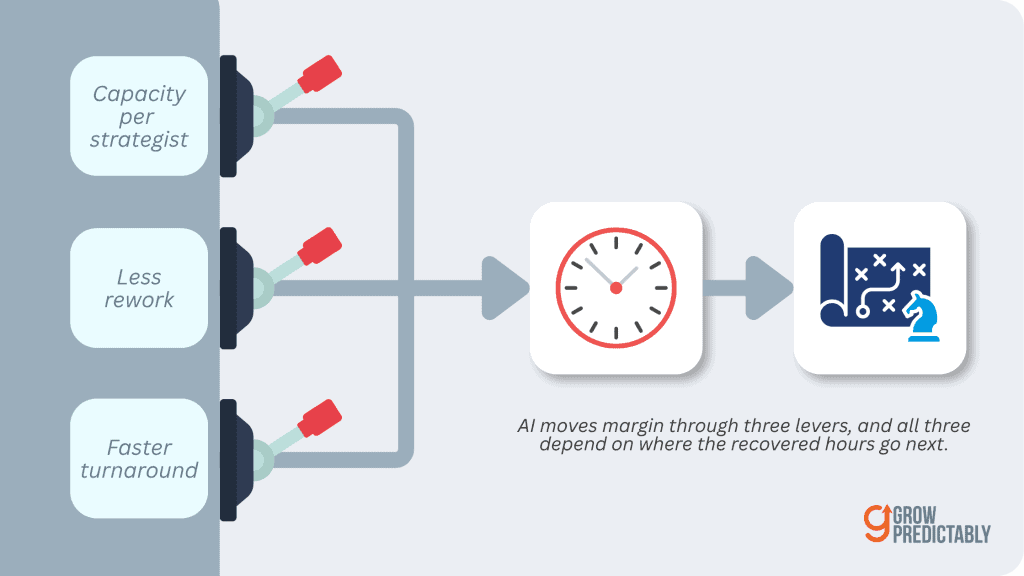
Turnaround speeds up, and that protects retention. Slow deliverables are the complaint that opens the door to your replacement.
The time savings are measurable. In CoSchedule’s State of AI in Marketing survey of 1,005 marketers, 83% of marketers using AI report increased productivity, and the average user saves more than five hours every week. Five hours per person per week is real money at agency loaded rates. It is also where most agencies stop.
Nobody decides where those hours go next. If your team saved five hours last week and you cannot say what they did with them, the savings evaporated into slack.
Which agency tasks should you automate first?
Automate the task classes that are repeatable, low-judgment, and hours-heavy: client reporting, onboarding, meeting notes, and first-draft production. Rank every task class by senior hours consumed per month. Automate the single class that caps your margin first.
One workflow shipped and adopted beats five pilots abandoned.
The filter: repeatable, low judgment, hours-heavy
Run the count in a simple spreadsheet with four columns: task class, senior hours per month, judgment level (low, medium, high), and whether the output is client-visible. The class with the most low-judgment senior hours is your constraint. In most agencies that is reporting or onboarding, and the honest count usually surprises the owner.
I build these automations for clients, and the winning build is never the flashiest one. One client had spent two years manually sifting email receipts to track expenses. A Make.com scenario removed the whole chore, and the walkthrough afterward mattered as much as the build, because adoption is the half of automation nobody budgets for.
Your version of that receipts pile exists somewhere in your delivery process. Find it before you buy anything.
Start at the constraint, not the demo
The failure mode is automating whatever a tool demo makes look easy. The workflow ships, nobody adopts it, and the hours never move. The recovery is boring and reliable. Pick the chore the team already hates, automate it end to end with a tool you can maintain (Zapier and Make.com cover most agency workflows), then hold a one-week adoption check where the old manual path is retired for good.
If the old path survives, you added a tool without removing any work.
Which work must stay human?
Anything that carries your voice, your accountability, or a decision a client will interrogate stays human. That covers positioning calls, strategy recommendations, pricing, and the judgment behind creative direction. AI can assist at the edges of that work, and handing it the center degrades quality in ways you will not feel until a client does.
The AI Collaboration Matrix makes this a 30-second classification instead of a debate. Two axes, task complexity and stakes, route every task to a collaboration mode. Only routine, reversible work gets fully delegated to the model. Your proposal narrative and your pricing rationale sit outside that zone more often than a demo suggests.
The jagged frontier: where AI quietly degrades quality
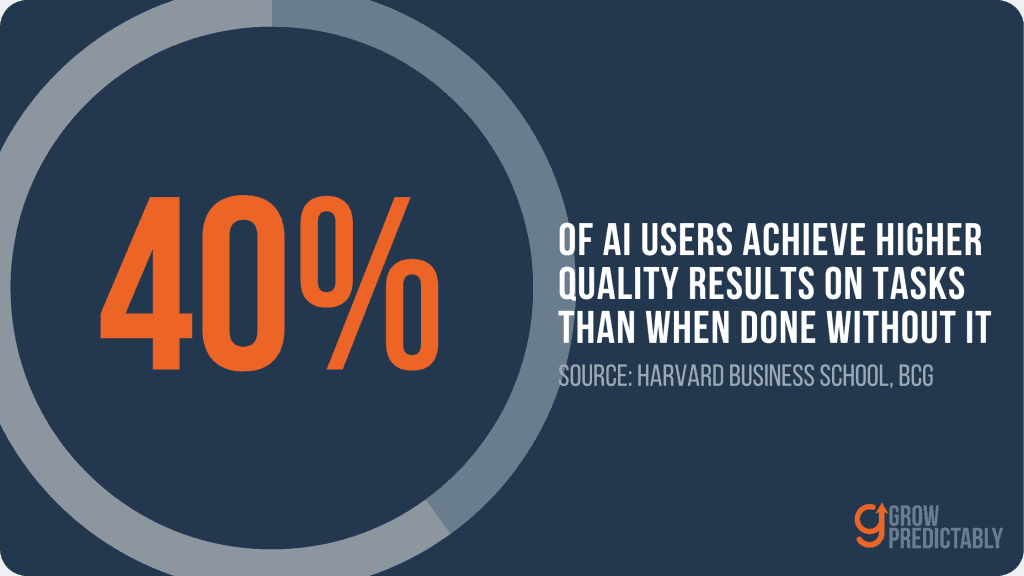
The quality risk has been measured. In a field experiment with consultants run by Harvard Business School and BCG researchers, AI users finished 12.2% more tasks, completed them 25.1% more quickly, and produced 40% higher quality results on tasks inside the AI’s frontier.
On a task designed to sit just outside that frontier, accuracy fell from 84% without AI to the 60 to 70% range with it.
On some tasks AI is immensely powerful, and on others it fails completely or subtly. And, unless you use AI a lot, you won’t know which is which.
Ethan Mollick, Wharton professor, writing on the jagged frontier study
The frontier is invisible from inside the chat window, which is why the classification has to happen before the task starts, never during. Your client’s account strategy does not announce when it crosses the line.
Six AI systems that actually move agency margin
Six systems cover most of the recoverable margin in a B2B digital marketing agency: client onboarding, content production, reporting, lead qualification, proposals, and delivery tooling. Each converts a named block of senior hours into strategist time.
None requires a data team, and every one fails without a named owner.
1. Client onboarding
Templated intake forms, auto-provisioned accounts, and triggered welcome sequences turn a scattered first month into a consistent one. The first weeks set the client’s quality expectations. Automated onboarding delivers the same experience whether your operations lead is at their desk or on vacation.
2. Content production
AI drafts, humans own the voice and the argument. In the same CoSchedule survey, 85% of marketers already use AI tools for content creation. Volume alone is no longer a differentiator for any client you serve. Volume without authority is the trap, and AI in B2B marketing covers why authority wins that trade. Sell the judgment layer, automate the production layer.
3. Client reporting
Auto-pulled dashboards reviewed by a strategist beat hand-built decks on both cost and quality. The hours stop going into assembling numbers. They start going into the sentence every client actually reads: what we are doing about it. A report nobody has to build is also a report that ships on time every month.
4. Lead qualification and follow-up
Instant response, scoring against your ideal client profile, and automated scheduling stop no-fit prospects from consuming senior time. The margin lever is subtraction: every hour not spent on a prospect who was never going to buy is an hour returned to accounts that pay.
5. Proposals and pitches
Assemble proposals from a library of proven sections instead of writing each one cold. Let AI draft the first pass against the discovery notes. The judgment stays human because the pricing and the promise are yours to defend. Whether AI can improve B2B agency proposal conversion rates depends almost entirely on keeping that split clean.
6. Delivery tooling for SEO and paid media
The delivery stack is where subscriptions multiply fastest, so screen tools before adding them. Ask who on the team opens it weekly, which task class it removes, and whether the vendor itself is stable. Choosing AI tools for SEO agencies walks that screen for the SEO side of the stack.
What does AI adoption cost, and what is the honest ROI math?
Tool subscriptions are the small cost of agency AI adoption. The real costs are process change and training. The honest ROI is recovered hours times loaded rate, counted only when the hours land somewhere billable. An hour saved that nobody reassigns is a cost with no return.
Expectation runs ahead of realization here. Forbes Advisor’s research finds 64% of businesses expect AI to increase their overall productivity, and the expectation is cheap. The realized version depends on the unglamorous half of adoption.
Microsoft’s 2024 Work Trend Index, a survey of 31,000 knowledge workers across 31 markets, found that 75% of knowledge workers use AI at work while only 39% have received AI training from their company. Most teams are improvising with powerful tools and no shared playbook.
Run your math accordingly. Price the workflow build and the training hours into the cost side. Count only reassigned hours on the return side, then re-measure capacity per strategist after 90 days. If capacity per strategist did not move, the automation decorated your process instead of changing it.
Why do most agency AI rollouts never reach the P&L?
Most agency AI rollouts never reach the P&L because they skip the diagnosis, skip the training, or hand judgment work to the model. The tools usually perform as advertised while the rollout fails around them, and the failure is organizational: ownership, sequencing, and habits rather than technology.
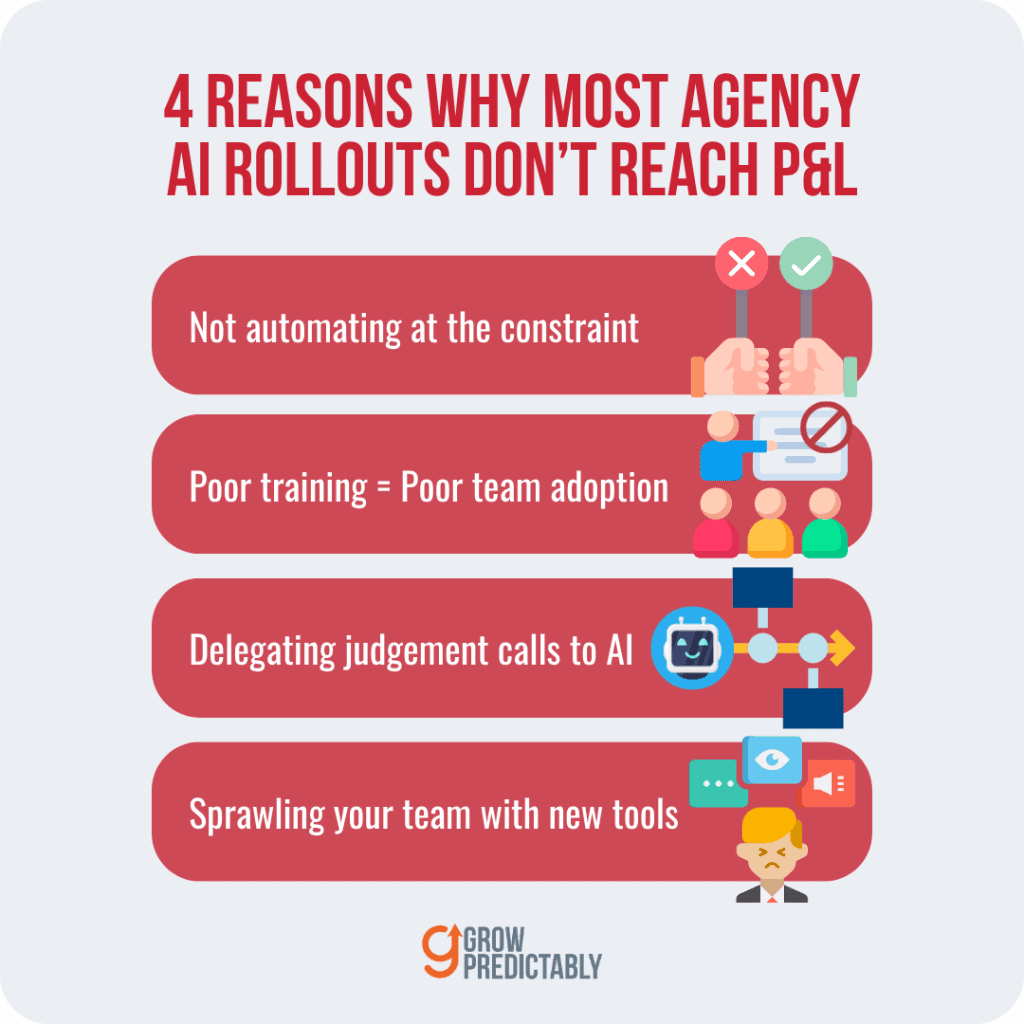
Four failure modes account for most of the leak:
- Automating everywhere instead of at the constraint, which spreads effort thin and moves no single number.
- No training, so the team uses powerful tools at a fraction of their value and quietly reverts to the old path.
- Wrong-mode use, where judgment-bearing work gets delegated and quality erodes below the line of sight.
- Tool sprawl, where subscriptions accumulate faster than any owner retires the manual work they were meant to replace.
As Karim Lakhani, professor at Harvard Business School, put it in Harvard Business Review: “Just as the internet has drastically lowered the cost of information transmission, AI will lower the cost of cognition.” Cheap cognition moves the scarce skill upstream, to deciding which work deserves your team’s own judgment.
Agencies that make that decision deliberately capture the margin. Agencies that let each employee improvise the boundary pay twice, once in subscriptions and once in eroded quality.
Where should your B2B digital marketing agency start this quarter?
Measure hours by task class for one week. Pick the single constraint class, ship one workflow, train the team on it, and reassign the recovered hours on purpose. That sequence fits inside 30 days. It beats a quarter of tool evaluations because it changes a number you can re-measure.
Take the Growth Gap Scan, which names the constraint capping your growth in about two minutes, so you automate at the bottleneck instead of at the demo.
Want to go deeper? Read the risks of ignoring AI for a digital agency or how digital agencies use AI to win more clients.
Frequently Asked Questions
How do marketing agencies use AI to increase profit?
Profit comes from reallocation, not adoption. Agencies automate repeatable production work such as reporting, onboarding, meeting notes, and first drafts, then move the recovered senior hours to strategy, billable work, or growth. Capacity per strategist rises without new hires, turnaround speeds up, and retention improves. An hour saved that nobody reassigns produces no profit at all.
What should an agency automate first?
The task class that is repeatable, low-judgment, and consumes the most senior hours per month. Count hours by task class in a simple four-column worksheet, then automate the single class capping your margin, usually client reporting or onboarding. One workflow shipped, adopted, and holding after a one-week check beats five pilots running in parallel.
Will AI replace marketing agencies?
AI replaces tasks, not agencies. Production work like drafting, reporting, and data assembly automates well, which is exactly why it stops being a differentiator. The work clients keep paying a premium for is judgment: positioning, strategy, pricing, and accountability for results. Agencies that automate production and sell judgment gain margin. Agencies that sell production compete with the tools.
How much time does AI actually save marketing teams?
CoSchedule’s State of AI in Marketing survey of 1,005 marketers found AI users save more than five hours per week on average, and 83% report increased productivity since adopting AI. At agency loaded rates that is real money, but only when the recovered hours are deliberately reassigned to billable or growth work rather than absorbed as slack.
What does adding AI to an agency actually cost?
Tool subscriptions are the small line. The real costs are process change and training, and the training gap is measurable: Microsoft’s 2024 Work Trend Index found 75% of knowledge workers use AI at work while only 39% received company training. Price the workflow build and training into the cost side, and count only reassigned hours as return.
When should an agency not use AI for a task?
When the task carries your voice, your accountability, or a decision a client will interrogate: positioning, strategy recommendations, pricing, and creative direction. Research on the AI frontier found consultant accuracy fell from 84% to the 60 to 70% range when AI was trusted on a task just outside its competence, and the line is invisible from inside the chat window.
About the author
Brian helps B2B founders install marketing + automation engines powered by Co-Thinking with AI. With 15+ years building predictable revenue systems, he's worked with SaaS, agency, and service businesses on 90-day done-with-you growth accelerators.
Ready to see your real growth gap?
Two minutes in the Growth Gap Scan and you walk away knowing the one thing capping your pipeline. Free, no obligation.