Micro SaaS Lead Magnets That Attract Qualified B2B Leads

Founder, Grow Predictably · 15+ yrs building B2B revenue systems
TL;DR: The best Micro SaaS lead magnets help a specific B2B buyer make a decision related to the product. A calculator quantifies a costly problem, a template helps the buyer complete part of the job, and a self-assessment reveals a gap. Choose the format by buyer stage, ask only for information proportional to the value delivered, and measure both landing-page conversion and product-qualified conversations.
Key Takeaways
- Build the lead magnet around one expensive, urgent, product-adjacent problem.
- Give buyers a useful result before asking them to talk with sales.
- Match the format and call to action to the buyer’s Customer Value Journey stage.
- Use calculators, assessments, templates, and comparison tools as product previews that also deliver standalone value.
- Measure download volume alongside lead quality and movement toward the product.
Micro SaaS companies have a lead-generation constraint larger vendors can partially hide with brand recognition and media spend: an unknown product must earn trust quickly.
That is why a generic ebook usually underperforms as a Micro SaaS lead magnet. It may collect email addresses, but it does not necessarily prove that the product understands the buyer’s problem or can help solve it.
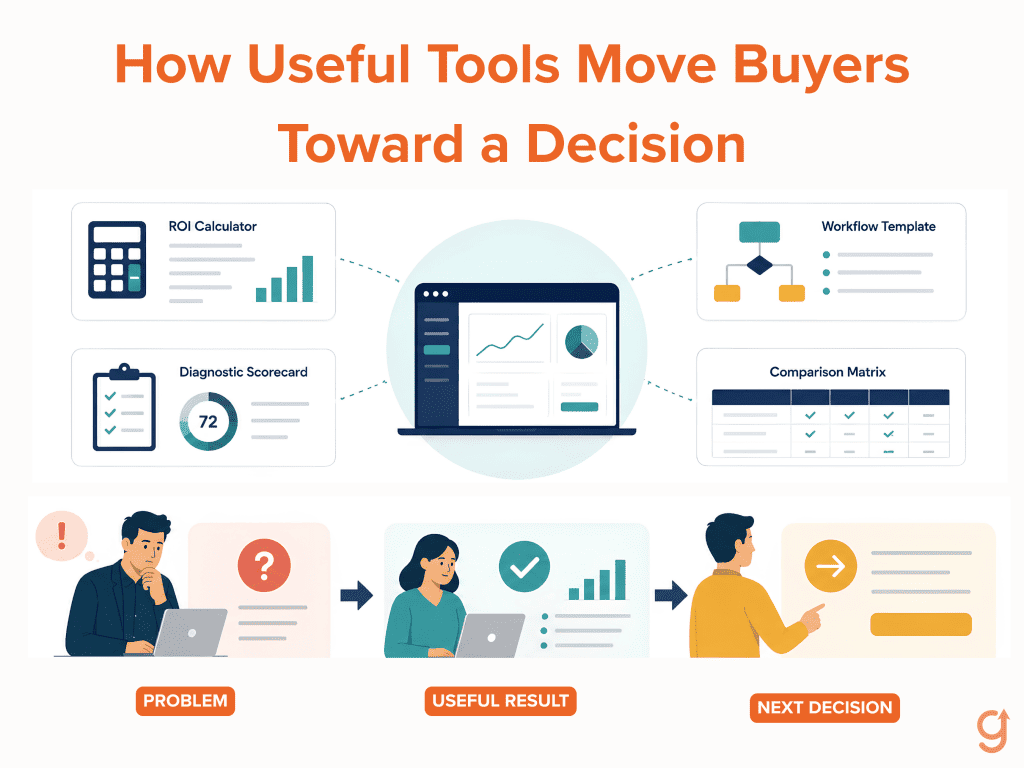
The stronger approach is to create a small but useful decision tool. It should let the buyer diagnose a problem, estimate an outcome, compare approaches, or complete part of the work your product supports. The lead magnet then becomes the first useful experience with your product’s way of thinking.
What role should a Micro SaaS lead magnet play?
A Micro SaaS lead magnet should attract a product-relevant problem, provide a useful result, and create a logical next decision. That combination matters more than the file format.
Across agency and in-house marketing roles, I have seen teams collect contacts without learning whether those contacts have the problem the product solves. The lead magnet should perform three jobs:
- Attract the right problem. The topic should be specific enough that the people who want it resemble the people who may need the product.
- Demonstrate useful expertise. The asset should contain a method, calculation, diagnostic, or workflow the buyer could not get from a generic search result.
- Create a logical next decision. After receiving value, the buyer should understand why a trial, product walkthrough, or deeper resource is the sensible next step.
This matters because B2B buyers increasingly want to learn independently. In a 2025 survey of 632 B2B buyers, Gartner found that 61% preferred an overall rep-free buying experience. Buyers favored self-service for general information and learning, but preferred seller input when they needed contextual help deciding whether a solution fit their company.
That creates a clear job for a lead magnet: help the buyer learn or diagnose independently, then make human guidance available when context becomes important.
As Alice Walmesley, Director Analyst in Gartner’s Sales Practice, explains, “Instead of offering generic information that buyers can find elsewhere, sellers should offer unique guidance.”
For a Micro SaaS company, the same principle applies to the lead magnet. If the buyer could generate an equivalent resource from a broad prompt or find it in the first search result, it has not earned the form submission.
How do you choose the right lead magnet format?
Choose the format by identifying what the buyer needs to understand, compare, estimate, or accomplish immediately before the product becomes relevant. I look for a decision close enough to the product to reveal fit, yet useful enough to stand on its own. That decision is a better design constraint than starting with an ebook, calculator, or webinar.
The answer points toward the format:
| Buyer decision | Useful lead magnet | Signal captured |
|---|---|---|
| “Is this problem expensive enough to fix?” | ROI or cost calculator | Problem severity and economic intent |
| “How mature is our current process?” | Scorecard or self-assessment | Gaps, priorities, and readiness |
| “Can we perform this workflow better?” | Template, checklist, or worksheet | Use case and implementation intent |
| “Which approach fits our situation?” | Comparison guide or selection matrix | Evaluation criteria and alternatives |
| “Can this product work for us?” | Sandbox, sample-data demo, or guided trial | Product interest and fit |
| “How do we make the internal case?” | Business-case builder or benchmark brief | Stakeholder and budget concerns |
Current buyer research supports this decision-oriented approach. The 2025 B2B Buyer Report found that 58% of buyers wanted more interactive tools such as calculators and self-assessments. It also found that 57% wanted clearer ROI data and 55% wanted content more relevant to their immediate needs and pain points.
Format still depends on the job. Content Marketing Institute’s 2024 B2B research found that case studies/customer stories and video were the formats most often named among best performers, while 33% of respondents used interactive content. A calculator is better than a case study when the buyer needs to quantify or test something.
That does not mean every company needs an elaborate calculator. The tradeoff is important:
- A calculator can surface economic intent, but unreliable assumptions will destroy trust.
- A template is fast to build and immediately useful, but it may attract people who want the file without needing the product.
- A self-assessment captures rich diagnostic information, but too many questions create friction.
- A case study provides proof, but only when the buyer recognizes their situation in it.
- A free tool can create product-like value, but it also creates maintenance and support obligations.
Choose the smallest format that helps the buyer make the next meaningful decision.
Which lead magnets fit different Micro SaaS products?
The right lead magnet translates a product capability into a useful buyer decision. I look for the practical bridge between the job a product performs and the uncertainty its buyer faces.
Toggl Track, Baremetrics, and Quaderno each reveal different ways to build that bridge around time profitability, subscription metrics, and tax compliance.
Toggl Track: turn time data into an economic decision
Toggl Track currently supports time tracking, customizable reporting, billable rates, scheduled reports, and profitability insights. Its buyers are not merely looking for a timesheet. They may be trying to understand where project margin disappears or whether work is being estimated accurately.
Useful lead-magnet concepts could include:
- A project-profitability leakage calculator
- A billable-utilization worksheet
- A client reporting template
- A time-tracking maturity assessment
The calculator is strongest when the buyer already suspects a financial problem. The template is better for someone who feels operational friction but is not yet evaluating software.
Baremetrics: help subscription teams interpret their numbers
Baremetrics provides subscription analytics, benchmarks, forecasting, dashboards, and trial insights. A generic “SaaS metrics guide” would sit too far from that value. A better lead magnet would help a founder interpret a decision hidden inside the metrics.
Examples include:
- A runway and revenue-scenario worksheet
- A churn-impact calculator
- A SaaS metric health scorecard
- A forecasting assumptions template
The goal is to let the prospect experience the distinction between having numbers and knowing what to do with them, without reproducing the product.
Quaderno: convert compliance uncertainty into a clear next step
Quaderno automates sales tax, VAT, and GST calculations, threshold monitoring, invoicing, reporting, and filing workflows for SaaS businesses. Its strongest lead magnet would reduce uncertainty without pretending to replace professional tax advice.
Useful concepts could include:
- A cross-border tax-obligation checklist
- A registration-threshold readiness assessment
- A SaaS tax workflow map
- An international invoicing requirements checklist
Here, a checklist or assessment is safer than an oversimplified calculator. The magnet can identify questions and workflow gaps while directing buyers to qualified guidance for jurisdiction-specific decisions.
These examples reveal the reusable rule: the best format mirrors the product’s core value without giving the buyer a thin sales brochure disguised as help.
How should lead magnets map to the Customer Value Journey?
Map each lead magnet to the buyer’s current question and the next reasonable action.
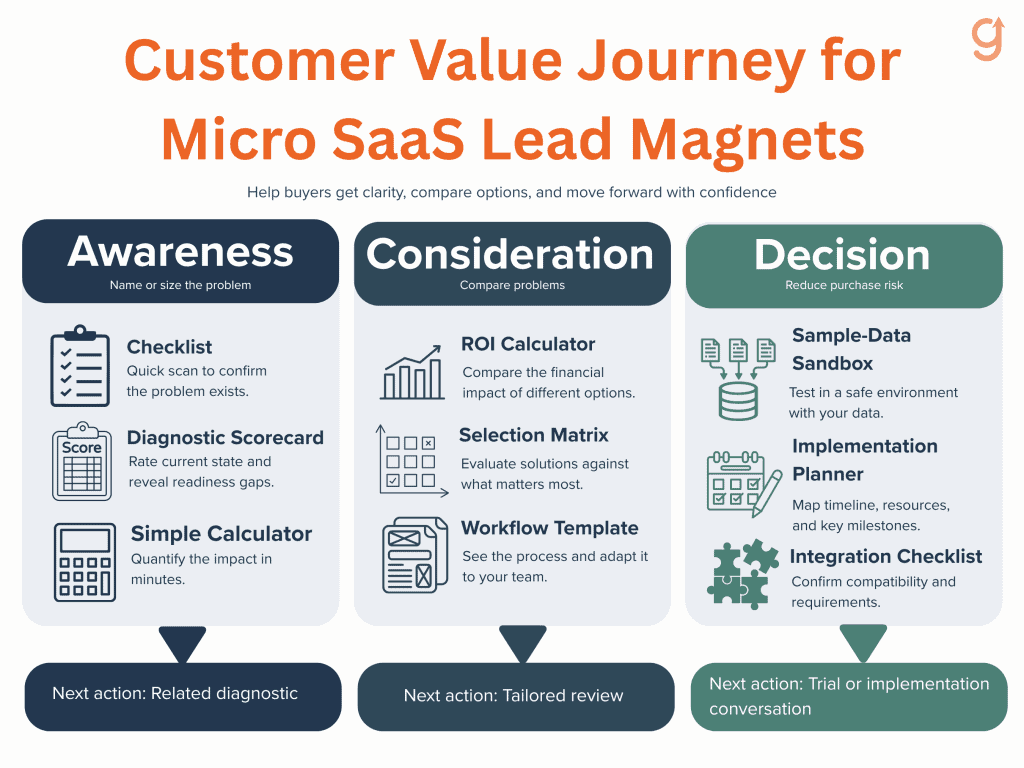
I use the Customer Value Journey because it prevents a common mistake: asking one asset to work for every buyer at every stage. A problem-aware visitor needs help naming or sizing the issue, while an active evaluator needs help comparing options and reducing implementation risk.
A buyer who has just recognized a problem needs a different kind of help from someone building a shortlist. The lead magnet, form, follow-up, and call to action should reflect that difference.
Awareness: help the buyer name the problem
At this stage, useful formats include:
- Checklists
- Short diagnostic scorecards
- Benchmark questions
- Educational calculators with minimal inputs
The goal is clarity, not a demo request. A security Micro SaaS might offer a configuration-risk checklist. A scheduling product might offer a meeting-cost calculator. Both help the buyer see the problem in concrete terms.
Consideration: help the buyer compare approaches
Useful formats include:
- ROI calculators
- Selection matrices
- Workflow templates
- Case studies organized by use case
- Product-category comparison guides
The buyer is deciding how to solve the problem, not simply whether it exists. This is where assumptions, limitations, and comparison criteria matter. A calculator should show its inputs. A comparison guide should explain who each approach is and is not for.
Decision: reduce implementation and purchase risk
Useful formats include:
- Sample-data sandboxes
- Guided trials
- Implementation planners
- Security or integration checklists
- Business-case builders
At this stage, the buyer needs evidence that the solution can survive contact with their actual environment. A generic ebook adds little. A concrete implementation plan or sandbox can remove a real objection.
The next action must also match the stage. An awareness checklist might lead to a related diagnostic. A consideration calculator might lead to a tailored review. A decision-stage planner may lead directly to a product trial or implementation conversation.
When should you gate a lead magnet?
Gate a lead magnet when identification enables personalized value, useful delivery, or relevant follow-up. Keep basic education accessible when a form adds little to the experience.
The decision should reflect what the buyer receives and what you can responsibly do with the information. Your team’s production effort does not determine the value of the exchange.
The 2025 B2B Buyer Report found that 48% of buyers would engage with gated content only when it was highly relevant. Another 33% were comfortable providing basic details such as an email address to access content. Match the information request to the value delivered.
Use little or no gating when:
- The asset provides basic education.
- Search visibility and sharing matter more than identification.
- The buyer has not received enough value to trust you.
- The resource is easy to consume directly on the page.
Consider a short form when:
- The buyer receives a personalized result or downloadable work product.
- Email delivery adds practical value.
- The answers allow genuinely relevant follow-up.
- The asset signals meaningful buying intent.
A work email may be reasonable for a detailed ROI model. Requiring phone number, company size, role, budget, and timeline for a one-page checklist is usually an uneven exchange.
Progressive profiling can reduce that friction. Ask for the smallest useful amount now, then learn more through product behavior, later-stage forms, or an optional consultation.
How do you promote and nurture Micro SaaS leads?
Promote a Micro SaaS lead magnet where its underlying problem is already visible, then nurture according to the signal the buyer provides. I would begin with the pages, conversations, and channels already attracting that problem before buying broader reach. The follow-up should help the buyer interpret or apply the result, with a product conversation available when context becomes valuable.
Attract the problem
- Add the tool to articles that discuss the same decision.
- Build an SEO landing page that answers the basic question before presenting the asset.
- Share a useful portion through founder-led LinkedIn content, communities, or partner newsletters.
- Use paid promotion only when the audience and economic value justify acquisition cost.
Deliver value immediately
- Show the result on-screen when possible.
- Send a clean copy by email as a convenience.
- Explain assumptions and limitations.
- Provide one logical next action.
Nurture according to the signal
Someone who downloads a template has expressed a different need from someone who completes an ROI calculator with a large cost estimate.
Follow-up should reflect that signal:
- Share implementation help related to the chosen format.
- Explain how to interpret the result.
- Offer a relevant case study or product workflow.
- Invite a conversation only when contextual guidance would add value.
Do not turn a useful calculator into permission for an aggressive sales sequence. Relevance must continue after the form submission.
What mistakes weaken Micro SaaS lead magnets?
The most damaging mistakes disconnect the lead magnet from a specific buyer decision, the paid product, or the experience after conversion. In practice, teams often respond to weak results by producing more assets. I would first inspect specificity, value exchange, product adjacency, delivery, and follow-up. One well-aligned asset can reveal more than a library of generic downloads.
Solving a broad problem
“The complete guide to productivity” attracts diffuse interest. “Calculate the margin lost to untracked client work” attracts a recognizable problem. Specificity improves both the asset and the resulting audience.
Choosing the format before the decision
Starting with “we need an ebook” encourages teams to pour a problem into a predetermined container. Start with what the buyer needs to decide, then select the format.
Hiding a product brochure behind a form
A lead magnet must deliver independent value. Product relevance should emerge from the problem and method, not from inserting sales copy on every page.
Treating all downloads as equal
Ten buyers who expose an urgent, product-relevant problem may be more valuable than hundreds of broad-interest subscribers. Track the signal attached to the action.
Forgetting the post-download experience
The thank-you page, delivery email, and next resource are part of the lead magnet. If the asset arrives late, the link fails, or the follow-up ignores what the person requested, trust declines at the moment it should be increasing.
Using fabricated social proof or benchmarks
An unattributed conversion lift may make a tactic sound proven, but it gives the buyer no way to judge applicability. Use a verifiable case, disclose your own measured context when appropriate, or present the recommendation as a hypothesis to test.
How should you troubleshoot an underperforming lead magnet?
Troubleshoot an underperforming lead magnet by locating the first meaningful break in the path from qualified visit to product action.
Avoid beginning with a universal “good conversion rate.” A landing page serving warm customers, a paid cold audience, and broad organic traffic should not be judged by a single metric because their intent and expected behavior differ.
Across 15 years of watching marketing decisions from both agency and in-house leadership perspectives, I have seen teams prescribe more activity before identifying the actual constraint.
I prefer a Growth Gap diagnosis: locate the current constraint before creating another asset or changing five variables at once.
If qualified people do not reach the page
Inspect distribution and message-to-audience fit:
- Does the headline name a problem the target buyer recognizes?
- Do referring articles and posts attract the same audience?
- Is the offer visible at the point of need?
- Are you promoting the asset in channels the buyer actually uses?
If people visit but do not opt in
Inspect the value exchange:
- Is the outcome concrete?
- Does the page preview what the buyer receives?
- Is the form asking for more information than the asset earns?
- Does the asset look current, credible, and specific?
- Does the call to action describe the result?
If people download but do not engage
Inspect delivery and usefulness:
- Can the buyer use it immediately?
- Are instructions clear?
- Does the asset produce a result or merely provide information?
- Are follow-up messages connected to that result?
If leads engage but do not move toward the product
Inspect product adjacency and next-step design:
- Does the asset solve a problem the product addresses?
- Does it reveal when the manual approach becomes limiting?
- Is the next action appropriate to the journey stage?
- Are sales and marketing interpreting the lead’s signal consistently?
Track a chain of metrics instead of one conversion number:
- Qualified visits to the landing page
- Start and completion rates
- Asset usage or result views
- Follow-up engagement
- Trial, demo, or product-qualified action
- Pipeline and revenue influenced
Change one major variable at a time when practical. Your own baseline, segmented by source and audience, is more useful than a universal benchmark detached from context.
How effective are lead magnets?
Lead magnets are effective when they attract a product-relevant problem and help the buyer make progress. Their value should be judged by lead quality, asset usage, and movement toward a trial, conversation, or purchase, not downloads alone. A high-volume asset can still fail if it attracts people who will never need the product.
What is B2B SaaS lead generation?
B2B SaaS lead generation is the process of attracting and identifying organizations that may benefit from a software product. It can include SEO, founder-led content, partnerships, paid acquisition, outbound activity, product-led experiences, and lead magnets. The goal is creating qualified opportunities to help a buying group evaluate and adopt the product, not merely collecting contacts.
What is a good lead magnet conversion rate?
A good conversion rate is one that improves against a relevant baseline while maintaining lead quality. Segment results by traffic source, audience, offer, and journey stage. Then examine what happens after conversion. Raising the form rate while reducing qualified trials or sales conversations is not an improvement.
What makes an effective lead magnet?
An effective lead magnet is specific, immediately useful, credible, easy to consume, and adjacent to the paid product. It helps a defined buyer diagnose, estimate, compare, or complete something important. It also creates a natural next step without withholding the promised value or forcing an early sales conversation.
How do you implement your next lead magnet?
Implement the next lead magnet by choosing one buyer, one product-adjacent problem, and one decision the asset will help make. Define the useful result and measurement path before building the landing page.
This keeps the project narrow enough to launch and makes later optimization diagnostic: you can see whether the constraint is traffic, conversion, usage, follow-up, or product relevance.
- Choose one ICP and one costly or urgent problem.
- Name the decision the buyer needs to make.
- Select the smallest format that helps make that decision.
- Define the useful result before designing the form or landing page.
- Connect the asset to one journey-appropriate next step.
- Instrument the full path from qualified visit to product action.
- Launch a narrow version, inspect the constraint, and improve from observed behavior.
If you already have a lead magnet, do not assume you need another one. First identify whether the gap is traffic, conversion, usage, follow-up, or product relevance.
Find your current Growth Gap and use that diagnosis to decide what to improve next.
About the author
Brian helps B2B founders install marketing + automation engines powered by Co-Thinking with AI. With 15+ years building predictable revenue systems, he's worked with SaaS, agency, and service businesses on 90-day done-with-you growth accelerators.
Ready to see your real growth gap?
Two minutes in the Growth Gap Scan and you walk away knowing the one thing capping your pipeline. Free, no obligation.