Referral Marketing Strategies in B2B SaaS: Earn the Referral Before You Ask

Founder, Grow Predictably · 15+ yrs building B2B revenue systems
TL;DR: A B2B SaaS referral program produces pipeline when the ask follows a result the customer can name, not when the reward grows. Wynter’s vendor-published 2024 survey of 100 B2B SaaS marketing executives at companies with 200+ employees found 58% rely on their networks to build a vendor shortlist. In this guide’s diagnostic view, programs stall on timing, not incentive, so a bigger reward cannot fix an early ask.
Key Takeaways:
- Wynter, a research vendor, published a 2024 survey of 100 B2B SaaS marketing executives at companies with 200+ employees. 58% rely on their networks to build a vendor shortlist, and 73% ranked word-of-mouth recommendations first (Wynter).
- In vendor-published research, Gartner Digital Markets, which runs Capterra, GetApp, Software Advice and UpCity, surveyed 3,500 software buyers online in August 2024. They were in nine countries, at businesses with five or more employees, and screened for involvement in business software purchasing. Peer recommendations (32%) ranked third among initial-list factors, behind reputation (53%) and previous experience (48%) (Gartner Digital Markets).
- The referral readiness check for B2B SaaS has five parts. They are a proven result, the right referrer, an acceptable incentive, forwardable proof, and tracking to revenue.
- A 2013 Journal of Marketing study covered business clients of a financial services firm and a telecommunications firm. The clients highest in reference value were not the clients highest in lifetime value (Kumar, Petersen and Leone).
- In a Knowledge at Wharton article dated July 21, 2010, Wharton professor Christophe Van den Bulte said that paying referral fees to a business customer’s employees could be seen as a bribe (Knowledge at Wharton). Pipedrive’s and Gusto’s published terms both tie the reward to the referred company paying.
A referral page can sit live on a pricing site for years and still produce almost nothing. A reward gets built, a handful of customers get asked, and the leads that arrive are thin compared to the effort spent chasing them.
The diagnostic view this guide uses treats that gap as a sequencing problem, not a reward problem. A referral ask that arrives before a customer has a result worth repeating produces silence, no matter the incentive attached to it.
This guide to referral marketing in B2B SaaS covers why referral programs stall and where peer recommendations enter a buyer’s vendor search. It then gives a five-part referral readiness check. It closes with how to choose referrers, which incentives a business customer can accept, and how to measure referral-sourced pipeline.
What makes a B2B SaaS referral program produce pipeline?
A B2B SaaS referral program produces pipeline when a customer has a specific result to repeat and an easy way to pass it to a peer. In vendor-published 2024 research from Wynter, 58% of 100 B2B SaaS marketing executives at companies with 200+ employees rely on their networks to build a vendor shortlist (Wynter).
The same survey found that 73% of those executives ranked word-of-mouth recommendations first. Cold outreach and supplier ads scored lowest, at 2.25 and 2. For the executives in that survey, a peer recommendation outweighed outbound and advertising. That gap is the case for giving referrals their own line in a growth plan.
Reach alone does not create pipeline. A referral asks a customer to spend a piece of their own reputation on a recommendation. If that result is thin or unverifiable, the referral gives a prospect little to act on. Growth strategy for B2B SaaS treats a stalled referral channel like any other constraint.
Find the upstream condition holding it back before adding incentive or software on top. The growth strategy diagnosis for B2B SaaS companies past $5M ARR covers that method in full. This guide applies it specifically to referrals.
Why do B2B SaaS referral programs stall?
B2B SaaS referral programs stall when the ask arrives before a customer has a result worth repeating. The visible symptom is a referral page and a reward sitting live with almost no activity. The upstream cause is timing, not incentive, and raising the reward without fixing timing spends budget on a gap it cannot close.
The symptom is easy to recognize. A referral page exists, a reward is attached, and few customers actually refer.
The cause sits upstream of the reward. A referral is a customer vouching for a result. A customer who has not reached a documented result yet has nothing specific to vouch for. Asking at signup, at the end of a trial, or inside a generic newsletter treats every customer as equally ready. Readiness depends on whether an account has a result it can name. Examples are a metric that moved, a workflow that got faster, or a renewal that got easier.
The tempting fix is to raise the reward. A bigger gift card or a steeper discount looks like the lever to pull when referral volume is low. It does not create a result the customer did not have before.
Schmitt, Skiera, and Van den Bulte’s 2011 study tracked about 10,000 customers of a German bank for almost three years. Referred customers were worth at least 16% more than nonreferred customers with similar demographics and acquisition timing.
The gap varied across customer segments. The study covers consumer retail banking, not B2B SaaS, but its design is the model this guide uses later for measurement. Compare referred and nonreferred customers acquired in the same period.
The sequencing fix sits one stage earlier, at the point where a new account reaches its first result. Onboarding emails built around that first-result moment are the input a referral program depends on. Without that moment defined and reached, a referral ask has nothing to attach to.
How do B2B SaaS buyers use peer recommendations to build a vendor list?
Peer recommendations are one input among several when software buyers build their first vendor list. In the vendor-published survey described below, buyers ranked peer recommendations third among the factors that put a vendor on that list. Reputation and previous experience both ranked higher.
That survey is Gartner Digital Markets’ 2025 Tech Trends Survey. Gartner Digital Markets runs Capterra, GetApp, Software Advice, and UpCity, and works with B2B companies to capture buyer demand, so it has a commercial interest in buyer research.
It surveyed 3,500 software buyers online in August 2024, in nine countries, at businesses with five or more employees, each screened for involvement in business software purchasing. 32% named peer recommendations as a top factor for their initial list. Reputation led at 53%, followed by previous experience at 48%.
That initial list carries weight, since the same survey found 81% of buyers end up purchasing from it most or all of the time. Word of mouth, counted separately from peer recommendations, was named by 26%. Customer proof shows up again at the shortlist stage, where 33% chose customer references or testimonials as one of their most influential sources (Gartner Digital Markets).
6sense, a revenue intelligence platform vendor, points the same way in its vendor-published 2025 Buyer Experience Report. The report drew on more than 4,000 B2B buyers across North America, EMEA and APAC.
It found that 94% of buying groups ranked a preferred vendor before first contact, and that they bought from that preliminary favorite 77% of the time (6sense). Kerry Cunningham, Head of Research and Thought Leadership at 6sense, said: “Buyers are moving faster but not taking more risks.” He added: “In uncertain times, trust and clarity win.”
Both surveys point to an early list. Gartner’s initial list forms before buyers have done any research, and 6sense’s preferred vendor is ranked before first contact. The implication this guide draws for a B2B SaaS company is that a referral needs to reach a prospect while that list is still forming.
What is the referral readiness check for B2B SaaS?
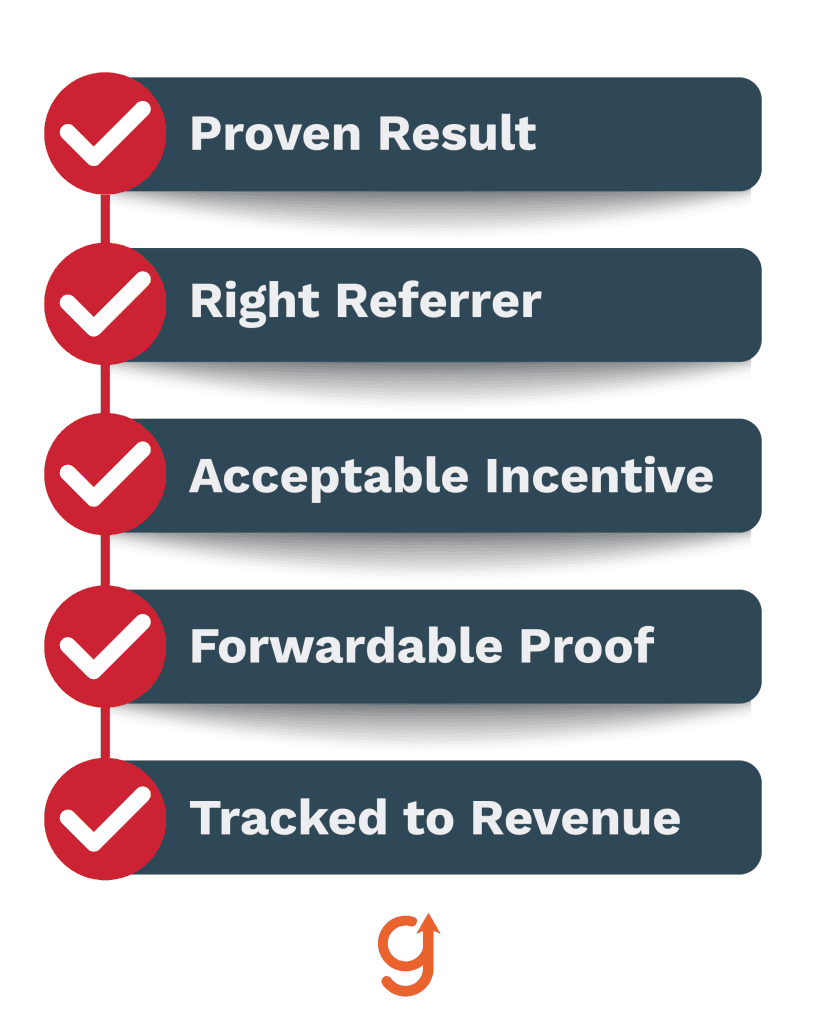
The referral readiness check for B2B SaaS is a five-part test run on an account before asking that customer to refer anyone. The five parts are a proven result, the right referrer, an acceptable incentive, forwardable proof, and a way to track the referral to revenue. Skipping a part turns a referral ask into noise.
Each part answers one question a team should be able to answer before an ask goes out.
| Part | Question it answers | How to check it |
|---|---|---|
| Proven result | What would this customer actually tell a peer? | The account has a documented result, such as a metric that moved, a workflow that changed, or a date it happened |
| Right referrer | Would a prospect see themselves in this customer? | The customer matches the target prospect on company size and use case, not contract size |
| Acceptable incentive | Can this person accept the reward without a compliance conversation? | The reward is product credit, an extended trial, a discount for the referred company, or a charity donation, not cash to an individual unless their employer allows it |
| Forwardable proof | How much work does the referral take? | A three-sentence introduction exists that names the result and links to proof a prospect can check |
| Tracked to revenue | Will the team know whether this produced revenue? | One reward per referred company, paid at a paid or activation milestone, reported on its own pipeline line |
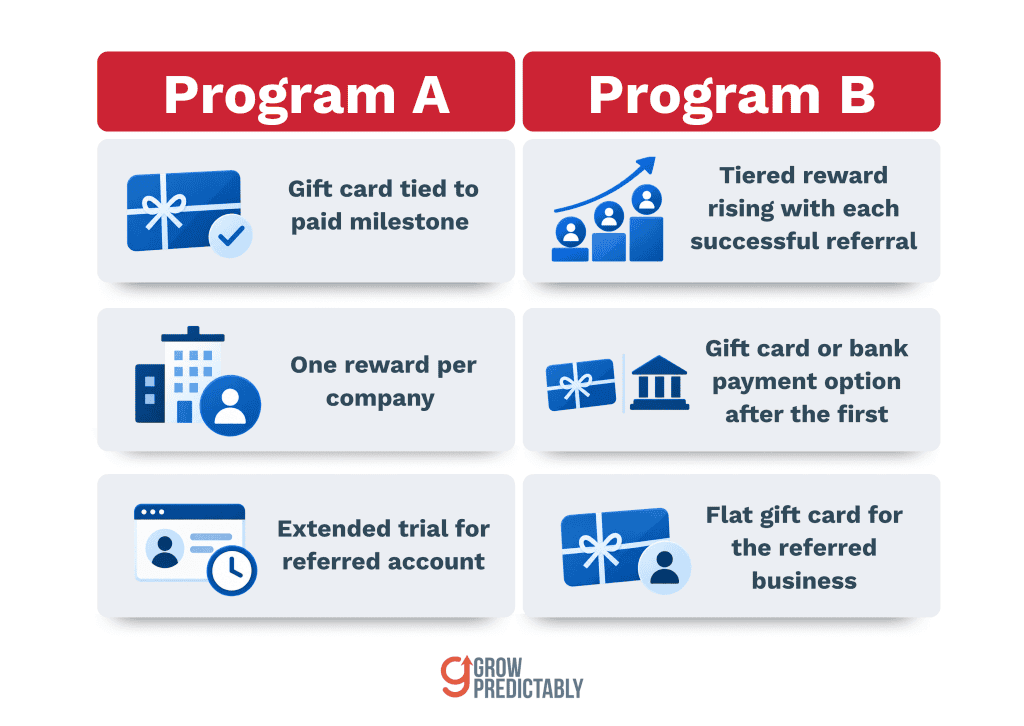
Pipedrive’s current referral terms show parts three and five in one published program. The reward is a gift card worth 100 in the referrer’s currency, paid once a referred company’s payments reach that same amount. It is limited to one reward per company, and the terms disqualify attempts to get around that rule, such as creating multiple accounts within the same organization.
The referred company gets a 30-day trial instead of Pipedrive’s standard 14-day trial (Pipedrive). None of that is a claim about what the program produces. It describes how the mechanics tie one reward to one company and to an actual payment.
The failure pattern behind this checklist is an ask that goes out before part one is true. A company that rewards the ask itself, instead of the result behind it, risks paying for introductions that never convert. The recovery is sequencing, not reward design. Hold the ask until a customer has a documented result, then move through parts two through five in order.
Part one lines up with a stage in the customer journey. The customer journey from awareness to advocacy places a referral after the stage where a customer reaches a result, not before it. The readiness check is the operational version of that sequencing rule, applied to referrals specifically. Part four depends on proof a prospect can verify.
Case studies built for lead generation give a referrer something to forward instead of writing a description from memory.
This is a diagnostic tool run account by account, not a taxonomy that sorts every customer into one box. A customer can pass part one and still fail part two. The check is built to catch that case before the reward goes out.
Which B2B SaaS customers should you ask for a referral?
B2B SaaS customers worth asking for a referral are chosen by reference value, not contract size. A 2013 Journal of Marketing study looked at business clients of a financial services firm and a telecommunications firm. It found that the clients highest in reference value were not the same clients highest in lifetime value.
Kumar, Petersen, and Leone define business reference value as a client’s ability to influence prospects to purchase, and the degree to which it does so (Journal of Marketing, 2013). The study groups the drivers of reference value into four categories:
- how long the client relationship has run
- how large the client’s firm is
- the format the client is willing to give a reference in
- how closely the client resembles the prospect being referred to
The published abstract does not say which direction each driver runs. This guide treats the four categories as a sorting question, not a formula. Ask which current customers score well on these four dimensions for the specific prospect. Do not default to the customer with the largest contract.
A promoter score is one input into that sorting question, not the selector by itself. A promoter score records who says they would recommend, and B2B SaaS NPS benchmarks show how to read one. The readiness check adds relationship length, firm size match, format, and congruency on top of that signal. Only then does a referral ask go out.
Which referral incentives fit a B2B SaaS customer?
Referral incentives that fit a B2B SaaS customer avoid cash paid to an individual employee. Quoted by Knowledge at Wharton on July 21, 2010, marketing professor Christophe Van den Bulte said that paying referral fees to a B2B customer’s employees could be seen as a bribe.
For that reason, he expected referral programs with a financial pay-out to remain a B2C practice.
“Of course, the absence of financial pay-outs does not mean that customer referrals are any less important in B2B markets.”
Christophe Van den Bulte, professor of marketing at the Wharton School, in Turning Social Capital into Economic Capital: Straight Talk about Word-of-mouth Marketing, July 21, 2010
He added that companies have to be more creative in finding incentives that let them draw on their existing customers’ networks.
Two current B2B SaaS referral programs show how published terms handle the question. Pipedrive opens its program only to current paying business customers, and it pays a gift card worth 100 in the referrer’s currency once a referred client’s payments reach that amount. Each company earns one reward at most, while the referred account gets a 30-day trial instead of the standard 14 days (Pipedrive).
Gusto takes a different route in terms of rewards (last updated in February 2026. Its referrer earns a tiered Visa gift card, from $300 for the first successful referral up to $400, $500, $700, and $1,000 for the fifth and later ones. From the second reward on, the referrer may take an ACH payment instead.
The referred business gets a $100 Visa gift card within 30 days of its first paid invoice (Gusto). That ACH option is a cash payment, so it is the case that a referrer should check against their employer’s policy. Both programs are two-sided, since the referrer and the referred company each receive something, and neither company’s terms state a result the program produced.
Referral incentives sit inside a company’s customer marketing work, separate from paid referral partners and affiliates, who are compensated under a different agreement. Partner marketing for B2B SaaS covers that paid relationship. This guide covers only referrals from customers.
How do you measure a B2B SaaS referral program?
A B2B SaaS referral program is measured the way Schmitt, Skiera, and Van den Bulte measured bank referrals. They compared referred and nonreferred customers acquired in the same period. Their 2011 study found referred bank customers were worth at least 16% more than similar nonreferred customers.
That study tracked about 10,000 customers of a German bank for almost three years. It describes consumer retail banking, not B2B SaaS, but you can borrow its comparison method. Hold demographics and acquisition timing constant. Then compare the group that arrived through a referral against the group that did not (Schmitt, Skiera and Van den Bulte).
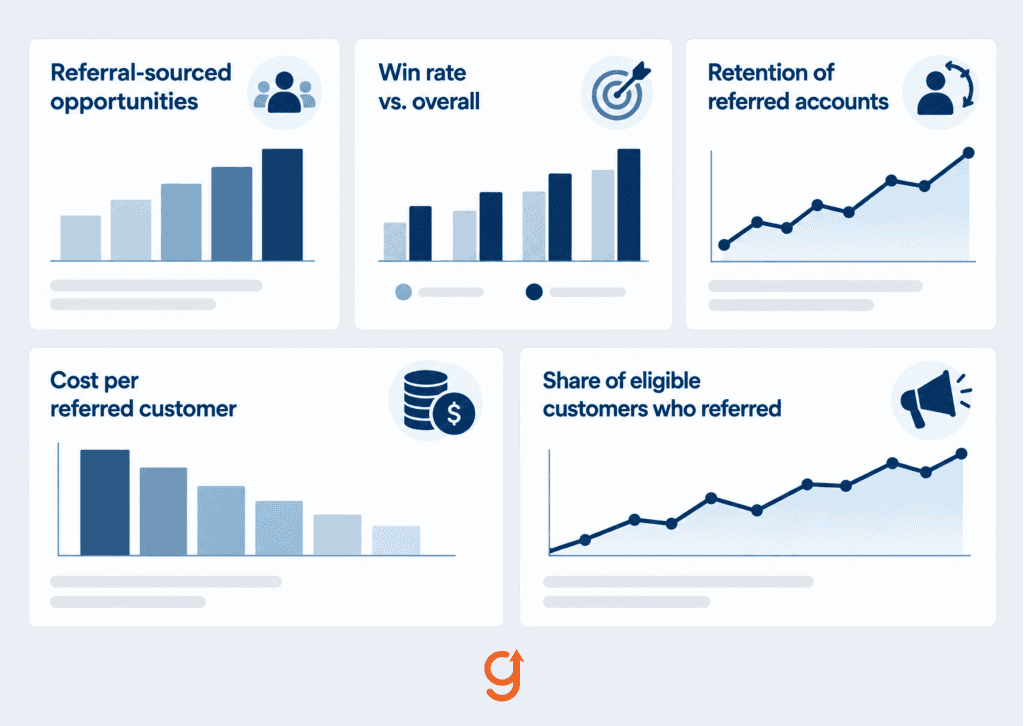
For a B2B SaaS pipeline, that comparison breaks into a short list of numbers worth tracking on their own line, separate from partner-sourced pipeline:
- the count of referral-sourced opportunities
- the win rate on those opportunities against the company’s overall win rate
- retention of referred accounts against accounts from other channels
- the cost per referred customer against the reward paid
- the share of readiness-check-eligible customers who actually referred someone
None of those five numbers has a published B2B SaaS benchmark in the sources this guide verified. Each company has to build its own baseline the first quarter it runs the readiness check, then track the trend from there.
Where should a B2B SaaS team start with referrals this quarter?
The starting point this guide recommends is the five-part check, not new software. Pull ten B2B SaaS accounts that reached a documented first result this quarter. Run the check against each one: proven result, right referrer, acceptable incentive, forwardable proof, tracked to revenue.
Only the accounts that pass all five get an ask this quarter. The rest go back into onboarding and customer success work until they have a result worth repeating.
A stalled referral marketing program is a symptom of a constraint sitting somewhere in the customer journey. Find that constraint with the Growth Gap Scan.
Frequently Asked Questions
Do referral programs work for B2B SaaS?
Referral programs work for B2B SaaS when the ask follows a result the customer can name. Wynter’s vendor-published 2024 survey of 100 B2B SaaS marketing executives at companies with 200+ employees found that 58% rely on their networks to build a vendor shortlist, and 73% ranked word-of-mouth recommendations first. This guide’s diagnostic view holds that programs stall on timing, not incentive, so a program built around a documented first result has a basis to work from.
How much should a B2B SaaS company pay for a referral?
The article does not name one flat rate. It points to two published programs. Pipedrive pays a gift card worth 100 in the referrer’s selected currency once a referred client’s payments reach that same amount, with one reward per company. Gusto pays a tiered Visa gift card starting at $300 for the first referral and rising to $1,000 for the fifth and later ones, plus a $100 card to the referred business. Neither program’s terms state a result it produced.
What is the difference between a referral program and an affiliate program?
In this guide, a referral program rewards an existing customer who introduces a peer, while an affiliate program compensates a paid partner under a separate agreement. The article treats customer referrals as part of customer marketing, tied to a result a customer already has. Affiliate and reseller relationships are commercial partnerships rather than customer introductions, and this guide does not cover their terms or payment structure.
When should you ask a B2B SaaS customer for a referral?
This guide’s recommendation is to ask only after a customer has reached a documented first result, such as a metric that moved or a workflow that changed. Asking earlier, at signup or at the end of a trial, treats every customer as equally ready and produces a weak referral. The readiness check in this guide treats the proven result as the first of five conditions to confirm before the ask goes out.
How do you prevent referral program fraud in B2B SaaS?
This guide’s recommendation for preventing referral fraud in B2B SaaS is to tie one reward to one company rather than policing behavior after the fact. Pipedrive’s published terms illustrate the mechanic. Rewards are limited to one per unique company or organization, defined by legal name or domain, and the terms disqualify creating multiple accounts within one organization. Pairing that one-reward-per-company rule with payment at an actual milestone, not at the referral itself, is the control this guide recommends.
Should B2B SaaS referral rewards be one-sided or two-sided?
The article describes both published B2B SaaS examples as two-sided, since the referrer and the referred company each receive something. Pipedrive pays the referrer a gift card and gives the referred company a 30-day trial instead of the standard 14-day trial. Gusto pays the referrer a tiered Visa gift card and gives the referred business a $100 Visa gift card. This guide does not recommend one-sided over two-sided, since neither program’s terms state a result it produced.
About the author
Brian helps B2B founders install marketing + automation engines powered by Co-Thinking with AI. With 15+ years building predictable revenue systems, he's worked with SaaS, agency, and service businesses on 90-day done-with-you growth accelerators.
Ready to see your real growth gap?
Two minutes in the Growth Gap Scan and you walk away knowing the one thing capping your pipeline. Free, no obligation.