SaaS ABM Strategy: Pick Accounts, Run Plays, Measure It

Founder, Grow Predictably · 15+ yrs building B2B revenue systems
TL;DR: A B2B SaaS ABM strategy is an operating sequence rather than a campaign type. Name a small set of accounts you can actually resource, agree with sales in writing on what counts as progress before anything launches, run plays against the buying committee instead of a persona, and score the program on pipeline and revenue movement. The agreement step is what makes the measurement step possible later.
Key Takeaways
- ABM is a resource-allocation decision before it is a marketing tactic, so the first question is whether the constraint on growth actually sits where ABM points.
- The account list has to be small enough to resource. A list nobody can service is a wish list.
- Four things get settled in writing with sales before launch: the list, what counts as progress, who acts on a signal and how fast, and what the program is accountable for.
- Engagement is a leading indicator, not revenue proof, and a scorecard that stops at engagement cannot survive a budget review.
- Momentum ITSMA’s benchmark data is the honest counterweight to vendor optimism about what these programs return.
What is a B2B SaaS ABM strategy, and when is it the right call?
Account-based marketing means concentrating sales and marketing efforts on a named set of accounts instead of spreading them across a broad audience.
In B2B SaaS, that list should be short enough to read aloud in a meeting. Each account on it needs:
- An owner who’s accountable for moving it forward
- A reason it was chosen over the accounts left off the list
- A next step that’s already defined, not left for later
Here’s the part I think gets missed most often: ABM is a resource-allocation decision before it’s a marketing tactic.
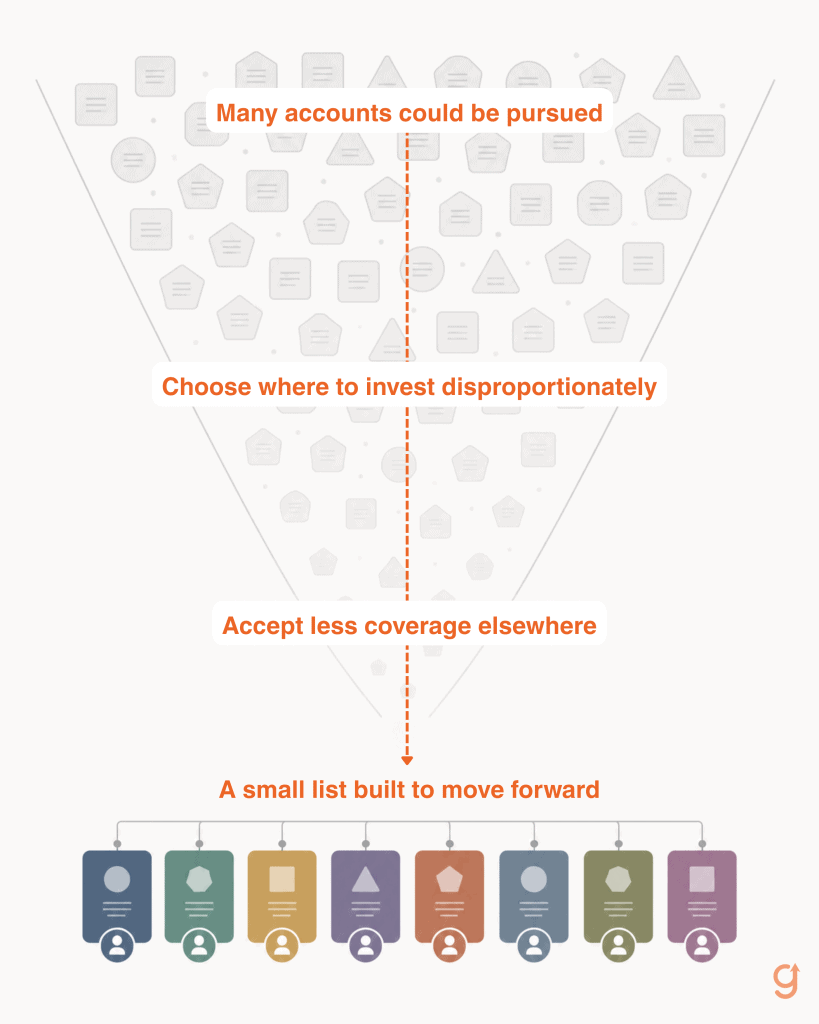
You’re choosing to spend disproportionately on a few accounts and accept less coverage everywhere else. That trade only makes sense when a few things are true at once:
- Deal sizes are large enough to justify the concentration
- The buying committee runs to several people, not one decision-maker
- The addressable set is small enough to name without inventing it
When ABM is the wrong instrument
ABM is the wrong instrument when the thing capping your growth sits somewhere else entirely.
If trials convert poorly, or churn is quietly erasing the revenue you’re bringing in, then pouring acquisition spend into 20 named accounts just pushes harder on a stage that was never the actual limit.
That’s why I’d argue that working out where the one stage currently capping growth actually sits is a cheaper first move than launching a program.
The sequence that follows is a working order of operations, not an industry standard. Treat it as a checklist you can argue with.
How do you choose the accounts worth naming?
Selection starts with closed-won reality, not aspiration. Pull the accounts that actually bought, expanded, and stayed, then look for what they had in common before they signed rather than after.
Build the account list
Three filters carry the selection:
- Fit. The firmographic and product-usage pattern that your best current customers shared before they signed.
- Trigger. An observable event that changes the account’s priorities: a funding round, a leadership hire, a compliance deadline, a competitor’s price change.
- Route. Whether you have any way in at all. A perfect-fit account with no relationship, no referral path, and no inbound history is a research project, not a target.
Do not wave the third filter through. It is the one that decides whether the program produces meetings rather than impressions.
Size the list to what you can resource
Set the list length by dividing the effort you actually have by the effort each account needs to receive something specific. If that arithmetic gives you 11 accounts, the list is 11 accounts.
Stretching it to 50 because 50 sounds more serious just produces 50 accounts receiving nothing in particular.
This is where programs tend to stall rather than fail loudly. In the 2022 benchmark from Momentum ITSMA and the ABM Leadership Alliance, fewer than 20 percent of surveyed programs reported being fully embedded in the business, and fewer than 25 percent had solidified key elements of their approach.
Give every account an owner by name before launch, and the list stops being a document.
What do sales and marketing have to agree on before anything launches?
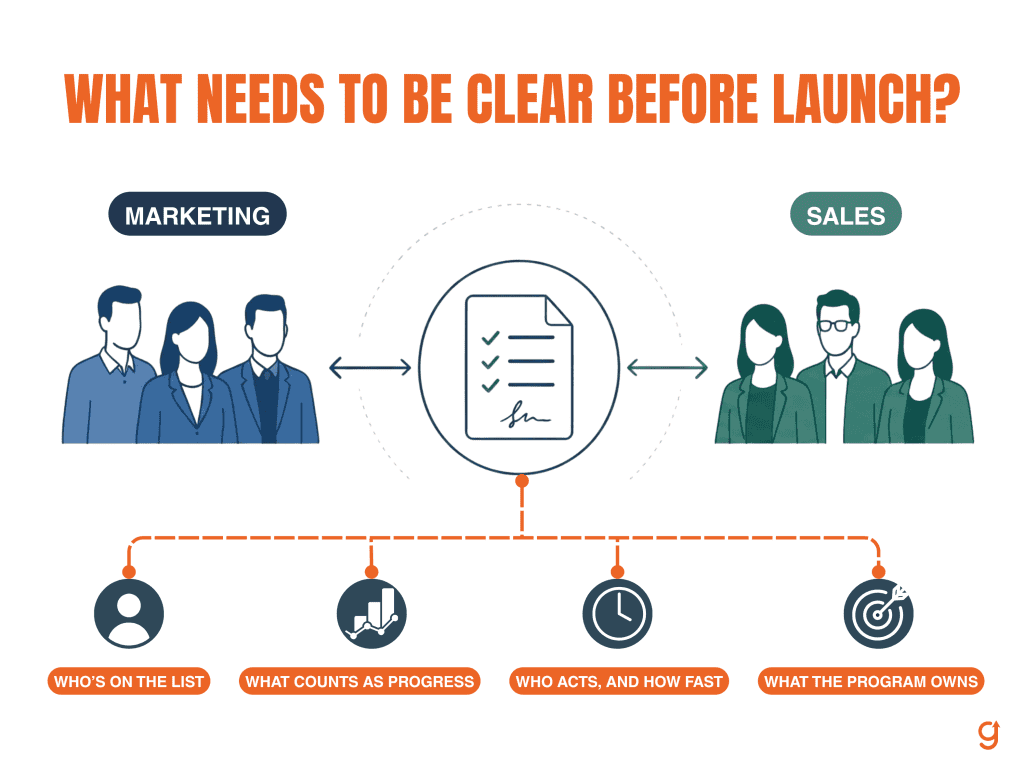
Four things: the account list itself, what counts as progress at each stage, who acts on a signal and within what window, and what the program is accountable for.
This is the step that decides whether anyone can answer the budget question later, and because it produces nothing visible, it is the easiest one to skip.
Four things, settled in writing, before anything ships:
- The list. Sales agrees these are the accounts, or the program is marketing talking to itself.
- What counts as progress? Defined commercially, stage by stage. A meeting booked with a named decision maker is progress. A whitepaper download is an activity.
- Who acts on a signal, and how fast? A signal that no one is obliged to act on within a stated window is a notification.
- What the program is accountable for. Pipeline created, pipeline influenced, win rate, expansion. Pick before launch, because picking afterward invites picking whatever looks best.
Executive sponsorship belongs in this conversation too.
In that same 2022 study, of the 197 respondents who answered the sponsorship question, 80 percent said their ABM program was sponsored by a business executive. That is a structural condition rather than a nice-to-have, because points two and three cut across two departments, and neither can enforce the other.
Rob Leavitt, SVP at ITSMA, which pioneered account-based marketing in 2003, put the shift plainly when the benchmark study was released:
The focus is now shifting from why companies should implement an account-based approach to how marketing, sales, and business leaders can collaborate to ensure maximum benefit from this strategic discipline.
Rob Leavitt, SVP at ITSMA, in the ABM Benchmarking Study release
What plays do you run against a buying committee?
A buying committee is made up of several people with different questions. The economic buyer wants to know what it returns. The technical evaluator wants to know what breaks. The eventual user wants to know what changes on Monday.
One message aimed at a single persona answers one of those and misses the rest of the room.
One-to-one, one-to-few, one-to-many
Tiering is one practical way to allocate effort, and it’s common enough to have been measured.
The ITSMA and ABM Leadership Alliance Account-Based Marketing Benchmarking Survey questioned 207 B2B marketers at 190 member companies through a web-based survey and qualitative interviews. It reported that 46 percent were targeting accounts across multiple tiers, up from 35 percent the year before.
The three groupings below are the ones that the survey named. Other organizations label and cut them differently, so I’d treat these as a workable split rather than a fixed standard:
- One-to-one. A handful of accounts get genuinely bespoke work: research on their actual situation, content addressed to their named problem, a point of view they couldn’t get from your website.
- One-to-few. A segment sharing a trigger or a use case gets a themed program, customized at the segment level rather than the account level.
- One-to-many. The remainder of the list gets programmatic reach with light personalization, mostly to keep the name familiar.
Two rules hold across all three tiers:
- Every play needs a named next step, because a play that ends in an impression can’t be scored.
- Cosmetic personalization costs more than it returns. Inserting a company name into a template signals effort without understanding, and the recipient can tell.
Mapping plays onto the stages an account moves through keeps the sequence honest about where each account actually is.
How do you measure a B2B SaaS ABM program without fooling yourself?
Score the program on a short list that runs from leading signals to commercial outcomes, and read each measure against a baseline captured before launch.
This section decides whether the program survives its first budget review. The failure mode here isn’t dishonesty. It’s measuring what moves first and reporting it as though it were what matters.
The scorecard
Six measures, in the order they mature:
- Account coverage. How many of the named accounts have engaged contacts across the committee, not just one champion?
- Engagement quality. Depth and seniority of engagement inside named accounts are read as a leading signal only.
- Meetings created. First meetings with a decision maker, attributed to the named account.
- Pipeline created and influenced. Kept as two separate numbers, because merging them lets influence quietly carry the report.
- Win rate against a comparable set. Named accounts versus a like-for-like group outside the program.
- Average contract value, retention, and expansion inside named accounts. The measures that arrive last and matter most.
Reading the scorecard
Two of these are worth working through, because they’re the two a review will press on hardest.
Engagement rate is interactions divided by impressions. If a campaign puts 5,000 impressions in front of a target account and produces 300 interactions, that’s six percent. Six percent tells you the content is landing with somebody. It doesn’t tell you whether somebody can sign anything, which is why I treat engagement as a leading indicator and never as revenue proof.
Pipeline contribution is revenue from named accounts divided by total revenue. If named accounts produced 200,000 dollars against a total of one million, ABM contributed 20 percent. That number only means something next to two others:
- What did those accounts contribute before the program started
- What a comparable set outside the program did over the same window
Without a baseline captured before launch, a contribution figure is a description rather than a result.
Set the review cadence to quarterly. The measures at the top of that list move in weeks, and the ones at the bottom move in quarters, so a monthly report on the fast ones points attention to the wrong end of the scorecard.
It’s worth being honest about the odds while setting expectations. The 2023 benchmark from Momentum ITSMA and the ABM Leadership Alliance found that while most of the surveyed programs achieve some measure of success, only small minorities achieve significant improvement, defined as more than 10 percent, across the most important metrics. That’s the number to put next to any vendor projection.
What does a documented B2B SaaS ABM program look like?
One published example, and it belongs to somebody else. There’s no first-hand case study here, because presenting another firm’s work as your own would be exactly the kind of borrowed authority this article argues against.
What a documented program can show you is the shape of the thing and the order in which the gains arrive.
The agency Insights ABM has published a case study on its work with a one-billion-dollar SaaS company in HR and payroll software. The client wanted to grow 20 percent annually and, on its own account, was struggling with resource efficiency and lacked an account-centric strategy.
The agency reports that the engagement produced more than a 20 percent increase in scheduled appointments and over 125 percent more qualified sales-ready leads.
Two things worth keeping in mind as you read that:
- It’s a vendor’s account of its own work, so the numbers are reported rather than independently audited.
- A single case study is an existence proof, not a typical result, and it’s not evidence that ABM alone caused the change.
What it does usefully show is the shape: a company with a growth target it was missing, no account-centric structure, and gains that showed up first in meetings and lead quality. That’s the same order the scorecard above predicts.
Where should you start with your B2B SaaS ABM strategy?
Draft the account list from closed-won reality, then take it to sales before you build anything else. That conversation is the program’s foundation, and it costs a meeting rather than a budget.
Everything downstream, the plays, the tiering, and the scorecard, depends on two teams agreeing on the list and the definition of progress first.
Nothing needs to be purchased to do that. If the conversation stalls on what counts as progress, that is not a delay; that is the program finding its real constraint early and cheaply. If it stalls on whether these are the right accounts, the same applies.
The list and the agreement are what the rest stands on. Tooling can wait until there is something for it to measure.
Frequently Asked Questions
How many accounts should be in a B2B SaaS ABM program?
Set the number by dividing the effort you actually have by the effort each account needs to receive something specific. If that arithmetic gives you 11 accounts, the list is 11 accounts. Stretching it because a longer list looks more serious produces more accounts receiving nothing in particular, which is a common way these programs stall.
What is the difference between ABM and demand generation?
Demand generation works for a broad audience and lets qualified buyers surface from it. ABM starts from a named list of accounts and concentrates sales and marketing efforts on them specifically. The practical difference is the unit of measurement: demand generation counts leads, while ABM has to be scored on movement inside named accounts.
How do you choose target accounts for ABM?
Start from closed-won reality rather than aspiration. Pull the accounts that bought, expanded, and stayed, and find what they shared before they signed. Then score candidates on three filters: fit against that pattern, an observable trigger event, and whether you have any route in at all. The third filter is the one most easily waived through.
How do you measure ABM success?
Use a short scorecard running from leading signals to commercial outcomes: account coverage, engagement quality, meetings created, pipeline created and influenced kept separate, win rate against a comparable non-ABM set, then contract value, retention and expansion. Capture a baseline before launch, because a contribution figure with nothing to compare it against describes rather than proves.
Does ABM work for smaller B2B SaaS companies?
It depends less on company size than on deal shape. ABM fits when deals are large enough to justify concentrated effort, when several people sit on the buying committee, and when the addressable set is small enough to name honestly. A smaller company with a short list and real routes in can run it; one with neither cannot.
How long before an ABM program shows results?
The measures mature at different speeds. Coverage and engagement move within weeks, meetings within a quarter, and pipeline, win rate and expansion over several quarters. Review quarterly rather than monthly, because a monthly report on the fast-moving measures points attention at the leading end of the scorecard rather than the commercial end.
About the author
Brian helps B2B founders install marketing + automation engines powered by Co-Thinking with AI. With 15+ years building predictable revenue systems, he's worked with SaaS, agency, and service businesses on 90-day done-with-you growth accelerators.
Ready to see your real growth gap?
Two minutes in the Growth Gap Scan and you walk away knowing the one thing capping your pipeline. Free, no obligation.